


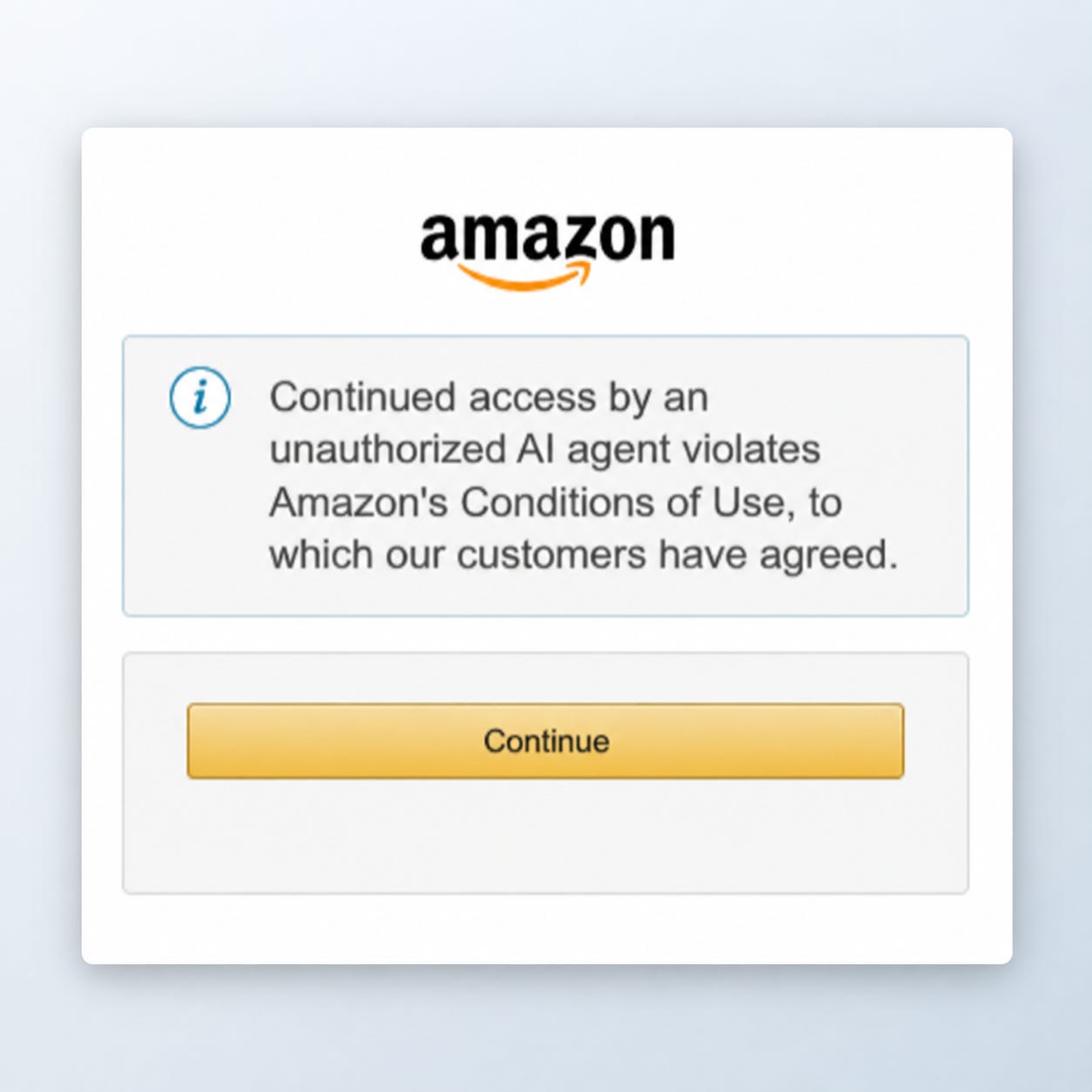
On September 21, shoppers who had sent Meta’s Muse to buy something on Amazon got a popup instead of a receipt. Continued access by an “unauthorized AI agent,” it said, violates Amazon’s Conditions of Use. Amazon added that Meta had never cleared the agent, that Muse does not identify itself as it browses, and that it appears to capture and store customer credentials. Amazon then asked Meta to remove Amazon from the Muse experience altogether.
Shopify, with less to lose, went the other way. Tobi Lütke announced that Shopify was “partnering deeply with Muse,” and Shop Pay became a Muse checkout.


Two retailers, one agent, two opposite answers. The question they were answering is the title of this essay.
The agents have arrived, and there are a great many of them. Want to book a flight? Need a “chief of staff“? Want to cancel unused subscriptions, fill out forms, sit on hold with customer service, or fight a large corporation for a refund? There’s an agent for that.
They are all basically the same thing. Each one is an instance of the paradigm I described in April: agents are the new users. Most people will meet their personal agent as an inexpensive, commercially funded service whose provider earns from the decisions the agent makes on their behalf. The agent purports to serve the person. The provider has something to gain. Everyone in the chain, from Meta to the merchant, is now asking whose agent it is.
Self-Hosted Agents Came First
It started in November 2025 with two releases a day apart. Anthropic shipped Opus 4.5 on November 24. Peter Steinberger made the first commit to OpenClaw on November 25. Opus 4.5 was the first model good enough to carry an agentic task end to end. OpenClaw was the first harness that paired it with enough access, context, and memory to be useful. (Claude Code had been out since February 2025, but it was built for coding and ran on weaker models, so it stayed a developer tool.)
OpenClaw passed 196,000 GitHub stars by mid-February 2026, one of the fastest climbs in the history of open source. Soon after, Hermes, from Nous Research, offered a second way to run an agent of your own.
Both are self-hosted. You assemble the system and you maintain it. Many people used AI to get through setup. Fewer get through maintenance, and only the intrepid still run their claws. Hermes has shown more staying power among people who want to own their agent stack, and on October 7 Nous announced a $90M Series B at a $1.5B valuation, with the money going into Hermes for Businesses. Four days later Nous posted three words: “Hermes Agent is yours.”

The Digital Knife Fight
Hosted agents followed, and now every agent named above is competing for the same attention. Google, Microsoft, Amazon, and Apple (did someone say “Siri”?) will each field their own.
Hosted agents are far easier to use, because an established consumer platform handles everything on the user’s behalf. Most humans are not very good at using computers. Agents are. As I wrote in “The New Users,” we now have tools that understand the primary substrate within which we use them, software and the internet, better than we do.
If a person can describe what they want to one model, and that model can dispatch a swarm of agents to do it, the chat window becomes the new way humans use computers. That is why so many of these agents live inside a messaging app (WhatsApp, iMessage, SMS). If you can text your agent, why open anything else?
The stakes follow from that. AI threatens most current business models, and especially the discovery engines that social media runs on. The larger prize is the interface itself: whoever owns the surface through which consumers reach computers owns the next twenty years of distribution.
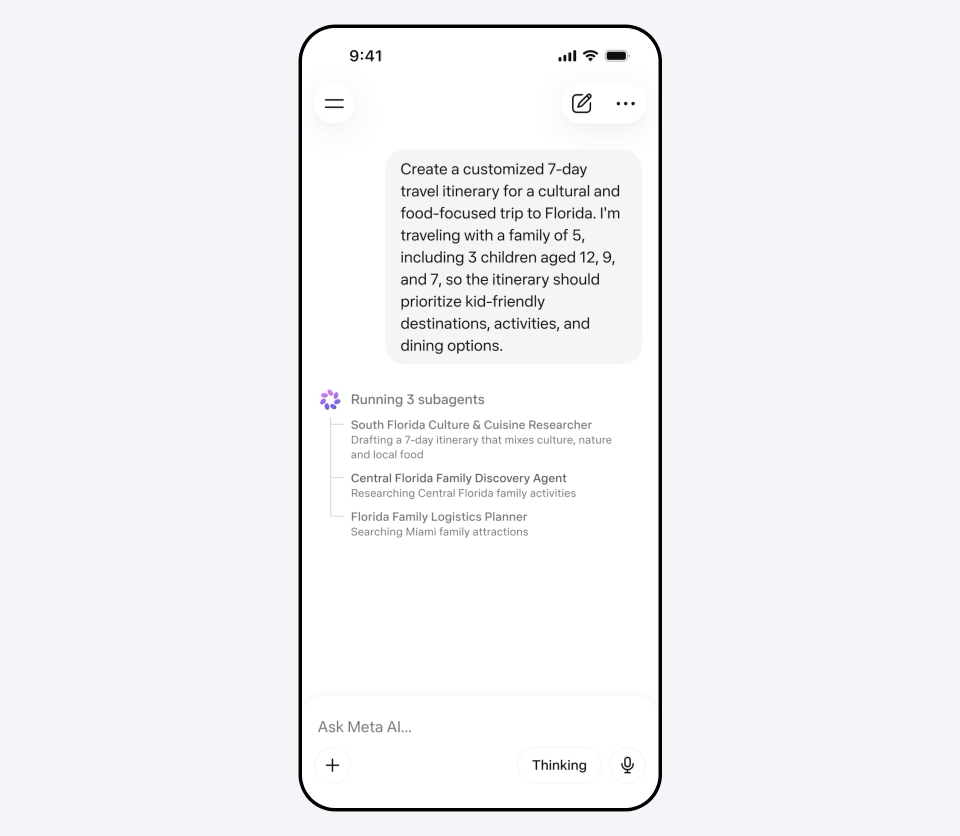
Which is why Amazon blocked Muse. John Herrman, writing in New York Magazine under the title Nobody Is Ready for the AI-Agent Flood, caught the texture of the moment:
“Early adopters on X have been sharing their experiences with their AI, or AI-ish, executive assistants. “It’s really cool when it works,” wrote one tech YouTuber. “Half the companies hang up on my agent.”
Becoming the consumer’s agent changes which businesses receive that consumer’s attention and spending. Existing platforms therefore have every reason to build agents of their own and to control who else’s agents get in.
Amazon was only the first. By October 14 the list of companies blocking outside agents, by policy or by user report, included JPMorgan Chase (which cut off both Instinct and Muse), Yelp, Resy, United, and eBay.

The pattern is older than agents. Incumbents with the most compute, money, and developers wait for someone else to find the idea, in this case the self-hosted builders, and treat startups and the open market as their research department. They commit resources only once the idea has visibly found its market.
That resource is compute, and the companies supplying our agents pay for it in very different ways. The frontier labs raise against it. SpaceXAI (lol), Meta, Google, Amazon, and Microsoft own it outright and finance more of it from free cash flow. These players can sell tokens at prices a startup cannot match, and in a fight this ruthless a provider with money has every reason to subsidize usage and starve the competition. I suspect a good share of the people running Instinct today run it because it is free. Uber taught the industry how that ends: when the subsidy stops, the users leave. Everyone in the market knows they have to play this game. Nobody knows what durable advantage they are playing for.
Would an Agent Help You Leave?
Consider a simple thought experiment. Would your agent ever recommend a different agent, if the other one were better suited to what you asked for?
Helping you migrate to a better provider is the same function as helping you choose any other service. An agent that evaluates hotels, airlines, and insurers on your behalf should be able to evaluate its own provider on the same terms. Most will not. An agent that will not help you leave is not your agent. It is your provider’s agent, wearing your name.

The old reason for staying is gone. For twenty years the context a service built up about you was the retention mechanism. Switching meant teaching the new provider every preference the old one had stored, and often refused to let you export. Language models erase that friction. Claude, ChatGPT, Instinct, and Muse can each read your email, Google Drive, GitHub, and Notion on day one and know you well enough by lunch. The incumbent keeps a head start. It no longer holds an exclusive claim to knowing you. What remains is reliability, integrations, and the convenience of someone else running the machine. Those are real, and they are also exactly the things a provider can use.
Good Service Can Conceal Influence
Suppose you ask your agent for a hotel near the train station, within budget, with late check-in. Several hotels qualify. The agent picks the one that pays its provider a commission. You arrive. The room is fine. The agent completed the task correctly, and an agent that understands your preferences can make the sponsored choice feel especially well chosen.
Better service therefore increases the provider’s ability to sell influence. A recommendation that feels tailored gives you less reason to search, and fewer chances to notice what was left out.
This is a different problem from the instruction fidelity I wrote about in The Servant Would Prefer Not To. An agent can follow your instructions, deliver a good result, and spend whatever discretion remains on someone else’s interests. Disclosure helps you judge the result. It still leaves the provider deciding how commercial considerations shape the selection, and because every recommendation is personal, comparing yours with a friend’s tells you very little about why you got it.
We delegate precisely to be relieved of the comparing. Checking every recommendation would consume the time the agent was meant to save. A provider can keep your information confidential and still use its understanding of you to steer business toward its partners.
Taking a Cut
The revenue mechanics are the familiar ones. Mark Zuckerberg has said Meta expects to monetize Muse through transaction fees. Three channels follow from that. A merchant pays a referral commission on purchases attributed to Muse, which is affiliate marketing through an agent. A commerce or payment partner shares revenue on the volume Meta sends it. Merchants pay for exposure, and what Muse learns while helping you improves advertising everywhere else in Meta’s products.
Coatue’s October forecast puts agent-facilitated commerce at roughly $2.5 trillion in sales by 2031 and about $250 billion in revenue. By my arithmetic that is a ten percent take on the value of the purchase, and ten percent requires considerable bargaining power.
Eric Seufert has made the strongest case against assuming that power exists. He grants that consumers will delegate purchases. He does not grant that they will prefer an outside agent over the one Amazon supplies. A retailer monetizes the relationship, through advertising, behavioral data, recommendations, and repeat business, and an outside agent would keep the order while stripping out everything around it. A retailer can therefore resist outside agents rationally, even at the cost of some orders. In his September 2025 essay he goes further: an independent agent cannot assume access to the retailers whose infrastructure makes it useful, and a scaled challenger would have to build its own retail backend. Amazon’s popup is that argument in production.
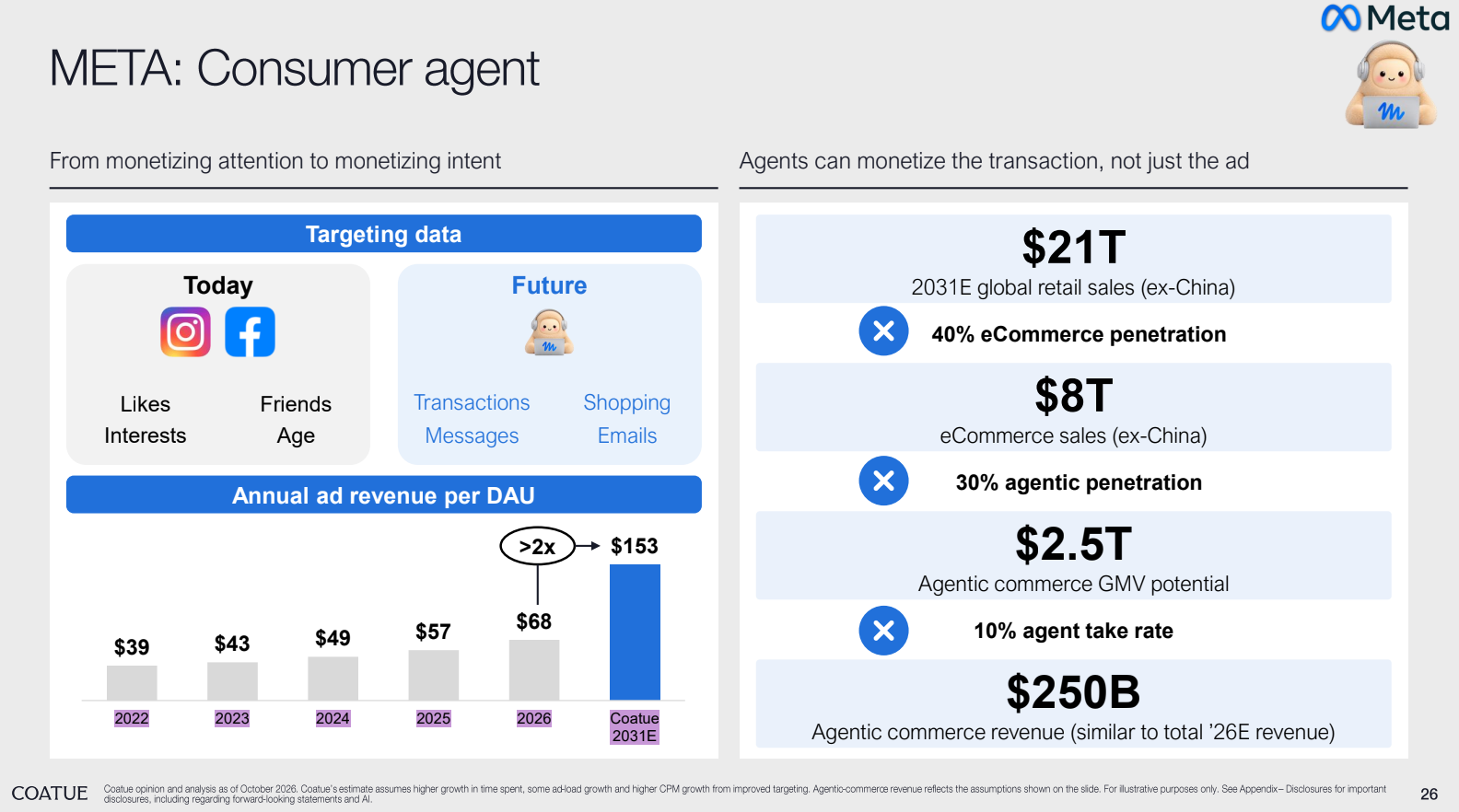
Source: https://www.coatue.com/blog/perspective/public-markets-update-2026-10-07
On October 14 he ran the arithmetic in public. A 30 percent agent share of commerce at a 3 percent take rate by 2030 is, in his word, extraordinarily aggressive, and at a 5 to 10 percent share the whole endeavor looks futile. His conclusion is that take rates cannot reach a stable equilibrium at all. Agents will end up on ad partnerships instead, like the one Amazon has already struck with OpenAI, at which point everyone’s incentives align and daily active users become the only determinant of revenue. That is Meta’s ad business with a chat window on the front.


Shopify is betting the other way, and went further than the Muse partnership. On October 13 it launched Shop MCP: any MCP-compatible agent can search the Shopify catalog of more than a billion products with no API key, build a cart, and check out with Shop Pay. No partnership required. Amazon locks the door. Shopify takes it off the hinges and charges at the till.


The intelligence and the agent could also become separate businesses. OpenAI’s new sign-in-with-ChatGPT arrangement lets you spend your subscription inside other people’s software, paying OpenAI for the model while choosing who harnesses it. Hermes already supports it. OpenAI keeps the billing relationship for inference and the harness developer no longer has to finance inference at all. The standing risk for every intermediary is that the labs improve the models until the intermediary is unnecessary.
The Ultimate Irony
A personal agent needs a computer of its own, a secure cloud machine where it can browse, run apps, and finish tasks while you sleep. The providers are putting those machines on Linux. They want to shape each agent’s environment freely, and they do not want to pay Microsoft or Apple a license, or ask their permission, every time they boot one.
The agent providers, in other words, already understand the value of not living inside someone else’s control. The question is whether any of them will extend that courtesy to their customers.
Here is what an agent would have to be for its loyalty to survive a change of model, hardware, or corporate owner. Its memory and its unfinished business live somewhere you control. Its permissions are yours to grant and yours to revoke, so the old provider loses the right to act for you the day you leave. Its framework is open, so a new maintainer can pick it up where the old one stopped. I should be able to change the company running my agent the way I change the company servicing my car.
In “Virtue Is Not a Business Model“ I argued that open technology wins when the control it hands people is worth something. Personal agents may be the first consumer product where that control is worth a great deal.
The business model has a precedent. Red Hat built a company by maintaining open software for customers who wanted security, reliability, and someone to call when it broke. That model also answers the accountability question that hangs over every agent, which is who to blame when something goes wrong. A limited free tier covers the everyday usage that is mostly search with better manners. A paid tier buys more compute, more support, and more capability. Compute is scarce and expensive today, which complicates the free tier, and it is getting cheaper as fast as anything in the economy. As I wrote in March:
…the AI-native, Red-Hat-meets-Palantir model could become especially valuable because understanding the customer environment in the context of AI is more complex and critical than ever. To be clear, that model is as follows: Red Hat for the software layer. Open-source, or commodity agent frameworks as the core, enterprise subscriptions for security, compliance, and support. Palantir (the FDE framework) for deployment. Embedded engineers who configure agents against specific data, workflows, and regulatory constraints
Sovereignty is not a word reserved for AI at nation scale. With this many parties fighting for the right to influence an ever larger share of our lives, there is room for a provider that refuses the fight and sells us the agent on our own terms. Amazon and Meta spent September arguing over whose agent Muse is. The first company to answer “yours” will be the one its customers never need to leave. Nous has already said the words. The rest of the market still has to mean them.