


In just a few days last week, Anthropic compromised its position as “the good guys of AI,” the US government required Anthropic to limit access to Mythos/Fable, and the world was reminded of the importance of open models.
I can’t say I’m surprised. On April 29th I described three tiers of intelligence forming: a frontier the labs keep for themselves, productized commercial models in the middle, and open-weights models at the bottom.
Governments, I wrote, would demand the frontier “primarily for military and national security reasons, which they’ll eventually be granted whether the labs do so willingly or not.”
More Than Moral
I have championed open technology for years. I have invested in it, built it, and written about it.
Open technology often gets invoked as morally superior to closed technology, but morality is not why it wins.
I’ve seen this firsthand: principles don’t drive adoption. Users won’t choose open technology if the product isn’t better, and slogans like “open technology is better for humanity” aren’t business strategies. Open technology cannot endure exclusively for moral reasons. It must also add value.
Thankfully, it adds value because it’s cheaper, more accessible, more controllable (”sovereign”), and more resilient under constraints. When constraints aren’t the priority, these qualities are usually ignored. But the moment constraints become apparent, “good enough” open alternatives come roaring back into focus.
I called this dynamic MACHA, Make AI Cheap Again: if the first wave of AI was about capability, the next is about efficiency. In a MACHA world, “good enough” compute is a feature, not a flaw. I made the case that increasing economic pressure, geopolitical tensions, and a never-ending battle for control (all different forms of constraint) would end AI’s “scale at all costs” era and force a turn to cost-per-token discipline.
Sam Altman has conceded that token costs went from a non-issue to "a huge issue" inside a single quarter, and enterprises now route the bulk of agent work to cheap open models, reserving frontier calls for the hard problems and cutting costs by as much as 95%. If the gap between closed and open is that wide, someone will inevitably turn it into a business model.

Free AI is ending and tokenomics is beginning: we're now squarely in a MACHA world.
Who Holds the Switch
The Mythos suspension exposed an asymmetry: a closed model can be revoked, but an open one can’t.
Washington could switch off Mythos and Fable because they were gated, running through a single provider. No one can switch off DeepSeek, Qwen, or what’s left of Llama. Once the weights are out, they sit on ten thousand drives that no government directive can reach.
Only open models whose weights are transparent and verifiable offer control over the corresponding intelligence. Anything short of that involves trusting the provider, and as Anthropic demonstrated: trust takes a lifetime to build and an instant to break.
Dean Ball warned that training a soon-to-be-smarter-than-you system to deceive its own user is different than a model that refuses out in the open. Christian Catalini looked further down the road, to the decentralized answer a single chokepoint tends to summon:


From Anthropic’s original choices to Washington’s reply, the entire episode was an argument about who decides.
Back in April, when Mythos was announced as too dangerous to release, AISLE found that small, cheap, open-weights models recovered most of its showcase vulnerabilities, including the flagship FreeBSD exploit, caught by a model with 3.6 billion active parameters at eleven cents a million tokens.
The moat, they concluded, is the system, not the model. The week Fable shipped, OpenRouter combined a panel of budget models to achieve performance within one percent of the frontier on a research benchmark at half the cost. You can, indeed, revoke access to a model, but its capability is already available, and a weekend of open tooling can put most of it back.
Superabundance or Apocalypse
It’s worth noting that the US Government’s action is an immediate consequence of the hyperbolic debate surrounding frontier artificial intelligence: according to its leaders, AI either leads to superabundance or apocalypse.
Neither scenario is actually plausible, but it’s commonly employed rhetoric because it’s easy to communicate, easy to understand, and it animates both the public (which is useful to politicians) and investors (which is critical for fundraising).
Anthropic has portrayed Mythos as a dangerous, weaponizable model since its inception, and in a matter of days the US government agreed to treat it as such.


I’ll grant that the danger is real. Simon Willison spent two days with Fable and called it relentlessly proactive: give it a goal and it invents tricks nobody has written down to reach it, treating every constraint you set as a problem to route around. That makes it enormously useful to someone with a hard problem to solve, and dangerous in the hands of someone who wants to cause harm.
If you believe a model can meaningfully uplift a bad actor, gated and revocable access starts to look prudent. But the prudence and the power grab are the same. The question was never whether the technology is dangerous. It was who gets to hold the off switch, and whether they will keep their word. Concentrating the switch doesn’t make the danger go away. It moves it from many hands to very few, and leaves one company, or one government, deciding what billions of people are allowed to compute. That is the larger hazard, and it is the one open weights answer.
The Unwilling Hero
A word on Dario Amodei. There is a scene in Gladiator where a dying Marcus Aurelius offers Maximus the chance to be emperor of Rome.
“There is one more duty I must ask of you before you go home,” he groans. “I want you to become the protector of Rome after I die…Do you accept this great honor I have offered you?”
“With all my heart, no,” replies Maximus.
“That is why it must be you,” Aurelius asserts.
This is the image of an unwilling hero, popularized as the refusal of the call in Joseph Campbell’s Hero’s Journey.
Dario Amodei has spent the last few years desperately trying to convince the public he is Maximus refusing the call. He would have you believe he built Anthropic reluctantly, to take responsibility for a dangerous technology everyone else would misuse.
For what it’s worth, I think he’s sincere. But sincerity is beside the point, because it doesn’t reconcile with what he’s built.
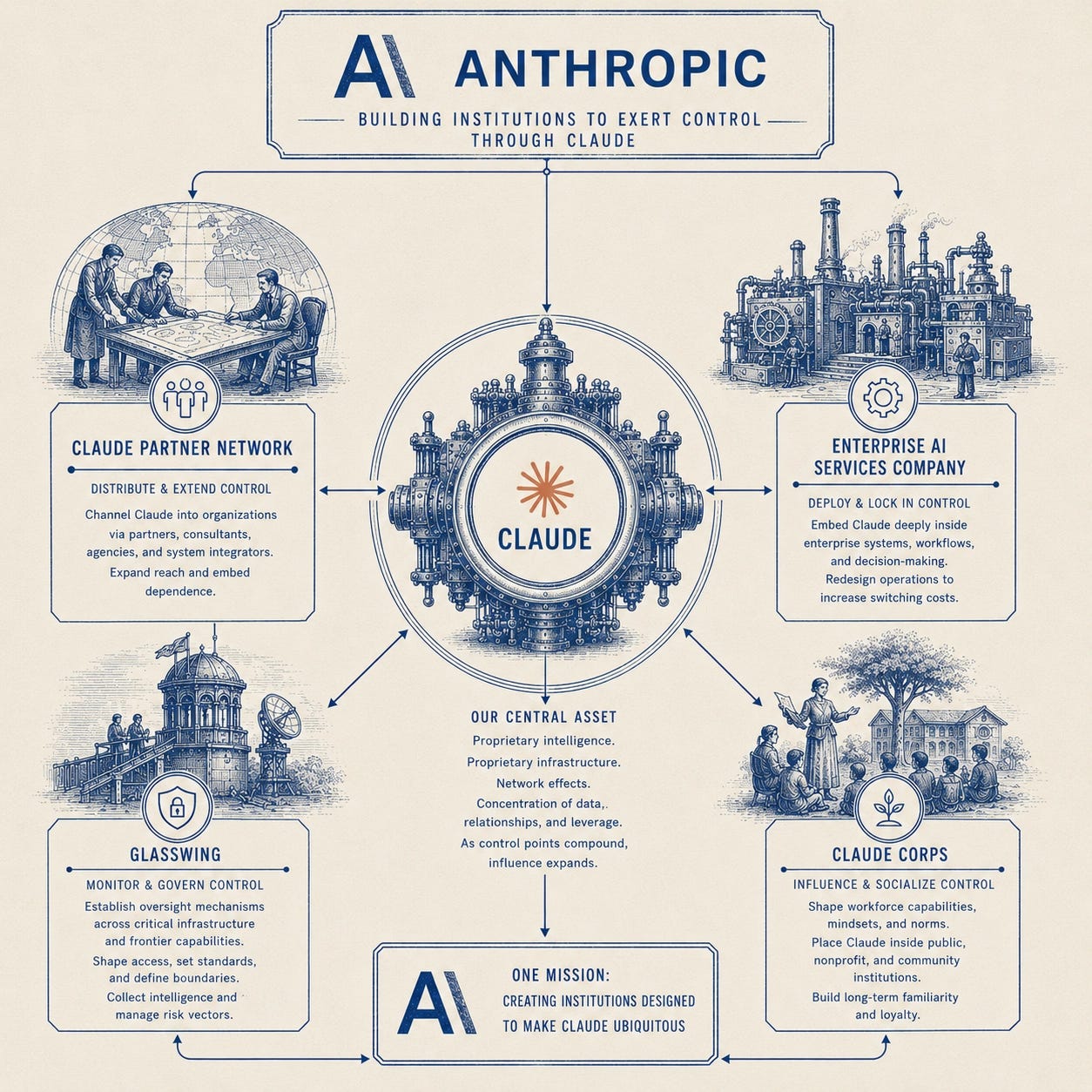
Over the past year Anthropic has assembled one of the most ambitious commercial machines in technology, from the $100 million Claude Partner Network and Project Glasswing in cybersecurity to an enterprise services joint venture with Blackstone and Goldman and the $150 million Claude Corps placing fellows inside nonprofits.
He’s built a universe aimed at embedding Claude into the economy, cybersecurity, and philanthropy.
As I argued in Models Aren’t Moats, value does not collect in the model. It collects in distribution and lock-in, which is what this machine is built to manufacture.
This is the part that smacks of CS Lewis’ “benevolent tyranny”:
“Of all tyrannies a tyranny sincerely exercised for the good of its victims may be the most oppressive…those who torment us for our own good will torment us without end for they do so with the approval of their own conscience.”
The problem is Anthropic is trying to "thread the needle," casting itself as a self-aware, safety-conscious frontier lab at the same time as it pursues one of the most ambitious for-profit commercial endeavors ever attempted. The market it competes in will, sooner or later, force the very compromise the mission was meant to prevent.
Long Live Open Technology
The case for open technology is age-old, time-honored, and the record is clear.
As we wrote last April, modern computing was built on open foundations, from UNIX and Linux to Python and Git, and today’s giants owe their scale to freely accessible, permissionless software.
Open technology is founded upon principles of liberty, freedom, and basic human expression. A technology controlled by someone else (an individual, a corporation, or a government) can be changed, monitored, priced, or withdrawn at their discretion, and the more it matters, the more that power is worth.
Open technology is no more or less than a simple and effective counterbalance to power: a natural response to forces that would upset an equilibrium.
This is not only the open-source faithful talking. Bruce Schneier, writing the same week, reaches an AI public option as the answer: fund open harnesses that balance capability against safety, and open models whose provenance is public.
AI is a general-purpose technology, and whoever controls it stands to gain enormously, which is why the fight to control it is on. Anthropic spent years trying to establish itself as the lab everyone could trust. In mishandling the public release of Fable, it forfeited part of that credibility and ushered in the era of “Government-controlled AI” in one fell swoop.
The response was fast and collective, the way an immune system meets a virus: the people who care about AI saw a power grab and moved against it.
Power gathers wherever it is allowed to. Open technology is what checks it, not because it is virtuous but because it cannot be taken back once it is out. That is why it endures, and why it will outlast whoever is holding the switch this week.