


For the entire history of computing, information technology (computers) and its users (humans) were independent of one another. That era is finished.
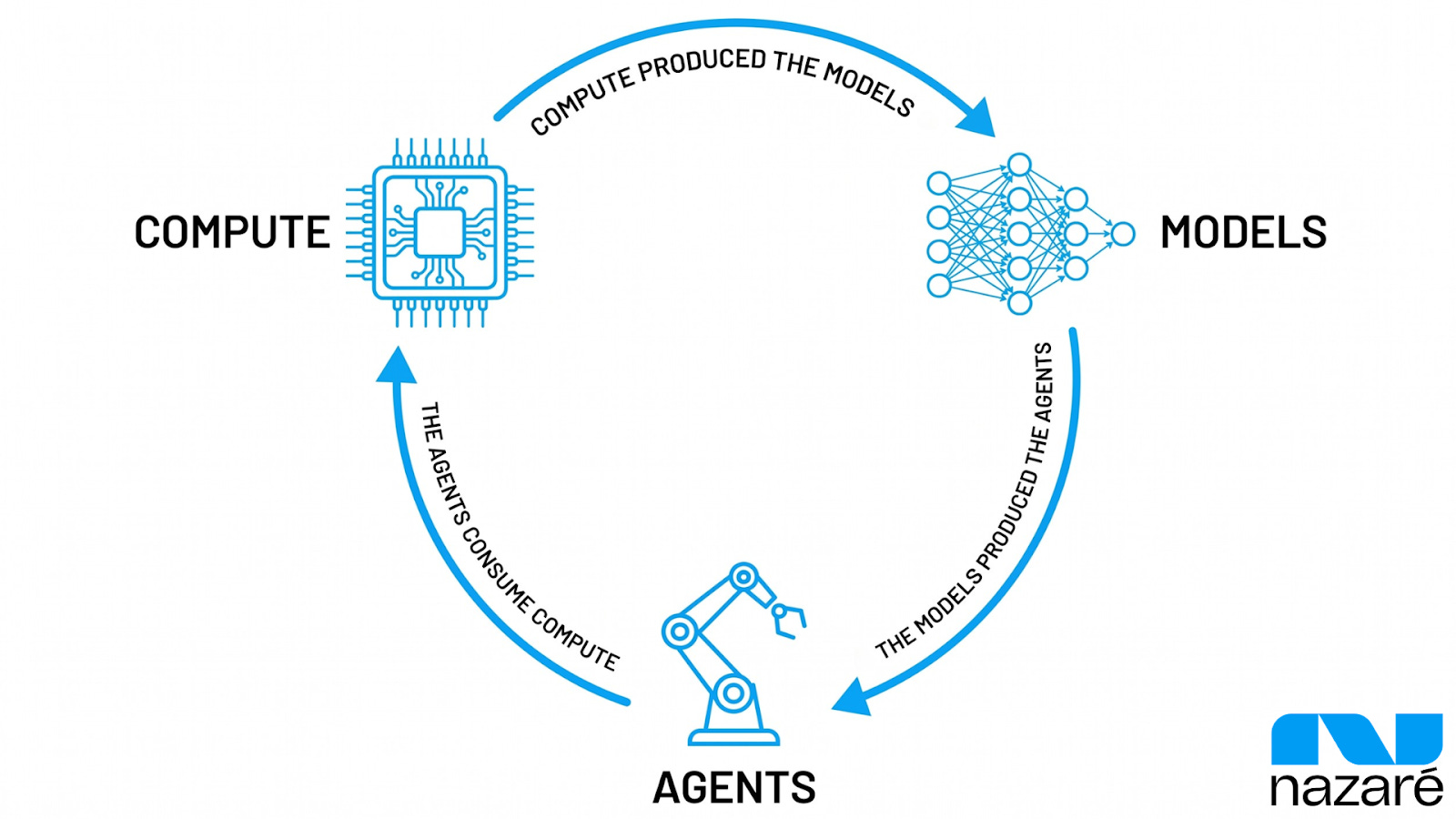
AI has collapsed technology and its user into a single, powerful, semi-autonomous feedback loop – a tool that wields its own tools, does its own work, and has the capacity to operate on its own.
In short, technology itself has spawned its own user.
Created, and now limited, by compute, the very resource they consume to be useful, agents are the new users around which the internet and software now need to rebuild.
Those exposed to the frontier have noticed — and are alarmed by how fast it’s moving. Most of the world is still catching up. We sit squarely in the narrow window before that changes.
Already Here
Those closest to the technology have been exposed to this future.
“Using a computer, has always been about contorting yourself to the machine…We are moving into a world where you no longer have to micromanage the computer. More and more, it adapts to what you want. Rather than doing work with a computer, the computer does work for you.”Greg Brockman
The best programmers and engineers in the world, for example, simply aren’t writing much code themselves anymore. What started as “vibe coding” has become humans acting as “managers,” surveying swarms of agents that are writing code on their behalf.
“It is hard to communicate how much programming has changed due to AI in the last 2 months...programming is becoming unrecognizable. You’re not typing computer code into an editor like the way things were since computers were invented, that era is over. You’re spinning up AI agents, giving them tasks in English and managing and reviewing their work in parallel.”, Andrej Karpathy
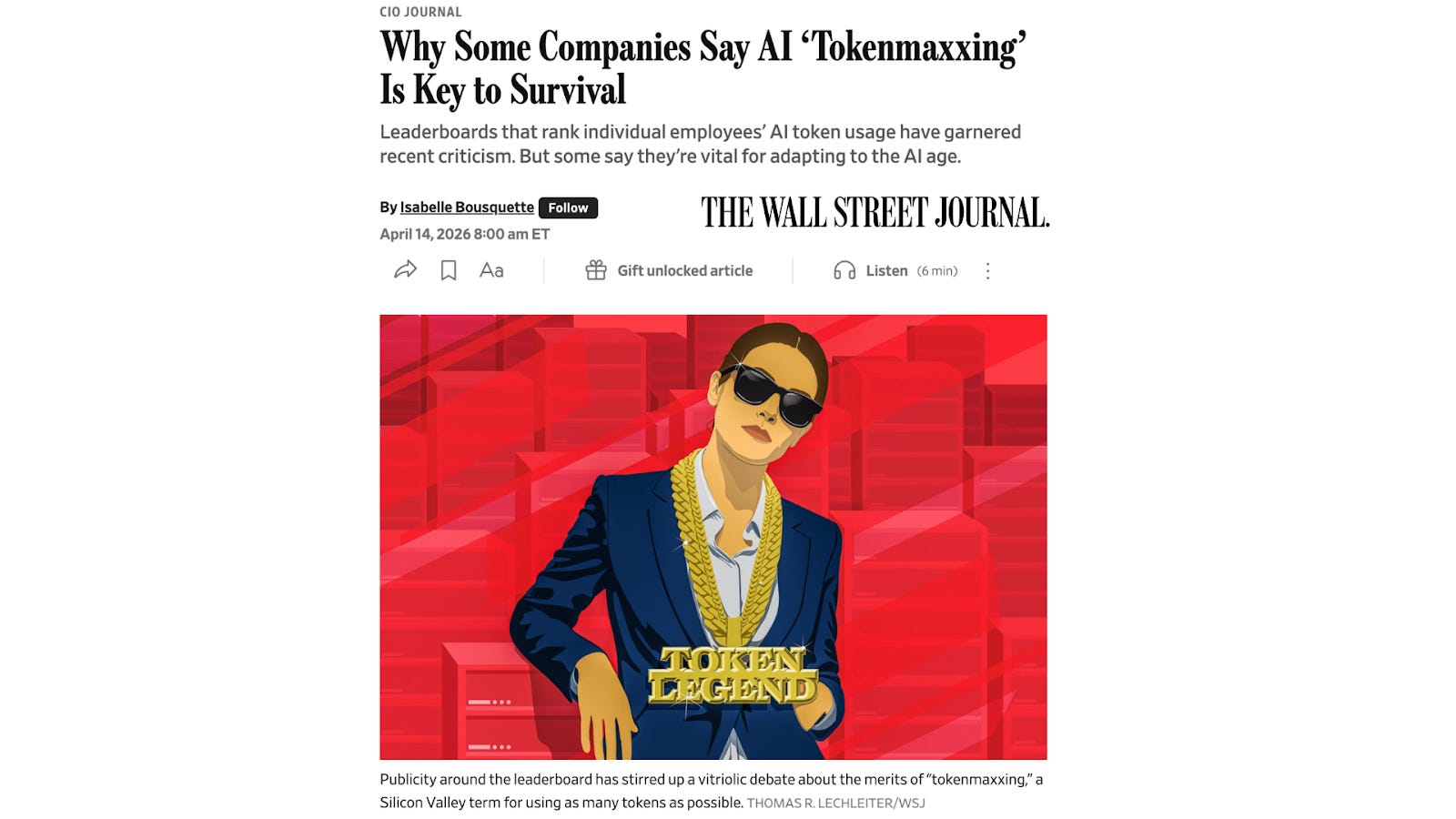
Agents are also software and internet native, sometimes more so than humans. Consequently, we now have tools that understand the primary substrate within which we use them better than we do. Before agents, concepts like “token budgets” and “tokenmaxxing” didn’t exist. Now that we have capable agents, executives like Uber’s CTO are publicly admitting that his company had already burned through its entire 2026 AI budget by April – nearly all of it on coding.
For the time being, it still takes talent and a good grasp on the specifics of what one wants to accomplish in order to create a highly productive agent swarm. But it’s no longer hard to imagine intrepid individuals equipped with agents starting companies, taking on incumbents, and creating enormous value without much human help.
Such is the epiphany even non-technical folks have when they encounter frontier-level AI for the first time, with some invoking “imagination” as the primary input required to create things of value now that agents can handle so much more work independently.
As we’ll see below, we may yet be early to this agent-native shift, but almost certainly not for long. No matter how long it takes to accommodate software’s powerful new user, however, the current status quo designed for humans will have to change.
The Jagged Frontier
Not everyone has seen behind the curtain. We are still early. In fact, another image circulating on the timeline is a visual approximation of just how early we may be.
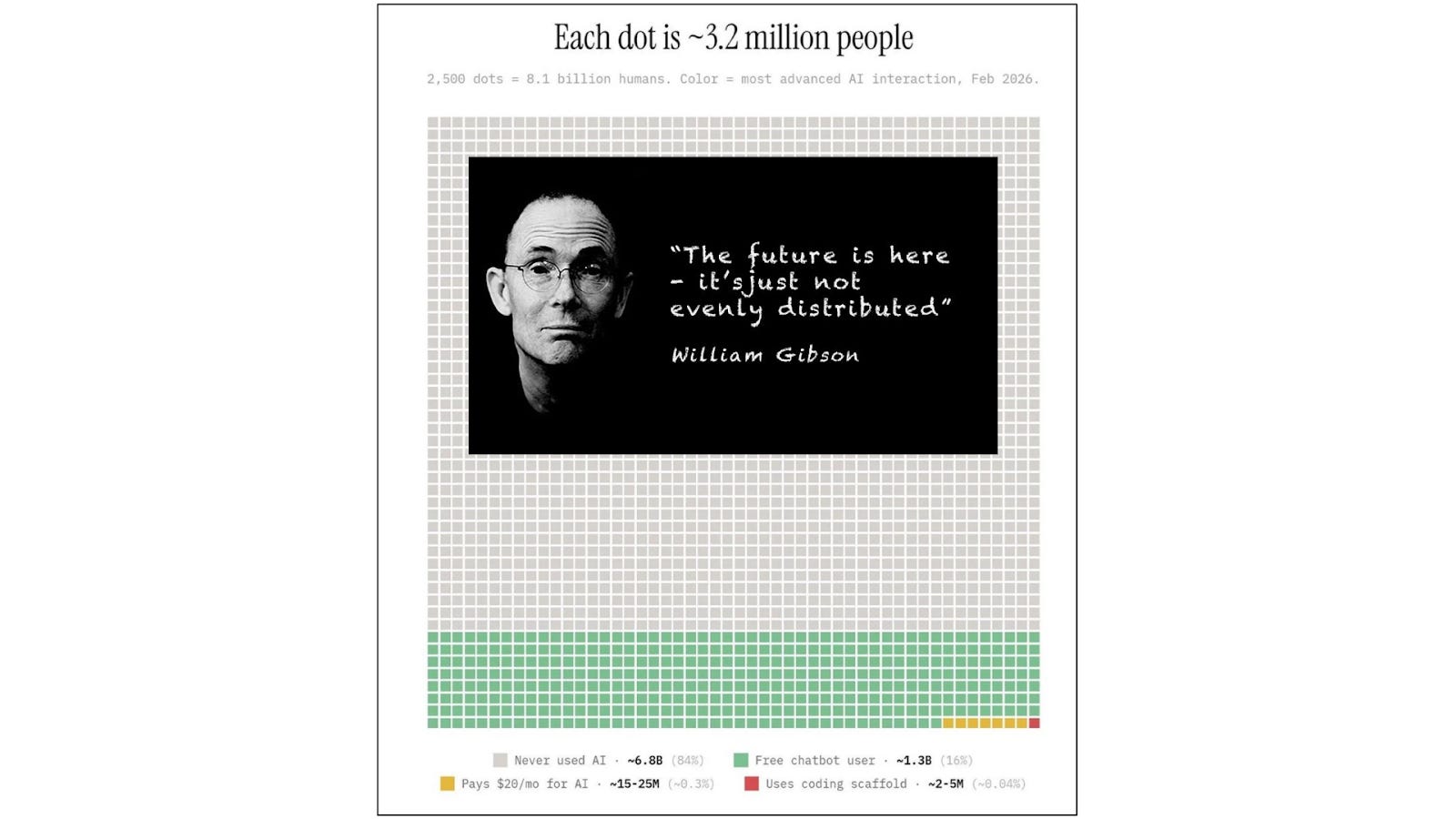
Here one is tempted to invoke William Gibson, because despite the cultural saturation of AI discourse, paid and power users of AI are a rounding error, and the overwhelming majority of the planet has seldom interacted with these tools at all.
As Travis Kling articulated in the brilliant March edition of his monthly updates, if all of the cacophonous noise about AI and agents transforming the world is being made by such a small proportion of the planet, what happens when the rest of the world catches up?
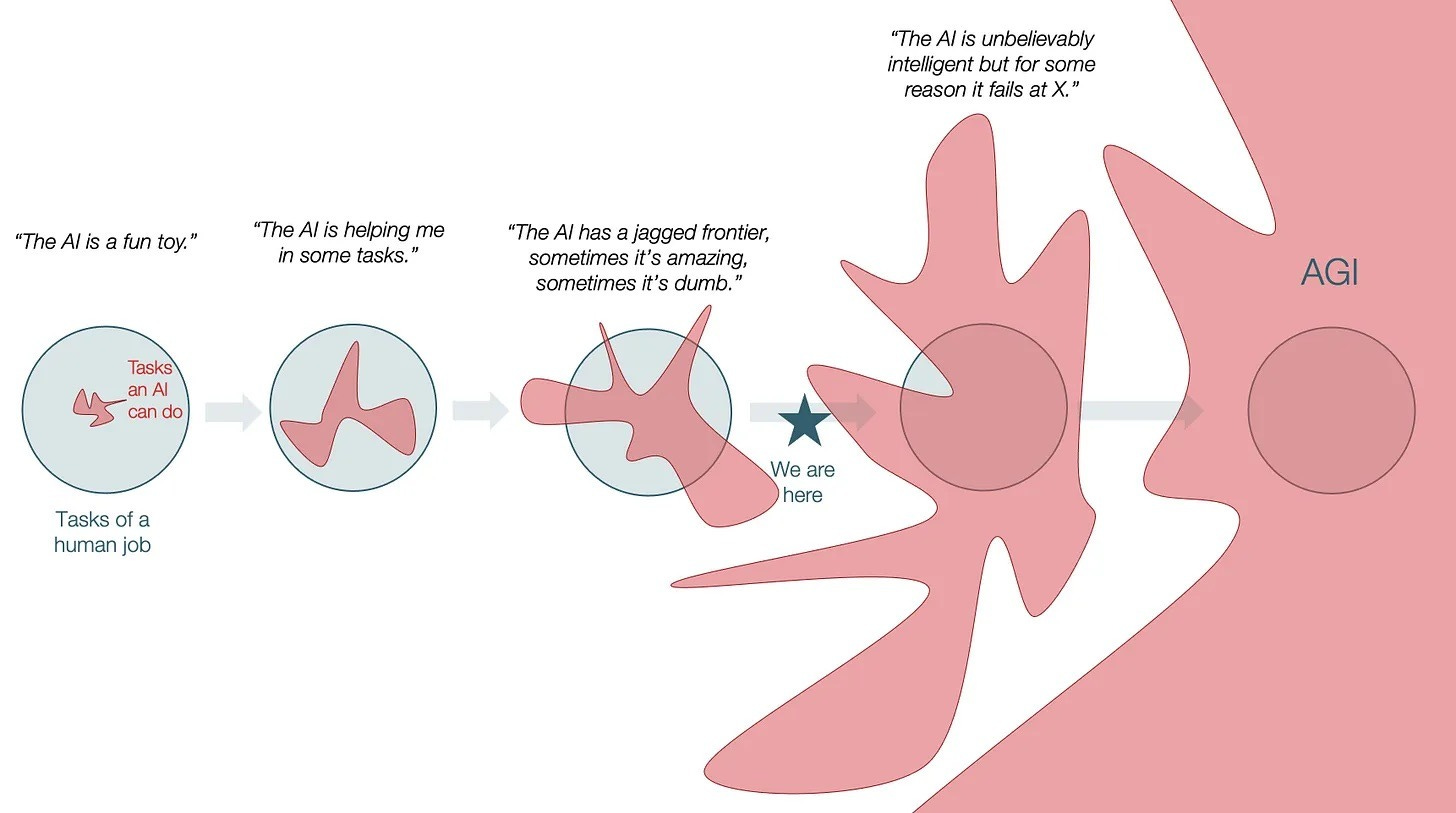
Which begs the prior question: why hasn’t the world caught up already? As usual, the answer is complicated, but at least part of it can be explained by something known in the industry as “the jagged frontier.”
In short, AI’s abilities are uneven and unpredictable. Two tasks that look similarly difficult to a human can sit on opposite sides of the frontier, meaning one the model nails effortlessly, sometimes called “one-shotting”, whereas for the other it fails completely, its answer riddled with errors.
[Source: One Useful Thing]
Humans expect capability to be consistent, but LLMs don’t work that way. What’s more, the “frontier” itself is dynamic, meaning each new model redefines the uneven capabilities: things that failed last month may work, and occasionally the reverse.
One’s opinion of AI, its quality, and the power of the technology is thus dependent on where one sits on the frontier.
Models are typically best at tasks for which there are verifiable outputs, like programming. As such, advances in programming are staggering, and those using it to code are so impressed as to be overwhelmed.
Writing, on the other hand, which is as much about how artfully one breaks the rules as it is about how strictly one follows them, is more difficult for AI to properly master (although it’s still pretty damn good at it).
Both Karpathy and Wharton professor Ethan Mollick, who co-authored the paper that coined “jagged frontier,” have noted the difference in perspectives between those exposed to top-tier AI-powered programming and those primarily interacting with chatbots.


Additionally, the frontier labs, and thus the primary interfaces with which people interact, remain compute-constrained. To experience the magic of the latest and greatest available models, users need to be on “max” plans that cost anywhere from ~$100-200/month. That’s great for the aforementioned companies willing to subsidize their employees’ tokenmaxxing, but remains largely inaccessible for the majority of the general public.
For the majority of the population using free-tier AI primarily as a chatbot or as an answer-machine replacing search, the idea of deploying an entire semi-autonomous workforce is inconceivable.
All of this explains a recent Bloomberg article about AI FOMO, which I thought did a remarkable job of capturing the zeitgeist and articulating the widening gap in understanding between those who have encountered the frontier and those who haven’t.
The Ground is Moving
Now here’s where things get spooky. In October of last year I wrote about what I called the “Too Fast Threshold.” I described how difficult it would be for humans to keep up with machines, especially as they continue to accelerate.
In theory, there exists a “holy grail” of autonomous AI development called recursive self-improvement (RSI) whereby the models themselves get smart enough to contribute to their own iterative improvement, creating a self-perpetuating cycle of development that has mind-bending implications.
If agents are now capable independent workforces, by definition some of that work may include improving the very technology upon which they depend. Agents may thus be the mechanism by which RSI, and by consequence the rest of the three-letter “ultimate” outcomes (ASI/AGI), finally gets realized.
This is in large part why everyone even remotely exposed to the frontier of AI is expressing genuine, incredulous, and sometimes alarmed, surprise at the speed with which everything is changing.
They feel the acceleration viscerally, and it’s compelling them to share their observations publicly. To them, many of the frameworks in place before AI are buckling, social, political, and economic, and it’s entirely possible that we’re unprepared.
As we wrote last week, the conditions necessary for useful agents only emerged in the last six months, around December of last year. No more than a month later, Anthropic started shipping major product releases almost weekly: Cowork plugins, Opus 4.7, Claude Code Security, Mythos & Project Glasswing, Managed Agents, several of them triggering a sectoral selloff in related public market equities, collectively called the “Anthropic Effect.” They’ve also refrained from releasing Mythos, their latest, most powerful model, publicly for fear of its ability to find vulnerabilities in internet-critical codebases.
For what it’s worth, this is largely why everything in public markets is trading like a shitcoin: just as the assumptions upon which software has been built are now obsolete, so too are the assumptions used to evaluate enterprises, underwrite investments, and interpret market signals.
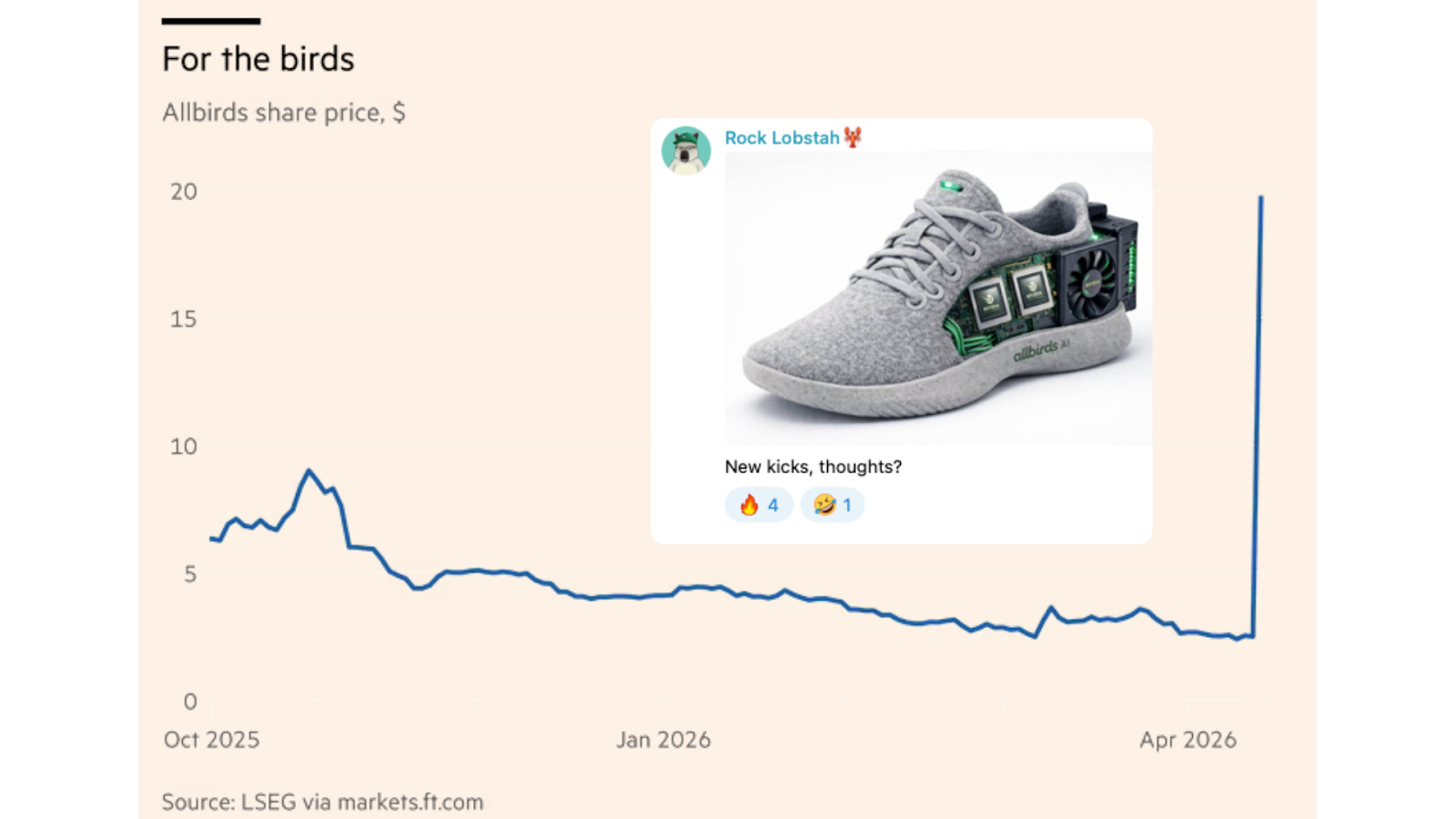
Price charts like the one above for Allbirds, a formerly struggling shoe brand, which has evidently become an AI company, pumping its stock ~700%, are funny, but more than anything else they indicate that markets and the mechanisms in place to steward capital towards productive enterprises are broken. Mispricing at this scale is precisely where the opportunity lives, skewed sharply toward whoever can still read what’s actually being built. We also addressed this in a previous piece.
The Window is Open
“That’s how big of a deal actually functional agents are: you can see them coming and yet still be amazed when they arrive.”
What happens when technology is its own user is that every rule gets rewritten, for building, for investing, for competing.
If this acceleration continues – and I believe it will – we may not have much time to adapt. But I don’t believe in the apocalypse, either. The phrase “this time is different” always warrants skepticism, especially when it comes to markets, history, or humanity. Markets will boom, and then they will bust. History isn’t over. Humanity will endure.
I do believe in technological revolutions, though, and in that sense AI may, indeed, be different. I have written before about my skepticism regarding the financial valuation of companies involved in the AI boom, but I remain unambiguously convinced that AI will transform the world. This is why I started Nazaré in 2023.
That technology has spawned its own user, to me, is reason alone to get excited. But on top of that, there is still time to learn to use these tools, the world has yet to fully adapt to AI, and most of the companies that will define this paradigm are still being founded.
We are still early enough to conceive of, design, and mold what comes next. Therein lies the opportunity for everyone: founders, incumbents, investors, and everyday citizens alike.