


Why European demand for AI will be served either way, and what the American buildout teaches about building the compute on the continent.
On February 3, the council of Groß-Gerau, a debt-laden town of 25,000 near Frankfurt, voted 18 to 14 against a €2.5 billion (about $3 billion) campus by Vantage Data Centers on land the company already owned. The Greens’ objection was waste heat, which they put at the output of 93,000 ovens. The SPD’s was selling the town to a billionaire investor. Vantage replied afterward that the heat would stay in a closed loop the town could have fed into its district heating. The one feature that could have given Groß-Gerau a stake in the project arrived as a rebuttal.
Europe has to build out its compute, and it can do that differently from the United States. The American buildout has just been tested by its lenders and by the towns asked to host it. Its lessons are public, and European builders can use them before committing to their own projects. Groß-Gerau is the lesson the Americans learned last.
Narrative and Inertia
A lot of people are down on Europe nowadays. Bond yields are rising, France is dealing with widespread protests, there’s renewed political instability across the bloc, and the EU has only a fraction of the AI capacity of the US or China.
It’s fashionable for influencers to mock Europe’s innovation record, leaning on the final clause of the cliché “America innovates, China replicates, Europe regulates.”


In September 2025, a year after his report on European competitiveness, Mario Draghi told EU officials in Brussels that “Too often, excuses are made for this slowness. We say it is simply how the EU is built. That a complex process with many actors must be respected. Sometimes inertia is even presented as respect for the rule of law. That is complacency. Competitors in the US and China are far less constrained, even when acting within the law. To carry on as usual is to resign ourselves to falling behind.”


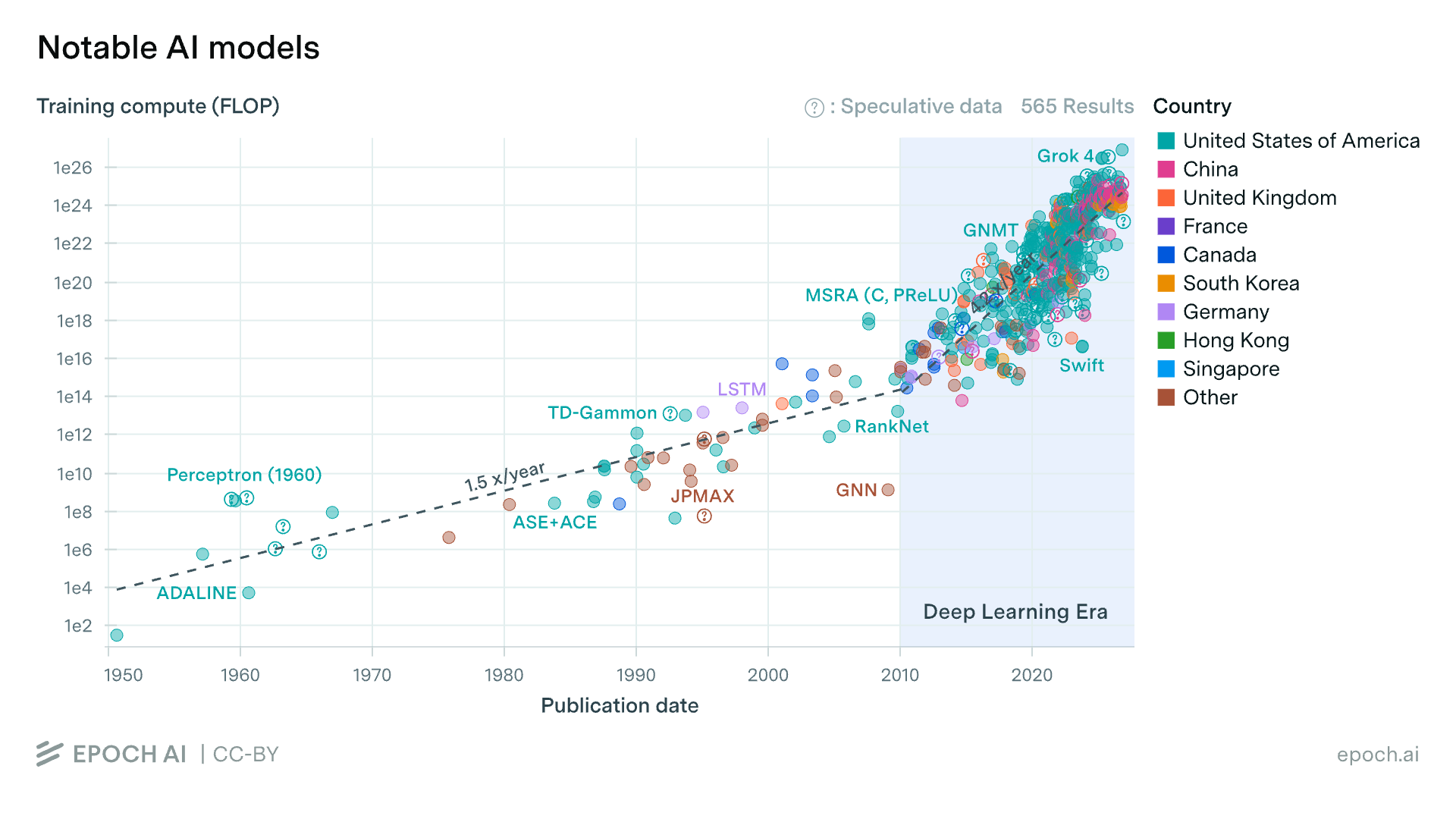
On AI, the numbers bear him out. Epoch AI’s database of notable models, the source behind Stanford’s AI Index, counts 64 from the United States in 2025, 35 from China, and two from Europe, one from the UK and one from France. South Korea alone released eight, four times as many as Europe. Through September 2026, the United States has added 49 and China 29. Europe has added none.
Breaking with Pessimism
In an essay titled “Build or Surrender,” Arthur Mensch, co-founder and CEO of Mistral AI, names the first obstacle.
“Closing the gap demands first and foremost a break with pessimism.”
Europe can still build competitive models. Epoch’s count, for example, doesn’t yet include Mistral’s Large 4 (aka “Le Chonk”), released on October 6, a model of about a trillion parameters whose open weights are due by the end of October. Mistral reports that it outperforms OpenAI’s GPT-6 Astra on some legal and financial work, and Simon Willison puts it about six months behind the frontier.
On October 3, Germany’s Aleph Alpha released Kolibri, an open-weight model that the company says matches models with up to four times as many active parameters.


Mistral says it trained Large 4 on 3,800 Nvidia GPUs, and Kolibri was trained on 768 Nvidia B200 GPUs in Germany and Finland. In the United States, OpenAI trained its Astra-class models on a cluster of more than 100,000 GPUs, over 26 times the size of Mistral’s cluster. Whatever the quality of Europe’s labs and researchers, competing at the frontier is hard from that position.
I believe Europe has not said its final word on frontier models. I expect Mistral and even Yann LeCun’s AMI Labs to share impressive models in the future, especially as this European compute buildout continues. As Mensch puts it in his essay:
Europe has the means to build these systems. Black Forest Labs and ElevenLabs, two European companies, produce the best models in their category. At Mistral, our researchers and engineers are based in Paris, London, Munich, Barcelona and Warsaw, as well as in the United States, where we export our products. With fewer resources, we train general-purpose reasoning models that now rank among the best open models, along with the world’s best specialized models in several use categories.
Furthermore, we know exactly how to improve our performance. We are about to increase our compute capacity sixfold over the coming year, building on the confidence we have earned in our methods and operations. We can move faster with more capital, and we will raise it.
I have argued before that most people do not need frontier intelligence. They need capable, affordable, available models under their own control. Serving them gives Europe another reason to build, whichever labs produce the leading models.
European Customers and Workloads
Training can run anywhere with power and chips. Inference has to meet the application’s latency requirements and the customer’s conditions for processing data. GDPR permits international transfers under specified conditions, and customers can have additional legal, contractual, and operational reasons to keep workloads in Europe. Europe will build both: training capacity follows the labs, and inference capacity follows the customers and will likely end up the larger of the two.
European operators can earn business by giving customers a deployment they can approve and rely on. They’ll be competing with foreign clouds already offering European hosting, so the terms of the service and control over the data matter alongside its location. For certain sensitive state workloads, France’s cloud rules require qualified services protected against unauthorized access by foreign authorities. European operators that can satisfy those requirements have a specific customer need to serve, alongside the usual competition on price and reliability.
A closed model runs only where its developer agrees, which so far means its own service or a licensed hyperscaler. Open weights run wherever someone has the hardware. Muse Spark Open, Mistral’s Large 4 weights due by the end of October, and Kolibri can each be served to European customers by any operator that downloads them, and every open release from the US, Europe, or China adds to that catalog. Mistral trains on European compute and, once the Large 4 weights are released, supplies a model for other European operators to serve. The pessimism about European models concerns training. European inference runs on whichever open models are best at the time.
Eurostat counts 20 percent of EU enterprises with at least ten employees using AI in 2025, up from 13.5 percent a year earlier. Established businesses paying for AI from operating budgets offer European providers a market beyond labs funding their next training run. Some of that spending reaches compute operators through software companies or cloud platforms, so a broad base of end users may still leave an operator dependent on a few buyers.
New capacity and competition can push inference prices down, while some workloads move to devices. Margins come under pressure when selling prices fall faster than an operator’s costs. Borrowing against this year’s inference rates repeats the American late entrants’ error.


Lessons from the American Buildout
Training and inference will expand on different schedules, and Europe’s buildout can reflect that. The American experience gives builders a clearer understanding of the commitments each project creates, the dependencies that can undermine it, and the conditions that make expansion worthwhile.
Europe’s data-center market has grown more slowly than those of the US and China, with a substantial expansion still ahead. The American builders are already looking past their own borders. SemiAnalysis expects capacity outside the United States to accelerate sharply in 2027 and gain share in 2028, driven largely by US constraints on labor and power, and by permitting fights of the kind now reaching European councils.
1. Fighting FOMO
In an essay titled “Compute Cargo Cults,” Neha Desaraju describes the state of compute and its corresponding financial infrastructure in the US.
By her account, the early winners of America’s compute boom secured hardware, land, and capital, and took balance-sheet risk before others would. Those advantages could support rapid expansion. Later entrants, pursuing the success of the first movers, have attempted similar strategies with narrower margins and more complicated projects.
In the US, for example, investors are competing for power and sites, and costs are rising. European projects have to justify their land, power, and hardware costs at the prices and contract terms available now. The returns earned by America’s earliest builders tell us little about what a later project can sustain.


2. Borrowing for the Buildout
Compute providers borrow against multiyear contracts with customers whose ability to pay may depend on future funding rounds. The supplier and its lenders then share the customer’s exposure to the same fundraising cycle. Customer concentration compounds that exposure when one or two buyers account for most of a provider’s revenue. Spreading contracts across several customers offers limited protection if they all depend on investors continuing to finance similar businesses.
Large data-center projects often depend on a major tenant signing a long lease. By SemiAnalysis’s account, a developer spends 5 to 10 percent of a project’s capital before a customer signs, and what unlocks the rest is a 15 to 20 year lease worth ~$30 to 50 billion per gigawatt. They count roughly a trillion dollars of non-cancellable leases signed in 2026 so far, by Meta, AWS, Microsoft, Google, Nvidia, AMD, Anthropic, and OpenAI, with neoclouds signing deals in the hundreds of megawatts, and say most of the debt against those leases has already been raised. A hyperscaler’s lease is a strong basis to borrow against. A lab’s lease is different. The market has already priced its doubt about whether lab revenue will ever cover lab costs.
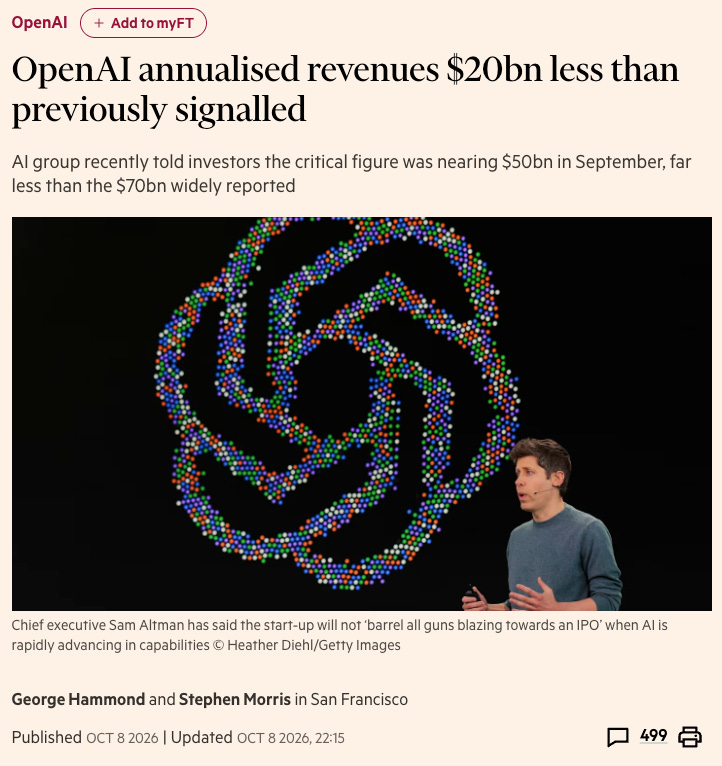
CoreWeave’s reported debt rose from approximately $21.4 billion to $35.1 billion in the six months to June 2026. Net interest expense consumed about a quarter of its revenue over that period. By October 15, its 9.625 percent notes maturing in 2032 were yielding approximately 15.6 percent.


Hyperscalers such as Microsoft, Alphabet, and Amazon can service their debt with abundant cash flow generated across large, established businesses. A buyer funding compute from established operating cash flow gives its supplier a different basis for investment from one planning to pay through future capital raises. The same distinction applies to European customers, including European labs that depend on future funding rounds.
An operator serving established businesses can spread its exposure across customers with independent sources of revenue. Lenders still need to know how much those customers have committed to spend and for how long. A business that can afford its AI bill can also reduce its usage or switch suppliers. Where customers buy on demand or sign short contracts, the financing has to allow for uncertain utilization and renewals, including through more equity, less borrowing, or expansion in stages.
The supplier also has to deliver the complete service on which those customer payments depend. Equipment, power, and facilities must become operational on a schedule the financing can sustain.
3. Financing the Full Package
As Desaraju writes:
The end buyer of compute only sees the resulting take-or-pay contracts quoted in GPU-hours. While it might naturally be assumed that those buyers are purchasing blocks of time, they’re actually buying the contiguous interconnected cluster, high-quality servicing costs, availability of fiber and labor near the cluster, the power contract, the real estate investment underneath, and dozens of things that used to be less operationally intensive or readily available. Now, much of this infrastructure has to be built from scratch or retrofitted.
Part of this is because the power, development, and equipment requirements for frontier AI compute are so much higher than most uses of that equipment pre-2022. This makes each part of the project slice harder to develop and finance on its own merits; it’s a full package. It’s part of this reason that structures like the below appear so much more complex today…
…Now, instead of three project finance packages, it’s one, because the market for each of the three is scarce and demand is high only for all of it together.
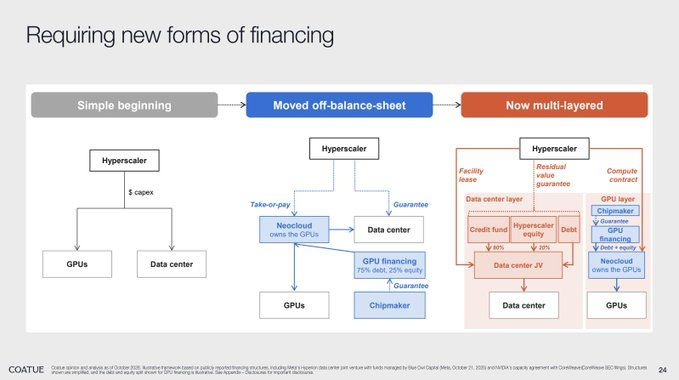
The equipment lender, the facility developer, and the power supplier may all be counting on income from the same successful deployment. Each needs to understand whether the complete system can operate on the terms promised.
The hardware, buildings, and power infrastructure also have different useful lives. Accelerators may require replacement while the site and its electricity supply remain useful, and the initial customer contract may end before some assets are paid off. Lenders therefore need to assess what will support repayment over that period, including the assets’ remaining value and who could use them after the original contract expires.
Desaraju proposes financing power generation separately where it can serve other customers and remain useful beyond the data-center project. A plant with access to other electricity buyers can generate income independently of the original compute contract, potentially through several generations of hardware. That gives lenders another basis for repayment. The case depends on having the connections, customers, and agreements that make those alternative sales possible.
That lesson will be useful in Europe, where the IEA’s November 2025 assessment puts grid-connection waits at two to ten years, seven to ten in the Frankfurt, London, Amsterdam, Paris, and Dublin hubs, and France’s five accelerated sites had connection horizons of three to four years in the government’s January 2026 update. Equipment purchases, delivery commitments, and debt repayments have to fit those timelines.
In the FT, Chris Miller describes how Iran’s attacks on Gulf data centers have complicated a buildout premised on cheap energy. In its September 15 update, AWS said the damage in Bahrain spanned multiple availability zones and exceeded what its regional services were designed to withstand. Most customers had moved their workloads to other regions before Bahrain became unavailable, but AWS couldn’t restore access to resources and data hosted exclusively there.
European operators serving customers with local data requirements need recovery plans that work within those requirements. That means funding usable backups and access to replacement compute in locations with sufficiently different exposures, and testing that the service can run there. Those provisions belong in the project’s economics from the outset. A site that looks attractive on electricity costs alone can become considerably more expensive once the operator accounts for protecting the facilities and recovering service elsewhere.
Heat With Nowhere to Go
Refusal now constrains European capacity as much as the grid does. The European Data Centre Monitor counted more than 70 projects rejected or restricted in the first four months of 2026, more than in all of 2025. Ireland lifted its four-year freeze on new Dublin grid connections only in December 2025, on condition that each new site can generate or store its full demand on its own premises. In Foreign Affairs this week, Niall Ferguson, Lisa Klaassen, and Eric Schmidt note that the American backlash has reached Texas and Utah, and the forecasts of capacity shifting abroad rest on that slowdown. Europe’s version comes with a legal hook the American one lacks, since the bloc’s 55 percent emissions cut for 2030 is binding law.

SOURCE: https://www.cnbc.com/2026/10/03/data-center-backlash-europe-asia-africa.html
Groß-Gerau is one entry on that list. I wrote in September that a data center’s costs are local and immediate while its benefits are distant, that host communities rarely get a stake, and that the industry therefore manufactures motivated opponents and no motivated supporters. Groß-Gerau was that argument with a vote count.
In March, Germany set out to double its data-center fleet and quadruple its AI compute by 2030, and it has since softened the one rule in Europe that turned the missing stake into a condition of building. Its 2023 Energy Efficiency Act required new data centers to reuse a share of their waste heat, ideally in municipal heating networks. Developers argued it could oblige them to reuse heat with no buyer, and on June 24 the cabinet reduced the obligation to an assessment, binding only where a heating network already exists nearby. Groß-Gerau’s objection was heat with nowhere to go, and the softened rule is the one that obliged a developer to find the heat a home. The next developer in Hesse faces the same council with one fewer thing to offer. In July, Stack Infrastructure abandoned a campus at Babenhausen, on the far side of Frankfurt, after the planning process stalled on uncertain local support. Economy minister Katherina Reiche called the June change the precondition for digital sovereignty, which tells residents that AI is the industry for which the rules get waived.
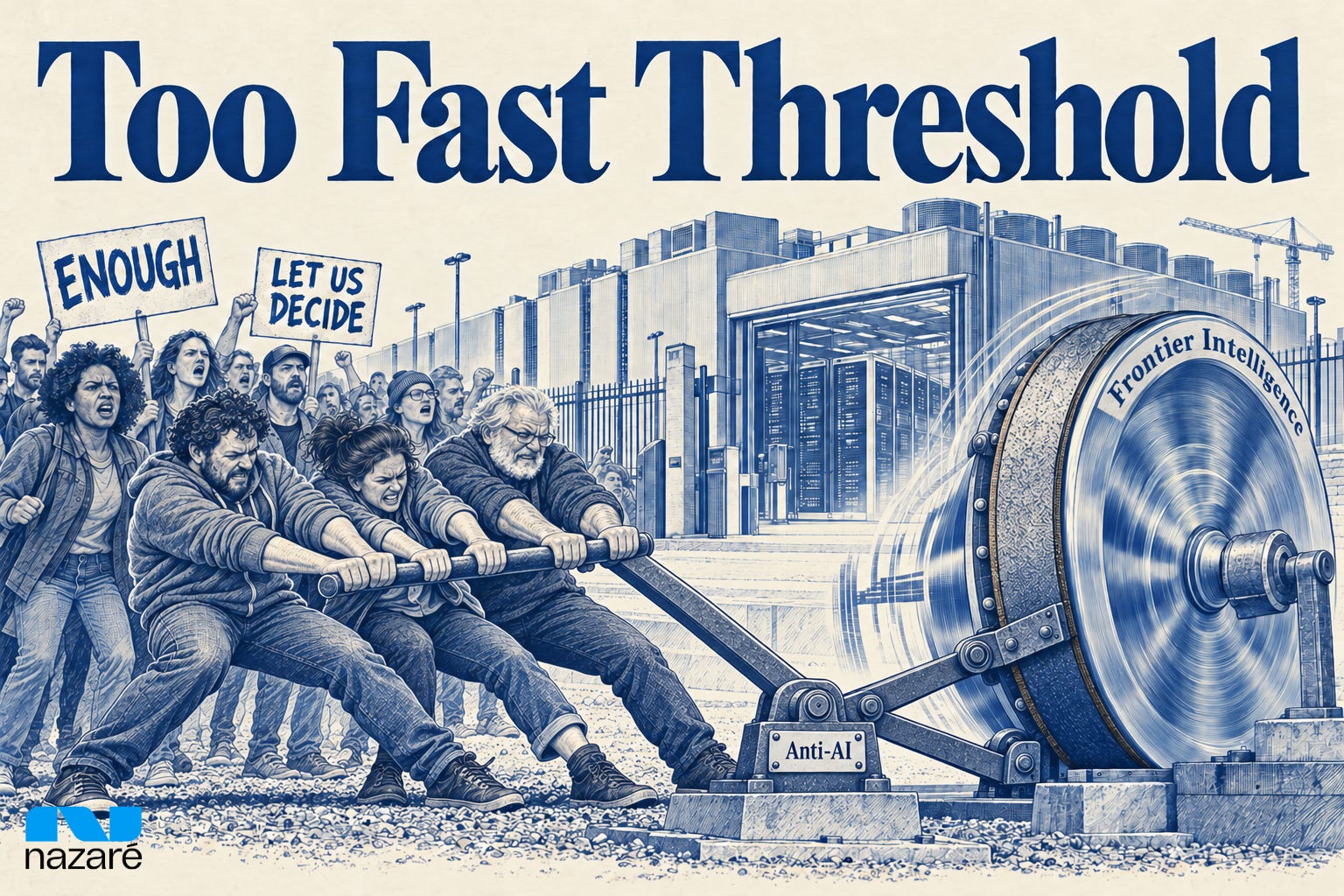
A year ago I argued that society would at some point decide AI is moving too fast, that the perception would matter more than the cause, and that the resistance would arrive as regulation, refusal, and friction. Council votes and connection freezes are that resistance, and in Europe the threshold is being crossed town by town.
Ferguson, Klaassen, and Schmidt describe AI as an imperial technology: whoever controls the models, chips, and capital sets the terms for everyone else, and a government running services on a model it can’t inspect, or a firm building on an interface that can be repriced or withdrawn, is a dependent user whatever its GDP. Below a certain threshold of energy, capital, and compute, they write, a country “is not in the game at all.” Europe watched that in June, when a US directive had Anthropic switch Fable and Mythos off for every customer, everywhere, inside an evening.
Mensch is right that the gap closes with a break with pessimism, and he’s right that the stakes are existential. AI will decide which economies grow over the next decade, European demand for it will arrive either way, and the open question is whether Europe can develop its own compute or become a vassal to those who do. Operators that choose sites where the project gives something back, and say so before the vote, will find the customers waiting. Operators that treat consent as a formality will join the monitor’s list.

