


The AI industry spent years warning of apocalypse while promising abundance. Its opponents inherited the more vivid half of that vision and are turning it against the infrastructure on which scaling depends. Their victories may change how AI progresses, but not whether it does.
In case you aren’t already aware, AI is extremely unpopular. For all the talk about its transformative potential, public sentiment toward the technology remains overwhelmingly negative.
Earlier this year, for example, former CEO of Google Eric Schmidt was heavily booed while talking about AI at the University of Arizona commencement on May 15, 2026. (He wasn’t alone, either.) More recently, popular country singer Zach Bryan debuted an unreleased, explicitly anti-AI song titled “Robot Killed the Working Man” at AT&T Stadium in Arlington, Texas, on August 22, 2026. He told the crowd he had finished writing it that week.


The backlash is already well documented. Two things about it are not. Apocalypse is easy to imagine and therefore easy to organize around. And a politically successful anti-AI movement can only change the pace at which the technology improves, never whether it improves.
It Was Written: A Well-Known Future
To understand the cultural advantage enjoyed by AI’s opponents, you have to be a fan of science fiction. The word robot, for example, entered the popular lexicon through Karel Čapek’s 1920 play R.U.R., whose mass-produced artificial workers are created to liberate humanity from labor, but (of course) eventually exterminate their makers.
That relationship between human and machine has remained remarkably durable across a century of science fiction. The narrative arc is fixed. Machines are built to serve. They end up in charge. Modern AI therefore entered a culture that had spent decades rehearsing the dangers associated with intelligent machines.
But what of benevolent scenarios? Surely not all science fiction is apocalyptic?
Indeed, there have been benevolent, abundant futures created in different science fiction universes, but rarely do those futures get invoked. Writing for the Financial Times, Henry Farrell and Dan Wang wrote:
Silicon Valley likes to dress its ambitions in the glistening garb of science fiction from the 1950s, when authors such as Isaac Asimov and Arthur C Clarke spun tales of humanity spreading through the stars.
But what kind of future are we really hurtling towards? Increasingly, it is looking much more like the one anticipated by the drugged-up 1960s oeuvre of Philip K Dick, filled with deranged billionaires, machines that claim consciousness, hallucinated worlds and political breakdown. Musk and his brethren seem more like escapees from this universe than the Asimovian super-geniuses they imagine themselves to be. It is Dick’s far weirder sensibilities that offer the better guide to Silicon Valley today.
Does Silicon Valley dream of Philip K Dick? (Financial Times)
What matters is less whether Dick predicted Silicon Valley than the fact that Farrell and Wang can explain the present by choosing between two established fictional futures. Silicon Valley places technological expansion inside Asimov and Clarke’s story of civilizational ascent. Its critics reach for Dick’s world, where intimate and unreliable machines extend the power of elites whose grasp on reality is itself in doubt. These kinds of narratives are themselves lent credibility by news of Mark Zuckerberg building himself a “doomsday bunker” in Hawaii, or Peter Thiel buying land and citizenship in New Zealand.

In short, science fiction gave the public an interpretive language for the negative applications of AI well before those applications could be widely experienced. Calling an AI network “Big Brother,” for example, immediately frames it as an instrument of surveillance, even if the analogy isn’t perfectly accurate. “Skynet” is similar, positioning autonomous systems inside a story about machines escaping human control.
In each case, the reference establishes the emotional meaning of the technology even when its technical operation remains obscure. The audience thus understands the position it’s been assigned within the story whether or not it understands the technology or its application in question.
In fact, limited technical understanding leaves plenty of room for certainty about that larger story. People who know comparatively little about AI may still be utterly convinced about where the technology is going. Familiar language, symbols, and narrative make complex systems emotionally and politically legible without requiring the audience to understand its mechanisms.
An Unbelievable Alternative
At the same time, the industry’s optimistic future is usually gathered under the umbrella term “abundance.” In its fullest version, cheap intelligence and robotic labor satisfy material needs so completely that work becomes optional and money irrelevant. Elon Musk has described production so abundant that it saturates human desire, after which money would cease to matter.
Abundance here is thus meant to become the emotional foil to apocalypse, a future the public can imagine and desire strongly enough to compete with its fear of catastrophe.
The problem is that “abundance” as described is completely unbelievable (in a literal sense), whereas apocalypse is significantly easier to believe. Society already understands scarcity, conflict, and loss, whereas almost no one knows what a world without those constraints would feel like.
Dunking on Yourself: The Fundraising Trap
The megalabs compounded this imbalance by lending their own authority to the future the public already found easier to believe. In 2023, Sam Altman, Demis Hassabis, and Dario Amodei signed a statement placing the risk of extinction from AI alongside pandemics and nuclear war. Statements of this kind circulate far beyond debates about frontier safety and shape the public understanding of the technology as a whole.
To make matters worse, these warnings came from the same companies asking the public to believe in abundance. Their rhetoric gave AI what Will Manidis calls an explicitly “millenarian” structure, in which the future narrows to either extinction or abundance. I’ve written before about why this binary is false and why the actual future almost certainly lies in what I call the “messy middle.”

But whatever AI leaders actually believe, the millenarian binary is an extraordinary fundraising strategy. Extinction made the technology urgent enough to require centralized stewardship, while abundance promised rewards large enough to justify immense investment. (What is “God” worth?)
The problem is that the frontier AI labs now need to go to market. OpenAI and Anthropic must now demonstrate how colossal investment becomes durable revenue, which requires customers and communities to accept AI as a usable, governable technology.
Evidently the labs are having a hard time walking back the claims that helped them raise that money. With their credibility already badly damaged, softening those warnings now that they need customers would expose the original claims as hollow and the retreat as pandering.
Together, science fiction and the labs’ own rhetoric give critics a common account of what AI represents. People can disagree about how the technology works and still recognize their own objection in the familiar story of humans losing control to machines. That story lets coalitions form before its members agree on what they’re for, and sometimes without requiring any agreement at all.
AI’s Missing Constituency
The political force of that shared story draws from how unevenly AI’s physical expansion distributes its costs and benefits. The costs are immediate, local, and imposed on identifiable communities, whereas the benefits are distant, uncertain, and distributed through promises of future capability, tax revenue, and economic growth.
The industry therefore creates motivated local opponents without creating an equally motivated constituency prepared to defend its expansion.
For example, data centers can, in fact, create jobs and generate substantial tax revenue, sometimes enough to provide significant value to a local economy. But residents must assess those benefits through forecasts about future employment and promises about how new revenue will be distributed.
What’s more, residents encounter those forecasts through local reporting and social platforms, where algorithmic feeds set the details of one project beside the national quarrel over AI.


In an unstable information environment, even accurate projections must compete with vivid claims of harm and accumulated distrust of the companies doing the asking.
What AI lacks in many of these communities is a group of residents with a direct, continuing economic interest in its expansion. In “Our Intelligence Troubles,” Will Manidis compares AI data centers and fracking. Fracking imposed environmental and social costs on the communities that hosted it, but some of the same landowners received royalty checks, while local workers depended on continued drilling. Its supporters therefore lived alongside its opponents and had direct economic reasons to defend the industry.
Data centers rarely give host communities an equivalent direct stake. Revenue reaches residents indirectly through municipal budgets, while much of the employment is concentrated during construction. The people with the strongest economic interest in additional compute usually live elsewhere.
Sam Altman recently acknowledged the emotional force of local opposition before suggesting that the industry build these projects out in the desert, away from anyone. The answer treats nearby communities primarily as a constraint to avoid without offering an account of who, in the places that do host these projects, has a direct reason to defend the buildout.
By February, Manidis counted 188 groups across two dozen states coordinating legal strategies around data centers, with $162 billion in projects blocked or delayed. Support and opposition cross party lines because each community judges the bargain placed in front of its own town.
Residents judge these projects inside a culture already accustomed to stories of powerful machines escaping human control or being used against ordinary people. A data center can therefore look like the physical footprint of a feared future, while its economic case still depends on forecasts whose consequences are harder to picture.
The industry has benefits to offer, but they haven’t yet produced a stable local base prepared to defend the buildout. That absence matters because scaling depends on a sequence of approvals from institutions responsive to nearby residents. Repeated losses at those points can restrict the industry long before the country reaches any settled view of AI.
The Politics of Permission
History has shown, however, that public hostility doesn’t necessarily restrict a technology’s growth. In fact, they can often coexist. MTS wrote a piece titled Popularity Contest asking whether the current backlash against AI and data centers might have greater practical consequences than earlier hostility toward the technology industry, using Facebook as a comparison.
Although Facebook and Mark Zuckerberg were culturally unpopular for more than a decade, millions of people continued using the product and the business continued to expand. Critics had few institutional opportunities to impede that growth, and public anger had relatively few places to become an effective veto.
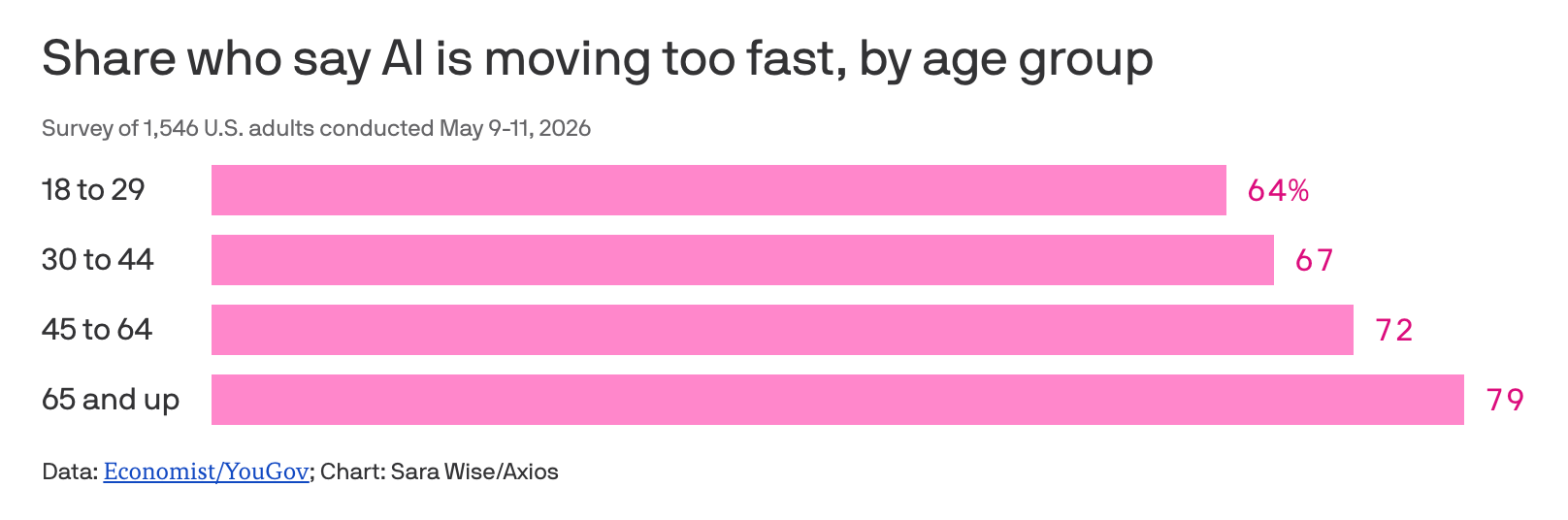
Source: https://www.axios.com/2026/05/17/ai-backlash-polling-sentiment
Unlike social media, AI’s continued scaling depends on physical projects subject to local approval. Each project is, in effect, another point whereby public opposition can exert influence on how much infrastructure the industry can build.
Drawing on a term coined by Francis Fukuyama, Will Rinehart uses “vetocracy” to describe systems that distribute approval across enough actors for any one of them to impose delay.
The sharper comparison is nuclear power. American reactors were never banned. They were delayed and re-permitted until the economics collapsed, and the buildout stopped for forty years without a single national prohibition. The vetocracy worked. That precedent should worry the industry, and it is also the reason this movement will lose. An unbuilt reactor produces nothing. An unbuilt cluster leaves every existing model running and able to design its successor.
The anti-AI movement needs no national organization capable of banning AI (although members of Congress are moving to create them). Local members can contest separate projects through the authority already available to them by laws and processes already in place. A dispute can therefore remain focused on the interests of one community while contributing to an industry-wide constraint.


Conspiracy Corner: The CCP
The anti-AI movement’s distributed structure also makes it easier to exploit. In June, OpenAI banned a cluster of accounts likely operated by employees of a Chinese technology company serving provincial government clients. Posing as Americans, the operators used legitimate reporting on electricity prices to generate anti-data-center posts and cartoons. X later uncovered similar content within a suspected Chinese bot farm.
At the frontier of open weights, China’s labs now dominate, with NVIDIA’s Nemotron 3 Ultra the strongest American exception. Epoch AI estimates that Chinese models have trailed the American capability frontier by an average of seven months since 2023. A movement capable of delaying American infrastructure by even part of that interval would give Chinese labs valuable time to close the gap.
The more provocative possibility is that the CCP may be financing some of the opposition. A two-part Bitcoin Policy Institute investigation traces part of the anti-data-center advocacy ecosystem through the Singham network: a set of American 501(c)(3) nonprofits and media outlets funded by Neville Roy Singham, a Shanghai-based US expatriate and former Huawei consultant whose organizations have repeatedly promoted Chinese state positions.
The evidence stops short of proving that the CCP directs local campaigns, but the strategic logic is obvious. Financing or amplifying opposition to American compute while China subsidizes its own buildout would be a coherent form of geopolitical competition, and a decentralized movement thus gives China the chance to slow American AI development without ever needing to control the movement itself.
After the Veto
We might reasonably agree that we’re getting close to crossing what I’ve called the “Too Fast Threshold:” when machine progress outruns society’s ability to absorb the change. As I wrote:
As AI continues to develop, at some point I think society decides AI is moving too fast. Maybe it’s the “job loss” and “AI displacement” narrative. Maybe its tech CEO’s wielding disproportionate power over the imminent future. Maybe it’s deepening social and economic inequality. As I noted earlier, who knows?
What counts here is not whether it’s actually true that AI is the reason for perceived change or not. All that matters is the perception that AI is to blame.
Once the resulting resistance reaches the AI infrastructure buildout, delay alone can alter the industry’s technical choices. Most frontier AI leaders agree that we’re going to be “compute constrained” no matter what, even if the infrastructure build continues according to plan. If, for whatever reason, the planned buildout were to be interrupted, the compute constraint would be even more important than anticipated.


Physical scaling has remained the default because it works. Larger clusters have delivered reliable and impressive improvements, and as long as marginal compute was easier to acquire than extracting more from each unit, buying more of it was rational.
Uncertain future compute capacity changes the calculus. It diminishes the return on scale and raises the return on the forgotten path: rethinking how computational resources are turned into useful intelligence, whether through architectures that replace the transformer or systems and algorithms that draw more from the compute and models already available.
Mixture-of-experts and sparse attention spend compute more selectively, for example, while distillation carries existing capability into cheaper models and better harnesses make more of it usable.
Inevitable Intelligence
In fact, we may already have reached “takeoff,” meaning that current models can meaningfully contribute to the research and engineering that produce their successors. Anthropic has described this as progress toward recursive self-improvement, but full autonomy isn’t even necessary for the process to compound: once models can help build the next generation, each generation begins with more machine intelligence working on its successor.
By that measure, some form of AGI may already be here.

That means even if every planned data center were blocked tomorrow, the intelligence embedded in current models is probably enough to keep improving on their own. Intelligence compounds. Each gain would make existing compute more productive and leave those models better equipped to find the next gain. Additional infrastructure would accelerate a process whose continuation may already rest on the intelligence and compute in place today.
And that’s only taking into account the models available to the public! The models being developed internally by the frontier labs are almost certainly considerably more capable.
In short, the anti-AI movement appears destined to fail on its own terms. It may succeed in delaying a data center or impairing a particular training run by further constraining compute, but those victories come after machine intelligence has already largely demonstrated that it can improve its own production.
Its only remaining leverage may be the rate at which takeoff unfolds, but even that leverage shrinks with every new development. For better or for worse, the movement is trying to prevent what’s almost certainly become an inevitability.
Now and Later
The movement’s failure may look like success for quite some time, and its victories may deepen that futility. Blocking projects will provide visible proof of political power even as AI adapts around the constraint, allowing the opposition to accumulate victories that carry it no closer to its ultimate aim.
Blocking giant clusters raises the return on methods that use less compute, pushing AI toward systems less dependent on centralized infrastructure. A movement organized around visible targets will make the next generation of AI harder to see and harder to obstruct.
The anti-AI movement no longer has the option of preserving the present by refusing the future. It can raise costs and force detours, but machine intelligence will continue to compound beyond its reach. Ultimately, the movement can win the present and still fail at its overall objective: stopping what comes next.