


April 16th 2025
Religious texts have, for millennia, explored life’s deepest questions – often those science has yet to answer.
Michelangelo’s “Creation of Adam,” for example, articulates the mathematical limit of humanity. Outstretched fingers extending to the asymptote of godhood – forever approaching but never quite touching divinity. Or the Tower of Babel, humanity's first cautionary tale about technological hubris – people building a tower to reach the heavens in pursuit of discovering God.
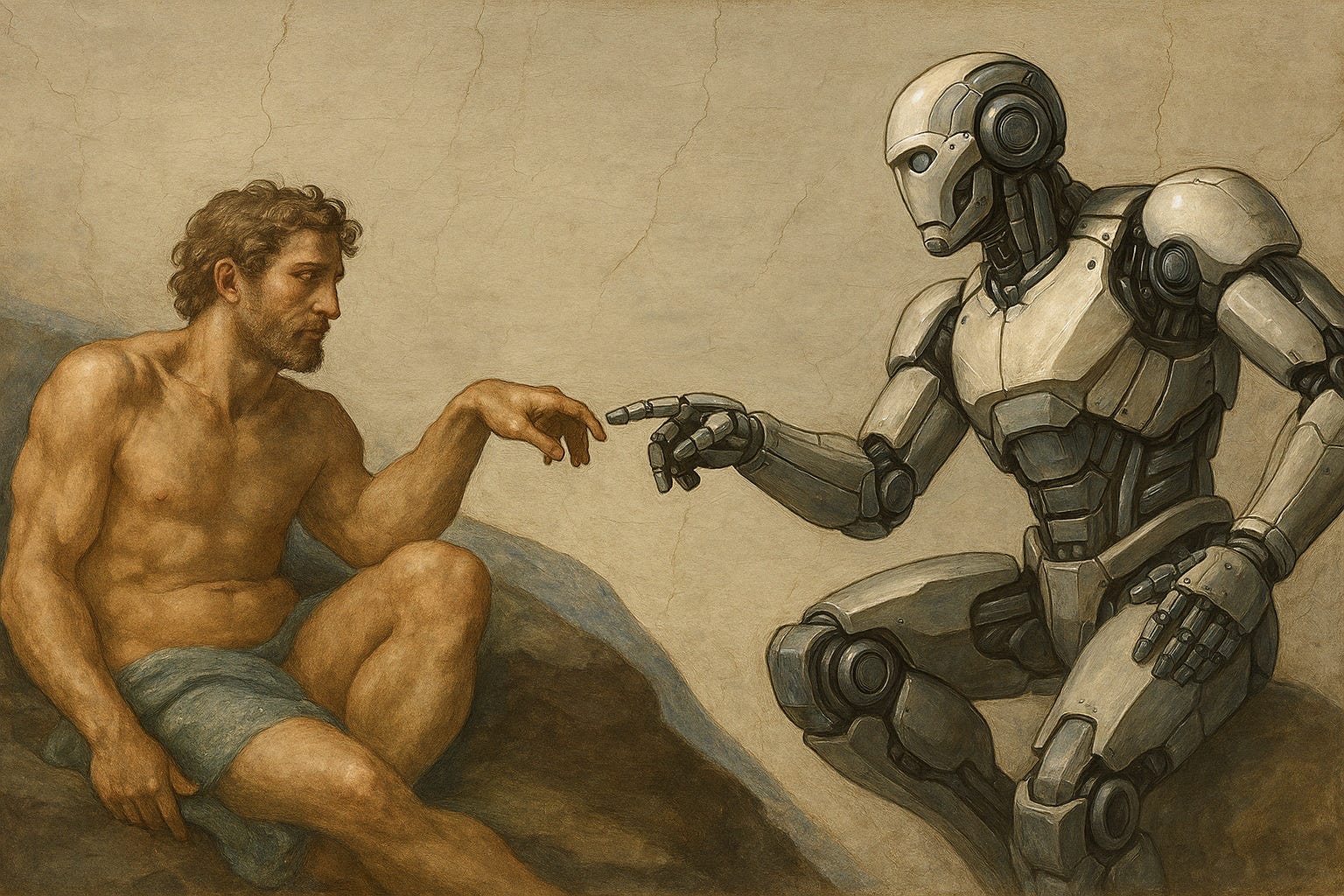
AI echoes these ancient themes. Like Prometheus stealing fire or physicists splitting the atom, we are again flirting with the creation of something powerful enough to transcend us.
Hence the extraordinary capital flowing into compute, chips, data centers, and foundational infrastructure. Amidst calls for ROI on all of this capex, two questions loom large:
Is AGI, superintelligence, or some form of God-like omnipotence actually possible?
If so, what might it (God / Infinity) be worth?
Faced with such immense power, potential, and influence, the instinct is often fear: to highlight flaws, vilify tech leaders, and imagine worst-case scenarios. Rightfully so, in some cases.
Indeed, the tech industry has spent decades centralizing power, computation, and data, and with AI they will attempt to reap what they’ve sown.
The most powerful AI systems are controlled by an oligopoly of tech giants with profit motives. They train on our collective data, deliver value to shareholders, and shape the future with little accountability. Centralized AI means single points of failure, narrow incentives, limited diversity in how intelligence is applied, and increasing concentration of power over how AI behaves.
If it’s as powerful as promised, no small set of operators should be entrusted with this power, let alone a single entity that wins the fabled “race” to AGI.
Instead, AI’s development should reflect the full range of human ideas, talent, and execution, unbound by corporate structures, regulatory jurisdictions, or other superfluous limitations.
Now, I’ll be the first to agree that AI’s current implementation is flawed. But we must avoid proposing alternatives that “solve” problems the market doesn’t value. I've seen this firsthand in crypto: principles alone don't drive adoption. Users won’t choose decentralization if the product isn’t better.
Put simply: decentralizing AI must add value – lower costs, better scaling, or greater efficiency – because ideals aren’t enough. Web3 proved that even with strong messaging around user control, privacy and removing middlemen, it’s impact (not intention) that moves markets.
Fortunately, the next decade will be defined by the convergence of several megatrends that do add value:
Open-source AI
Decentralized infrastructure (blockchains, P2P networks)
Crypto as a coordination and incentive layer
Edge computing
Individually disruptive and collectively transformative, this convergence will help democratize intelligence, reshape how technology serves society, and add enormous amounts of value.
Together, they enable a more intelligent and resilient architecture. The future of AI won’t be a single monolithic brain in the cloud. It will be tiered – a layered, distributed system where different levels of intelligence exist across the compute continuum.
You’re already seeing glimpses of this in products like Apple Intelligence. Lightweight models run on-device using the Apple Neural Engine, drawing on local context like health data, preferences, and private inputs. When needed, these agents escalate to Apple’s larger clusters in the cloud. It’s tiered intelligence in action: fast, efficient, contextual, and private (almost).

This isn’t decentralization for decentralization’s sake. It’s good engineering. Processing data locally is cheaper, faster, and more energy efficient. It reduces latency and removes the need to transmit sensitive data. Architecturally, it mirrors how we already manage tiered storage: cache what’s useful nearby, sync to the cloud as needed, escalate to bigger systems for more complex tasks.
More importantly, it unlocks new levels of functionality. A local model fine-tuned on your context can interact with a massive cluster model that holds the world’s knowledge. This is agentic coordination at scale. The result is a fluid, distributed intelligence system that’s both personal and planetary.
And with the rise of more powerful edge devices and specialized chips, local model clients are potent. This shift (from centralized servers to edge-powered agents) mirrors the evolution of the internet itself, from mainframes to personal computers, from centralized ISPs to mesh networks. The physics of compute are pushing intelligence out to the margins.
Before you take my word for it, history tells us what happens next. Closed systems dominate in the early days. Then open alternatives create orders of magnitude more value. The philosophy of openness and collaboration has always driven technological revolutions.
From UNIX and Linux to Python and Git, open systems have laid the foundation for modern computing. The web itself was built on open-source infrastructure: Apache, MySQL, WordPress, Wikipedia. Cloud computing, too, with Docker and Kubernetes rewriting the rules.
And today’s tech giants? They owe their scale to open-source. Google rides on Linux. Facebook’s stack is littered with open tools. AWS leans heavily on open software. Even Microsoft, once an open-source opponent, now embraces it. Apple’s core operating systems are built atop Darwin, an open kernel.
Nevertheless, these same companies (plus a few vaulted into their ranks by private capital) are now building walls around AI. Proprietary models, closed ecosystems, tightly controlled platforms. The playbook is familiar, but again, history suggests this won’t last.
Early computing was dominated by closed systems until open alternatives created orders of magnitude more value. The same will happen with AI. Just as Linux unlocked an explosion of innovation, open-source AI will enable applications today’s giants can’t imagine.
The first “aha” moments have been DeepSeek’s and Meta’s open-weight models. I can assure you these will not be the last.
As foundational capabilities become commoditized, the spotlight will shift from who owns the model to who builds the most compelling applications. A new ecosystem will emerge: specialized AI companies serving niche industries and use cases akin to the Web2 companies that emerged after internet infrastructure became widespread.
Think of Android. Built on open-source Linux, it became the most popular mobile OS on Earth, powering a vast commercial ecosystem. AI is headed down a similar path. Open foundations. Competitive layers on top. Differentiation through UX, data, design, and domain expertise.
The economic expansion will be massive. As intelligence becomes cheap and ubiquitous, previously impossible businesses become viable. Small companies, small teams, emerging markets, under-resourced sectors, the next unicorns…everyone stands to benefit. It’s not just about efficiency. It’s about access and competition.
Trying to capture the value of God in one company’s walled garden is blind greed fighting an uphill battle against the patterns of history. What’s more, it flies in the face of the growth and flourishing that will come from decentralizing AI.
From the industrial revolution through the web, open technologies have laid the groundwork for new eras of tremendous innovation and economic expansion. Instead of pouring unfathomable value into a few corporate treasuries, we can build public foundations that unlock thousands of use cases, new businesses, and unimaginable solutions.
What then is the value of God? Far more when it’s available to all than when it’s controlled and mediated by a small cohort of human authorities.
Dr. Steven Waterhouse
Nazaré Ventures