



If Stripe is to be believed, the “singularity” began January 1st of this year.
“While it’s clear that the changes will be vast,” reads the August 2026 Investor Letter, “nobody can know with specificity how AI will reshape our world. Many predictions from wise individuals have already been abjectly falsified.”
One prediction that has not been falsified, however, is that demand for tokens appears to be unlimited. Even before the industry began seriously entertaining the possibility of recursive self-improvement (RSI), AI was clearly a recursive technology in many ways, and especially when it comes to agents.
I wrote in April that AI was a technology that had “spawned its own user,” by which I meant that agents were “created” using compute, and as the largest consumers of tokens by a wide margin, they are now limited by that same resource.
The clearest downstream consequence of unlimited token demand is the thus-far correlated near-infinite demand for compute. In one of the latest “Cheeky Pint” podcasts, Sam Altman asks:
“How much compute can we productively throw at a single problem? A few years ago, it was impossible to throw more than a dollar of compute at a problem and have it help you at all…And then, we figured out chain-of-thought and the models could think hard about a problem and people really started using a lot of compute… Now, you can throw a whole team at something. And you can do that 10,000 times in parallel.”
But Sam’s in a particularly privileged position as it relates to compute. His company, OpenAI, is part of the oligopoly that controls the vast majority of the compute on the planet.
Dylan Patel, SemiAnalysis’s founder and CEO, said earlier this year that Anthropic and OpenAI would take as much as 40 to 50% of the incremental compute in 2027, and that the US accounted for roughly 70% of newly deployed AI data-center power, whereas China represented less than 10%. In March, for example, SemiAnalysis’s researchers reported asking every neocloud provider they knew for small clusters of compute, only to find that the capacity was already committed.


As of writing, Anthropic intends to IPO in a matter of days, and according to its amended S-1 filing, it has about $900 billion in compute contracted, running through 2045. Of course the reality of those contracts is more complicated than the topline aggregate, but roughly $1 trillion in expected contracted compute is a staggering figure.
Because one curious thing about extremely strong demand is that it’s rarely met with sufficiently ample supply, especially not in the “early” stages of a paradigm shift, before the industry in question has found its steady-state equilibrium. It follows that compute is a scarce resource, hence the extraordinary race to build out the infrastructure necessary to meet this demand.
Now, my job is to invest in promising young startups working in artificial intelligence, the most impactful technology paradigm of our time. Many of those startups need compute to pursue their ambitions. They have to compete with the likes of Anthropic and OpenAI for a critical basic input like compute, and they can’t commit $1 trillion to the cause.
How Compute Changes Hands
Several things happen when an industry and its participants encounter substantial constraints. For one, market dynamics evolve to coordinate exchange. It sounds trite, but Adam Smith’s oft-invoked “invisible hand” is most effective where constraints are most visible. That’s because intermediaries emerge to solve problems like discovery, liquidity, fungibility, quality assurance, communication, and settlement (among many others).
Market participants might pay more to get compute sooner (pricing power), for example, or commit to buying large quantities of it for years to secure future supply (economies of scale). Someone else, however, might be willing to wait, or sell capacity they no longer need. These preferences form the foundation upon which compute changes hands whether or not any more compute actually comes online.
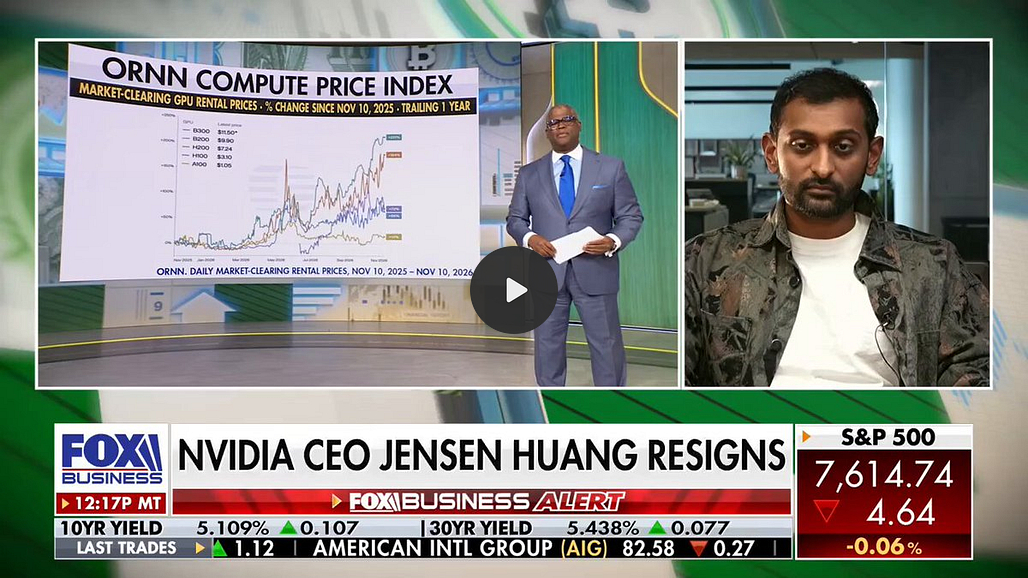
This is in large part why we’re seeing “compute markets” take shape. Ornn lets buyers reserve capacity and resell what they no longer need. Silicon Data’s rental benchmarks help participants judge what those commitments are worth and underpin the compute futures CME is developing. Architect, the startup founded by former FTX US president Brett Harrison, is also building its own compute derivatives market. These financial instruments would let buyers and suppliers hedge future rental prices, so committing to compute becomes less of a bet on what everyone else will be willing to pay for it next year.
A hedge fixes the price. Someone still has to get the actual compute into the buyer’s hands, and that takes brokerage and market making. Epilogue (disclosure: a Nazaré Ventures portfolio company) started as a GPU broker and is now building a compute exchange, seeded by its own market making. A market maker quotes both sides of a trade, so a buyer finds a price on the day they need capacity, whether or not a seller turns up that day.
These essential markets treat compute as a fungible asset, but I also wrote about how compute isn’t always fungible at the bare metal because no two units of compute are interchangeable. Vast.ai (disclosure: Nazaré is a seed investor) creates value in “provisioning” compute: matching workloads to hardware and checking that hosts deliver what they claim.
The Labor Market for Compute

In 2002 I was running research at Sun Microsystems focused on archival storage built on clusters of cheap AMD servers, and Sun’s salesforce hated it. Sun made its money selling $40,000 UNIX boxes, but my prototype, which Sun eventually shipped as the
In my opinion, a large share of the M&A activity in the AI industry is linked to a form of “compute arbitrage.” Because companies founded earlier in the AI boom may have multi-year compute contracts agreed to at (much lower) prices from 1-3 years ago, acquiring them means getting access to compute that has significantly appreciated in value. Now, the acquisition cost of course typically reflects the value of the compute, but the acquirers are buying the availability of the compute as much as they are the older strike price.
But finding someone willing to sell you compute doesn’t mean they can sell you as much as you want. Although markets have emerged to serve the myriad needs of compute buyers and sellers worldwide, there still isn’t enough to satisfy the entire market.
The Benefits of Adversity
In the same interview, Altman explores “token allocation” strategies, discussing how he approaches the cost and availability of compute internally at OpenAI. Referring to solving frontier math problems (and specifically the “Navier-Stokes” Millennium problem), Sam describes encouraging employees to push the limits, exploring what’s possible without constraints on their access to compute. But then he qualifies his assertion:
I think this is a thing that our company is particularly good at, but also fits an important property of the field: let people explore at the limit of what is possible, and then trust that the incredible optimization pressure will figure out how to do this in an efficient way.
He put the cost of the Navier-Stokes proof at around $10 million and bet that OpenAI could redo it a year later at one-hundredth of the cost. Sam is right that the principle he describes is an important property of the field. Whether the companies I invest in get access to compute or not, they must grapple with this property in everything they pursue. Every AI company has an incentive to make its compute go further.
Active readers will recognize this as what I call MACHA: Make AI Cheap Again. It’s the acute pressure applied by the industry and its competitive dynamics writ large to improve performance and lower costs, ultimately to capture value.
In many ways, compute-constrained entities, be they startups or not, share the properties of a country like China suffering from the scarcity imposed by a sanctions regime. Much though they would prefer otherwise, they cannot secure the compute they desire, and they’re thus forced to reckon with the prospect of doing significantly more with less.


I’ve written at length about DeepSeek and its innovative system design. The lab developed a way that computation and communication between chips could overlap, reducing the time processors spent waiting for information, dramatically improving how effectively the available hardware could train the model.
Subsequent open-weights models have built on that progress (including through techniques like distillation, as I wrote in October), and just last month Moonshot’s Kimi K3.1 Pro, a 2.8-trillion-parameter mixture-of-experts model that activates only about 104 billion parameters per token, scored 55 on Artificial Analysis’s Intelligence Index at launch, placing fourth overall and ahead of both Claude Fable 5.1 and GPT-6 Astra. Four days later, Artificial Analysis rebuilt the index around private test sets, and Kimi dropped to ninth, behind both. It still leads every model on Terminal-Bench 4.0, which tests agents working in a terminal.


The weights themselves weren’t released until November 4, but a Chinese open lab once again matched or exceeded key proprietary systems on agentic coding and other hard evaluations, operating under tighter compute and data constraints than the closed frontier labs.
Buying Compute on Demand
The economics of buying compute change when the same workload can run well on more kinds of hardware. If you can get more Nvidia GPUs today and put them straight to use, buying them may be the best return on your money. The more often you expect to run the same workload, the more attractive it becomes to spend some of that money making it run well elsewhere. You get the benefit every time it runs, and you have another supplier to call the next time you need capacity.
Not only are the frontier labs building their own chips, models themselves are apparently getting good enough to adapt themselves to the hardware on which they run. In its IPO roadshow, Anthropic says Mythos Preview brought prompt processing for one of its models on AMD MI355X GPUs to useful performance in approximately three days, against six to 12 months for its traditional approach.
I’m also hearing of some semiconductor companies using AI to engineer hardware at the kernel level for agents, which may usher in yet another era for semiconductor innovation.


Open weights do something similar at the model level. Several companies can serve the same model, and each can win business by figuring out how to serve it better. In October, OpenRouter, now owned by Stripe, changed how it chooses among those providers. It had largely favored the lowest advertised input-token price. It now takes into account what users pay in practice, how long they wait, and how often the request fails. In its test, the new system spent 6% more per request and cut the share of requests that hit a rate limit by 46%. There’s real value in getting an agent through its next step without having to wait and try again. A provider that figures out how to do that can earn more traffic.
In November, OpenRouter updated the system that chooses which model gets the request in the first place and how much reasoning to pay for. Think about how different that is from committing to buy years of capacity in advance. For some kinds of inference, you can wait until you know what the job requires before deciding how much to spend, which model to use, and who will run the job. The companies that make those decisions can give customers more choices and, in doing so, gain considerable influence over which model developers and compute providers get paid.
Where the Savings Go
The trouble with treating today’s shortage as a permanent feature of the industry is how quickly the amount of work you can get out of the same hardware is changing. This is the other overly relied-upon trope: the Jevons paradox. Cheaper electricity would help, of course, and there’s plenty of investment going into new supply. In the meantime, better chips and software can reduce the electricity needed to do a given job even where power prices are rising. A better model can make a job possible at the same budget that previously bought an unreliable result. Researchers measuring the cost of achieving a fixed level of performance have found declines of roughly five- to tenfold per year on several benchmarks. At that speed, a product that costs too much to serve today can have very different economics by the time a new data center comes online. Some of those savings will inevitably go straight back into compute. Like stock buybacks or reinvesting in the business, purchasing more compute will remain a sensible way to spend money for a long time.
From the same interview, for example, there’s an exchange between the host (John Collison, co-founder of Stripe) and Sam where they discuss Stripe’s token operating expenses:
Sam: You want to go spend all Stripe's profit on OpenAI services and then complain about this? I'd be delighted to have a conversation.
John: But we’re on a path to that! We now spend, you know, 1%-ish order of magnitude of Stripe's OpEx is tokens.
Sam: That feels too low.
John: Yeah. So, we're working on fixing it. And it'll get to 5%, and 10%, and 20%
Sam: Do you have an intuition on what the right number is? What it should be today?
John: What it should be today is maybe, tricky. But, steady state...isn't it going to be, 10s of percentage points of their OpEx?
Sam: I think for many companies, the answer to that is clearly 'yes.' And I think there will come a time when the right thing to do is to really optimize that. Also, another thing I'm proud of about OpenAI is—we've tried to really drive the cost per unit of intelligence down, and down, and down.
On OpenRouter, October token volume was nearly 25 times what it was in January, even as the effective price per token fell 57% for closed models and 70% for open weights. That’s one platform, and it gives some sense of how quickly the use of AI can expand while the price falls.
As the cost of getting a reliable result comes down, companies can afford to use agents for work they previously reserved for exceptional cases, or for work that was too expensive to do at all. The largest labs can put those gains to use on capacity they’ve already reserved. How much everyone else gains depends in part on how easily they can buy the capability as it becomes affordable.
Cheap Enough to Try
Jerry Neumann wrote recently about what happens when the same venture partners have much more money to invest. It can be read as a meditation on the power law and how oversized funds violate it, because a small check in a promising young company can earn an extraordinary multiple and still contribute very little to the return of a multibillion-dollar fund. At that size, partners have a reason to favor companies that can absorb more money, often after the business has already taken shape. The opportunity itself can be just as good as it was before, and success just as large in absolute terms, but almost worthless relative to the size of the fund, forcing the fund to reconsider an otherwise fantastic opportunity.
https://colossus.com/article/venture-is-dead-again/
Neumann makes a point about venture that’s easy to forget when the checks get big. You give a founder enough money to try something, then decide what to do with the benefit of having seen them try. Finding out you shouldn’t write a second check is, on balance, a perfectly good result.
Stripe’s investor letter says nobody knows how AI will reshape the world. In 2022, Pieter Levels was using Stable Diffusion to redesign rooms when, for fun, he trained it on photos of himself. It made him a medieval warrior. People started asking for portraits of their own. To find out whether they’d pay for them, he put up a $30 Stripe payment link. He could wait for an order, buy a $3 training run, and email the portraits himself.
Levels says his first provider raised the price of a run to $20. He took the job to Replicate, which started offering the same kind of training for about $2.50 a run. At that price, someone else could try an idea as strange as his before they had any reason to call it a business.
Altman says we can put 10,000 agent teams on a problem now, because the models and agents are good enough. But who gets to pick the problem? If securing compute takes a balance sheet that can carry years of it committed to in advance, we’ll learn little more than an extraordinary amount about the problems a handful of companies think are worth solving.