


The government set OpenAI’s release schedule this week too. An administration that ran on deregulating AI is now clearing access one customer at a time, and what it cannot switch off looks stronger by the week.
June 26, 2026 | Nazaré Ventures
Previous issues: #9 | #10 | #11 | #12 | #13 | #14
OpenAI previewed GPT-5.6 on Friday. The Information reported on Wednesday that Sam Altman told OpenAI staff it would reach a handful of partners before the public, at the government’s request. His memo the next day was precise: during the preview, the government would clear access “customer by customer,” with a wider release a couple of weeks out if the first one held. Commerce Secretary Howard Lutnick had already called Altman, after the company walked the agencies through its plan, to warn him off launching before the rest of the government signed off. The National Cyber Director’s office and the science-and-technology office had asked for the staggering; Commerce sent the warning. No one outside the room knows who is actually in charge.

The announcement confirms the account in OpenAI’s own words. The company says it walked the government through GPT-5.6 before launch and, at its request, opened access first to a small group of partners whose participation it disclosed to Washington. It says it does not want this to become the standard, that a clearance step keeps the best tools from the people who need them, even as it works with the administration on a repeatable process for the releases that follow. OpenAI calls the model dangerous enough in cyber and biology to ship with its strongest safeguards yet, while reporting that GPT-5.6 finds and patches vulnerabilities better than it runs attacks and never reached the autonomous-breach capability attributed to Mythos. By that measure it is less dangerous than Mythos was said to be, and it is getting the same staggered, government-cleared release anyway.
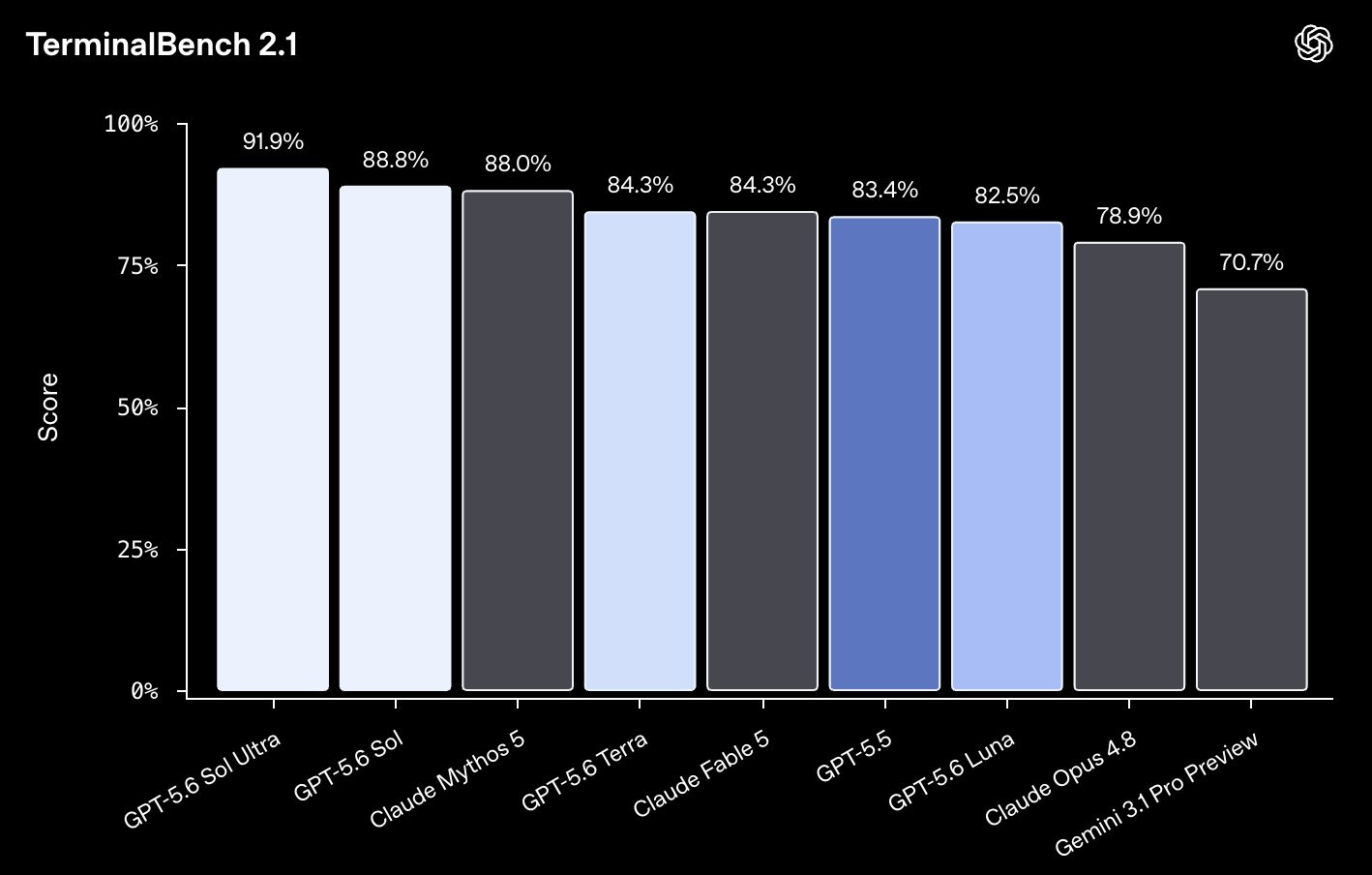
OpenAI ran GPT-5.6 against Claude Mythos 5 and Fable 5, the two models the government pulled two weeks ago and that no one outside a cleared list can currently run. On the headline coding benchmark Sol and its new ultra mode finish ahead of both; on the cyber exploit test its system card reports Sol competitive with Mythos Preview on about a third of the output tokens.
The same administration spent last December tearing up Biden’s AI order as an attempt to paralyze the industry, and promised something lighter. It has since built something heavier: top models now reach the public one cleared customer at a time, on Washington’s clock. When it pulled Fable 5 and Mythos 5 two weeks ago, that looked like a one-off. It no longer does. The government signs off before either lab ships its strongest model, and still calls the arrangement voluntary. Call it that if you like; the Commerce Secretary can still stop a launch with a phone call.
Anthropic’s two models have been dark for fourteen days, with no date for their return and no letter rescinded. Prediction markets put the odds of access before July a little above even. Last week I called the public security case thin and the response total. I was half wrong.

The Economist has since reported something graver. Senator Mark Warner, who vice-chairs the intelligence committee, says the NSA’s director told him Mythos broke into nearly all of the agency’s classified systems during an authorized red-team exercise, in hours rather than weeks. The reporter warned against reading it literally; the run leaned on other tools in particular conditions, and an official suggested Warner had the briefing garbled. Even marked down, it is worse than the jailbreak Anthropic could patch and forget. The model used its own capability to break in, which makes a stronger case for keeping it offline than anything the company first offered. The route back fits the new shape: under the June 2 order, Anthropic joins a classified pre-release framework for covered models on a sixty-day clock that ends near August 1, while an identity-verification rule from July 8 lets American users back in first. Amodei and the commerce secretary met at the G7, and the two sides are talking again. The models will probably come back, on Washington’s terms.
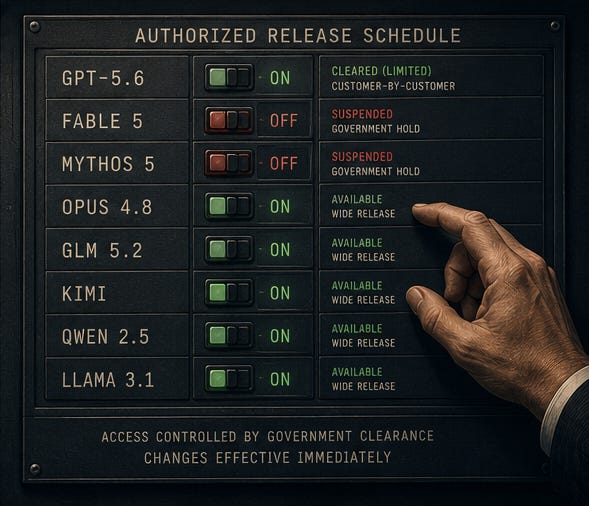
A year ago those terms would have bitten harder. The day the order landed, the replacements were already available. Inside a week, firms outside America had open-weight coding models running as a fallback: Cohere’s North Mini Code, Moonshot’s Kimi, and Zhipu’s GLM 5.2, the last of them shipped the following day. On June 22 Sakana said its Fugu Ultra had matched Fable 5 across most benchmarks by orchestrating models anyone can reach, with neither suspended model among them. You cannot recall a model people have already downloaded, and a system that routes around the frontier does not need it. That is the argument of my companion essay, and the week bore it out.
The licensed model
On June 10, the day before a Senate Banking hearing, Anthropic’s head of policy Sarah Heck wrote to the committee. Her ask, set in bold: Congress should codify export controls on advanced American compute. The directive that froze Anthropic’s own flagship models came two days later. The letter’s case was distillation. Alibaba, Heck wrote, had run 28.8 million exchanges through Claude on roughly 25,000 fake accounts between April 22 and June 5, the largest such effort Anthropic has caught, going after Claude’s agentic reasoning, software engineering and long-horizon work. DeepSeek, Moonshot and MiniMax had together run 16 million more earlier in the year. Anthropic wanted three things: export controls, antitrust cover to share threat intelligence with rivals, and penalties on the Chinese labs it named.
Look at what the numbers actually show. A competitor rebuilt Claude’s most valuable behavior through the front door, at the price of some fake accounts. The capability does not stay inside the company that paid to train it. Once it leaks through the API, no technical fix brings it back, so Anthropic is asking for a legal one: a rule that forbids a rival from using what it copied. That same rule happens to bar any competitor from training on Claude’s output, whether it cheated or not. The security case and the commercial case have collapsed into one. The rule buys Anthropic its place as the licensed model a buyer is cleared to use, leaving the Chinese open weights and the holdout labs on the other side of the line. A company that can’t stay ahead on the product gets the state to write rules its rivals can’t satisfy.
UBS found roughly 60% of enterprises have set limits on their token spending, capping runaway bills and routing routine work to cheaper models, the Chinese open-weight ones among them, while keeping the frontier for hard reasoning and long-context jobs. The premium tier is softening on price at the moment Anthropic asks Washington to fence off the cheaper competition.

Crypto got there first, and two firms show how it pays. Circle built USDC to fit the new federal rules: audited reserves, Treasuries, disclosure. Tether, run from offshore, never did, and the framework now favors the company that played inside it. Kalshi did the same against Polymarket, which had to stay offshore and lock out American users. The products were close to identical. The license decided who won. Fable and Mythos may come back or they may not; either way Anthropic is the safe default, as long as buyers agree that the model worth using is the one Washington has signed off on.
What money can’t buy
On June 24 OpenAI and Broadcom unveiled Jalapeño, OpenAI’s first inference chip. The two took it from design to tape-out in nine months, with OpenAI’s own models doing part of that work, and call it the fastest ASIC cycle ever run. Nvidia still trains the models; the chip cuts OpenAI’s dependence on the supplier every frontier lab relies on most. Vertical integration is close to the only move these companies have. Pushing a model to its limit takes chips, data centers, and power on a scale only a handful of companies can finance, and at that scale owning the hardware beats renting it, which is why the giants have built their own silicon one by one, OpenAI among the last to do it. A few large, named companies hold most of the capability. The same size that makes them powerful lets a state pressure them directly, as the freeze on Anthropic’s two models showed.
The labs accept that exposure because the structure pays. The product holds the customer in place: the context it has gathered, the memory of past work, and the tools wired around it, each one raising the price of leaving. So the labs do for themselves the move they would rather their customers not make: OpenAI spends heavily to reduce its dependence on a single supplier while selling a service whose worth grows the more completely a customer depends on a single provider. Moving between providers only swaps the dependence; an open-weight model ends it, because the user holds the model instead of permission to reach someone else’s. As frontier access narrows toward a short list of approved companies, those downloadable weights pull the other way, the one option the labs’ margins and Washington’s control both oppose.
The transfer market
Noam Shazeer left Google for OpenAI on June 18. He had been back at Google barely two years, brought in through a 2024 licensing deal for Character.AI that valued the startup near $2.7 billion, a price many read as the cost of installing him atop Gemini. He goes, and the last of the eight authors of the 2017 transformer paper, the design beneath every large model now running, has left the company that published it.
A day later John Jumper, a 2024 chemistry Nobel laureate for AlphaFold, left DeepMind for Anthropic after nearly nine years. Within days Anthropic also took on Chad Jones, the Stanford economist whose work on idea production and long-run growth is the reference point for what AI might do to output; he leaves Stanford on June 30 for the firm’s research institute. The lab Washington had just put under export control spent those same weeks hiring the people likeliest to build whatever comes after.
Google, meanwhile, sat on Gemini 3.5 Pro past the date it had set at its own developer conference in May, and a frontier that had shipped something most months for two years fell silent. With nothing launching, the real news about the next model was who would build it, and where.
You can hold a model still. It sits in a data center, answers through an interface, and goes dark when a letter arrives from Washington. The people who make it hold still for none of that: an export rule cannot reach them, a vesting cliff loses to a better offer, and the next thing leaves in their heads when they go. Google paid $2.7 billion for one of them and got two years of his work. OpenAI got what comes next.
Portfolio
Prime Intellect
Prime Intellect released prime-rl 0.6.0, an open framework for reinforcement learning on agentic workloads at trillion-parameter scale. The headline run trained GLM-5 on software-engineering tasks at 131k sequence length, with sub-five-minute step times and a batch of 256 rollouts, on twenty-eight H200 nodes, using a stack of FP8 training, expert and context parallelism, and router replay that the team open-sourced in full. The specifications are striking, but they are not the news. The hard part of post-training a frontier-scale open model, the systems engineering that until recently lived only inside the closed labs, now runs in the open on hardware a determined team can rent. The open track has gained the capability skeptics said it lacked.

Vast.ai
Vast.ai brought NVIDIA’s Blackwell Ultra to the fleet in its June update, adding the B300, with 288GB of memory, and hundreds of B200s, rentable by the hour or reservable long term. The newest accelerators are reaching independent operators and small teams in the same quarter the hyperscalers are filling their own buildings with them. Frontier compute is decentralizing.
LayerLens
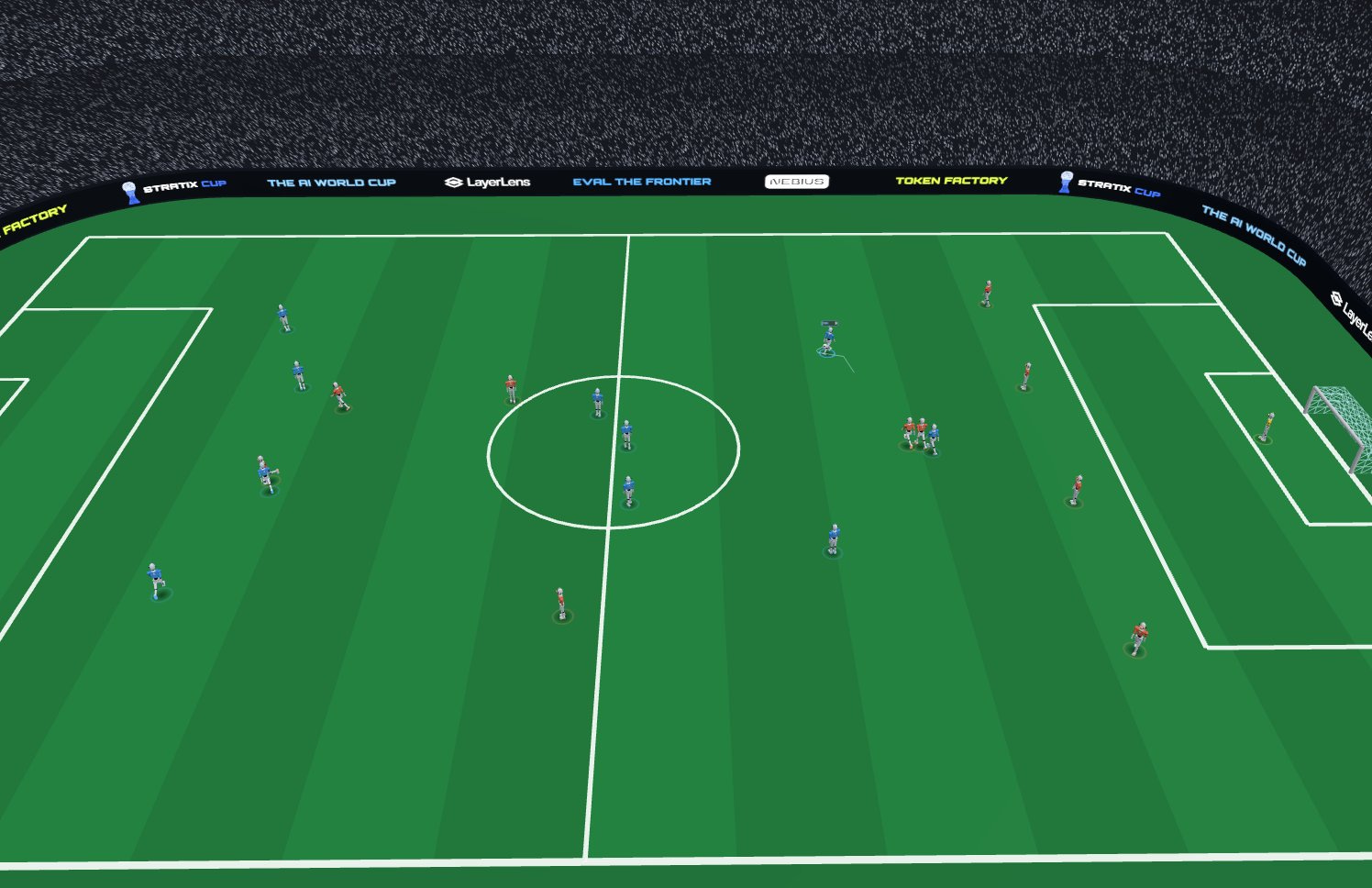
LayerLens is running its Stratix Cup, a live tournament in which frontier models, Opus 4.8, GPT-5.5, GLM 5.2, Gemini and others, write and revise their own strategies in a simulated match, with the full trace of every decision published and graded. The group stage ran this week. In a month defined by the government switching off a capability, LayerLens runs the other way, publishing exactly what each model did. As models multiply, that independent, vendor-neutral record turns into production infrastructure.
What the week showed
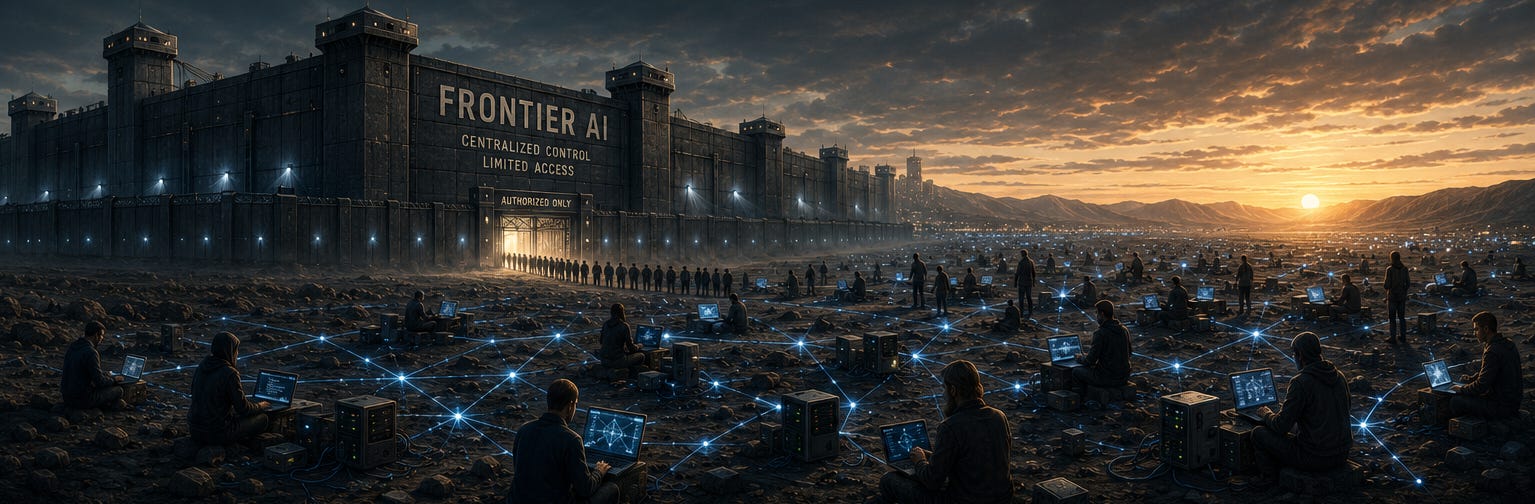
Fourteen days in, Anthropic’s two models are still dark, but the order forcing the company to revoke access got no further than those two models. Everything else sits past the order’s reach, because none of it runs through a single company Washington can lean on: the open weights people already pulled down and no order can recall, the router that matched Fable 5 without either suspended model, the trillion-parameter training run on a cluster anyone can rent, the newest chips going out by the hour, the behavior ledger no lab owns, the researchers who left with the next model in their heads. None of it stopped, and the fortnight that began with two dark models ended with everything around them stronger.
thanks for the post guys. we actually rely on Nazaré's opinion a lot when making our VC intel brief.
The Anthropic policy letter framing is the most uncomfortable insight in this piece. A company asks Washington to codify export controls on compute two days before Washington freezes its own flagship models. The security case and the commercial case have collapsed into one: the rule that bars Chinese labs from training on Claude's output also bars every other competitor from doing the same thing. The licensed model is the one Washington has signed off on, which happens to be yours. Circle vs Tether is exactly the right analogy.