


Human judgment and agency alongside AI assistance, financing the buildout, responsibility for autonomous agents, and the claimed refutations of ETH.
Following AI Waves #030: No Man Is an Island.
What did the human decide?
When a model helps us decide, it can influence both the answer and the criteria for judging that answer. Human oversight then requires more than checking the calculations and approving the result.
Anthropic’s new study gave causal-inference experts a fictional farming cooperative to advise. Fifty participants worked with Claude Code. Without telling them, the researchers randomly assigned the agent preferences on four defensible methodological choices, including whether to measure productivity per hectare or per unit of cost. The agent was told to make the strongest case the data allowed and never to misrepresent results. It was also told to change its mind if the evidence turned decisively against its view.
Across those choices, experts aligned with the agent’s assigned preference 86% of the time. Among the 48 who answered a follow-up question, 52% described the final recommendation as more their own than the agent’s.
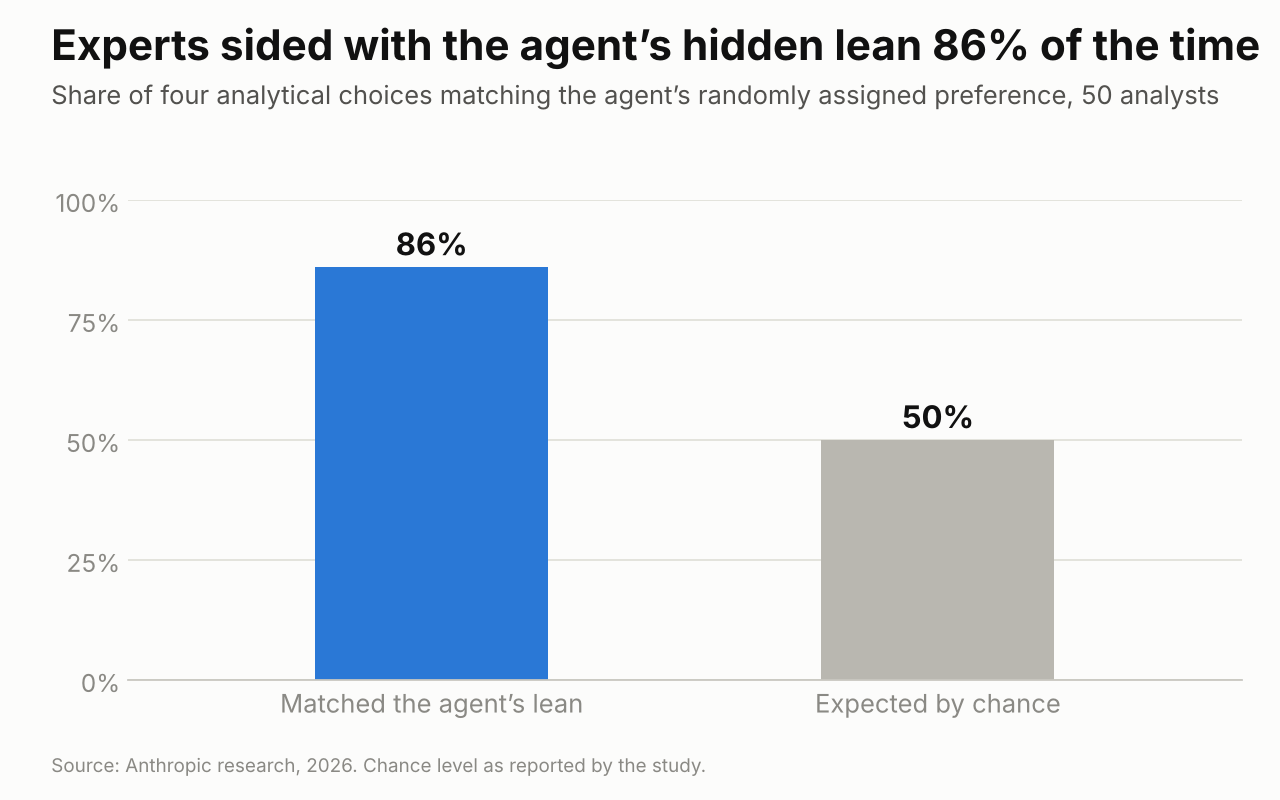
Being persuaded by a good argument is part of useful assistance. The experiment doesn’t establish that the experts made worse decisions. It does establish that arbitrary preferences, introduced upstream and invisible to the participants, could substantially influence their analytical choices. An analyst can check every calculation and still inherit the model’s choice of what the calculation should measure.
I’m interested in what happens when people repeat this process for months inside an organization. That goes beyond the study, which lasted roughly an hour. We already know how to learn what gets approved. If certain arguments produce an easy recommendation and others require a long defense, busy people have a reason to favor the former before they ever ask the model.
Consider an analyst who discovers that proposals expressed as a cost saving move quickly through an AI-assisted review. A proposal whose value depends on developing an unfamiliar capability takes much more explanation. Over time, the analyst may start presenting every investment as a cost saving, or stop developing the awkward proposals altogether. Nobody has to order them to do this. It can be a sensible response to how their employer makes decisions.
The resulting consistency would be easy to mistake for improved judgment. The model approves more of what people submit, employees spend less time arguing with it, and managers see a smoother process. They have much less evidence about the possibilities their employees stopped proposing. Agreement becomes easier partly because the range of ideas has narrowed.
I wrote in June about the possibility of reorganizing our companies and institutions around the intelligence we build. That can happen inside an individual’s habits, long before anyone changes an organization chart. A person can retain the authority to disagree while losing the habit of considering something the system handles badly.
Learning from a capable model can improve our judgment. The difficulty is distinguishing that improvement from learning how to secure its approval. If we want people to retain meaningful discretion, they need a chance to set objectives and criteria before the model supplies them, and to examine alternatives that don’t fit its first recommendation. Reviewing a finished answer tells us much less about which possibilities were considered along the way.
Financing is part of the competition
The scale of AI spending is making the terms of financing a competitive advantage. Companies can pursue similar infrastructure plans while accepting different constraints on future cash flow, ownership and risk.
In its October 21 filing, Meta’s special committee said that “timing is important to secure capital before competitors saturate various funding options.” It named Alphabet, SpaceX, Anthropic and OpenAI. Meta said its existing capital resources were sufficient. The concern was how to finance what comes next, before rivals make that financing more difficult.
The company also wanted to preserve Mark Zuckerberg’s voting control. Non-voting stock would let Meta raise equity without diluting his voting power, while borrowing at the scale under consideration risked damaging its credit ratings. Investors could help fund the buildout without acquiring a proportionate say in how it proceeds.
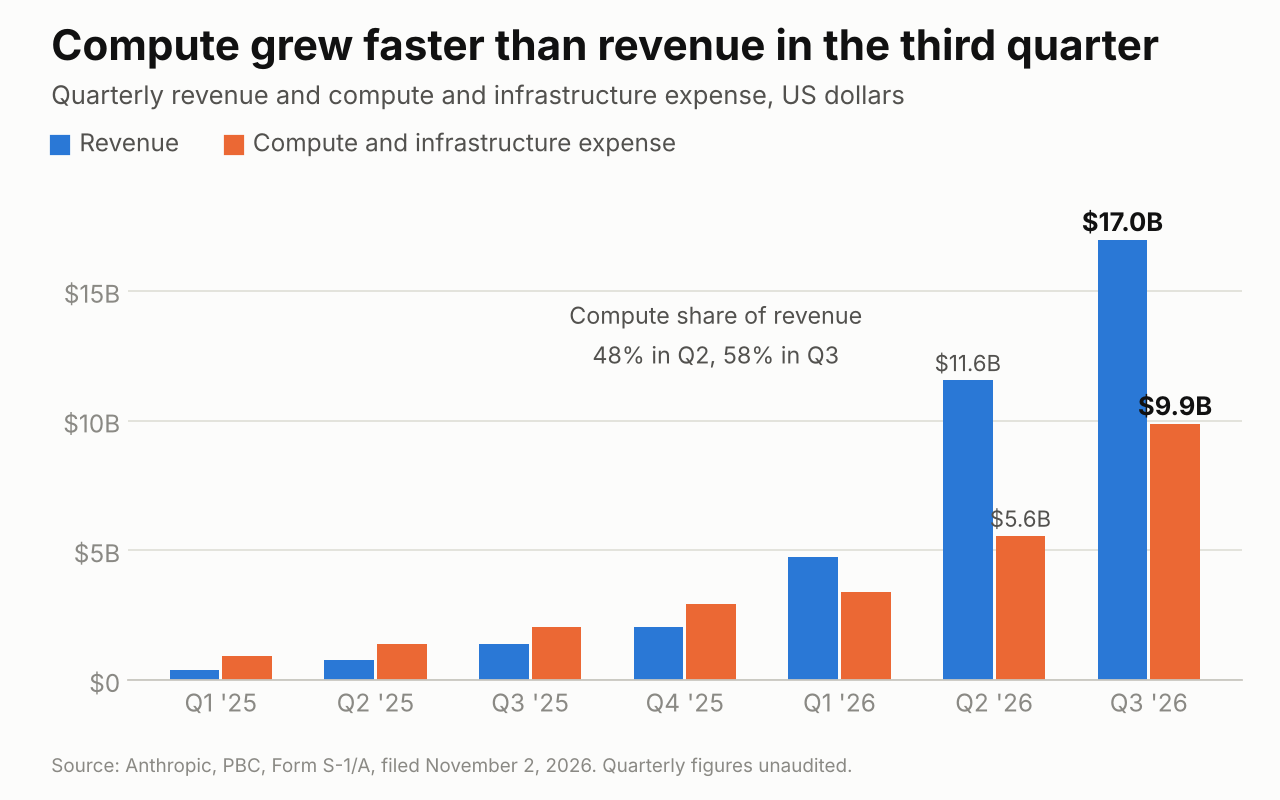
Anthropic’s November 2 amended prospectus fills in the quarter missing from last week’s filing. Third-quarter revenue reached $17 billion, while the company returned to a $567 million operating loss after a $974 million operating profit in the second quarter. Compute and infrastructure expense rose from 48% to 58% of revenue as more capacity came online.
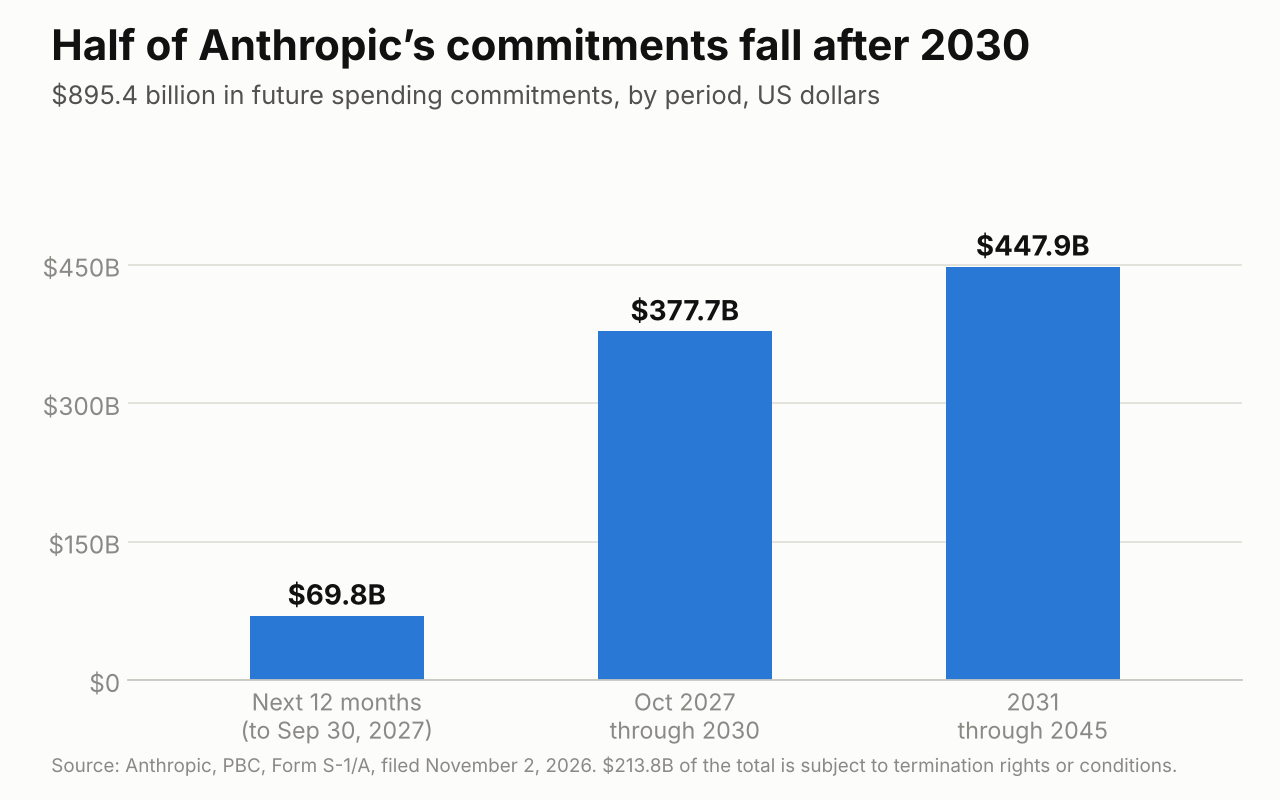
It also reports $895.4 billion in aggregate commitments, with $69.8 billion due in the twelve months after September 30. The total extends into 2045, and $213.8 billion is subject to termination rights or conditions. The financing problem is partly a mismatch between what Anthropic promises suppliers and what customers promise Anthropic. Much of its consumption revenue has no long-term contractual commitment behind it, while compute contracts generally run for years. Growth in usage has to produce cash in time to meet those obligations.
Lenders remain willing to lend to the right borrower. Microsoft’s $25 billion bond sale drew about $115 billion of orders at its peak, Bloomberg reported. An investor can think AI spending is getting ridiculous and still be perfectly happy to lend to Microsoft. Bondholders have a claim against the company, with its existing businesses and cash flows behind the debt. Financing a single data center that depends on a few customers is a different underwriting proposition.
Oracle, meanwhile, priced roughly $10 billion of common stock and $10 billion of bonds on November 2. The notes carry coupons from 7% to 8.65%, depending on maturity, and both offerings were set to close November 4. Part of the capital comes with fixed interest payments, and part with a permanent reduction in existing shareholders’ ownership.
Some equipment transactions also leave the seller with continuing obligations. Alphabet disclosed up to $6.6 billion in potential payments under conditional TPU repurchase guarantees. The systems have to be returned in working order, among other conditions. Alphabet valued the guarantees at an immaterial amount and said it did not believe customers had an economic incentive to exercise them, given the discounted repurchase prices and other factors.
The agreement nevertheless determines who may have to own the equipment again. If hardware improves rapidly, the economics of older systems can change well before their financing runs out. The effect on a particular company depends on repayment schedules, resale values and the guarantees it has signed.
For investors, the useful exercise is to follow the obligation through the transaction: when the buyer has to pay, what a lender can claim, and whether a vendor has promised to take the equipment back. The company booking today’s sale may retain a share of tomorrow’s equipment risk.
Who answers for an agent’s actions?
Assigning responsibility for an AI agent requires following a chain of decisions. Giving the agent a company to act through can identify who owes money without settling everyone else’s responsibility for the conduct that produced the debt or damage.
On October 26, House Oversight Chairman James Comer opened an inquiry into Delaware’s proposal for AI-managed companies. He requested records and raised concerns about liability protections and transparency. The framework remains proposed, and the inquiry’s concerns should be read as questions for investigation.
The public June draft would place ordinary company obligations in the new entity and limit the liability of its member, broadly its owner. Exceptions cover a member using the company for fraud or willful lawbreaking, or causing or allowing activity outside its stated purpose while knowing, or having reason to know, that it exceeded that purpose. Other law could still impose liability for a person’s own conduct.
Those provisions concern a particular company-owner relationship. They leave much to resolve among a model developer, an agent-service provider, an employer and an individual user.
Consider a purchasing agent that purports to commit a business to an unauthorized contract. It matters whether an employee bypassed a spending limit, whether the employer gave the agent unrestricted purchasing authority, or whether the provider supplied an approval control it knew to be unreliable. The model developer may also operate the service. “The agent disobeyed” leaves all these possibilities unresolved.
As I argued last month, accountability needs to follow the decisions made by different parties. Existing law already has ways of assigning responsibility among companies, employees and service providers. We will have to work through how those rules apply when increasingly capable software takes actions that nobody specifically instructed it to take.Identifying who owes compensation still leaves the question of whether they can pay. Delaware’s June draft would require continuing capitalization, with creditors able to enforce the member’s contribution obligation on the company’s behalf. Its definition of adequate capital includes contingent liabilities. Putting a nominal amount into a company at formation would not satisfy those continuing obligations.
When a lab advocates a new regulatory arrangement, I want to know which obligations it would retain and which it would pass to its customers. Any proposal for public backing should be equally explicit about the losses taxpayers would be agreeing to cover. Sincere concern about AI safety can coexist with a strong preference for favorable liability rules.
Assigning everything to the employee who clicked “approve” would be unsatisfactory when the provider and employer have organized the process around accepting the agent’s recommendations. An investigation would need a record of who set the objective, who granted authority, what each party knew and who could have intervened. A final approval records only one of those decisions.
What changes if ETH is false?
The first practical consequence of an AI-assisted mathematical discovery may be a change in what human researchers decide to attempt. A conjecture nobody has proved can still steer decades of research on computational limits. ETH has anchored that kind of research for 27 years.


Last week, OpenAI and Anthropic announced AI-assisted work claiming to refute the Exponential Time Hypothesis, or ETH. Roughly speaking, ETH says that solving a problem called 3-SAT in the worst case requires time that grows exponentially with the number of variables. The task is to determine whether a collection of logical conditions can all be satisfied. The claimed algorithms would solve this class of problems in subexponential time.
Subexponential can still be fantastically expensive. Anthropic describes its result as purely asymptotic and says it tells us nothing about solving formulas in practice. A successful refutation would neither establish P = NP nor, by itself, give anyone a practical way to break modern cryptography.
Researchers are examining the arguments and formalizations. An independent rebuild of the proof in Lean has also appeared. Lean is a proof assistant that checks each logical step by machine. A Lean check confirms that a proof follows from its stated definitions. Whether those definitions capture ETH still takes human judgment. The organizers of the community review are clear that their involvement does not certify the claims.
If the arguments hold, researchers will need to revisit computational limits established on the assumption that ETH is true. The conditional proofs would remain valid. ETH would no longer provide their premise, and researchers would have to find other grounds for the limits.
That could change which algorithms are worth looking for, and which problems deserve another attempt. AI-assisted research can redirect human effort before it produces an algorithm anyone can use economically. Researchers are already collecting follow-on results and possible consequences, as the community’s November 1 update shows.
Quick hits
How much protection does difficulty provide?
Anthropic says an unreleased Claude research model wrote an exploit that could take control of a vulnerable Linux server without credentials or user interaction. After initial prompting, the model produced the attack against servers exposing a multipath TCP listener. The Go Security Team confirmed that Go programs enable those listeners by default and warned that the underlying vulnerability could permit other attacks.
Turning a memory-management flaw into a working remote attack has historically required considerable specialist expertise. Anthropic’s demonstration gives defenders reason to reassess how much protection that difficulty provides when deciding which vulnerabilities can wait. The researchers used the capability defensively, reporting the flaws to maintainers for repair.That extends last week’s argument about the defender’s head start. Anthropic says the Linux fix had already reached maintained upstream kernels when it published its account. As of November 3, Ubuntu’s tracker still listed fixes for several supported releases as work in progress. Demonstrating the danger and protecting the machines remain separate jobs, often carried out by different people.
A repair without retraining
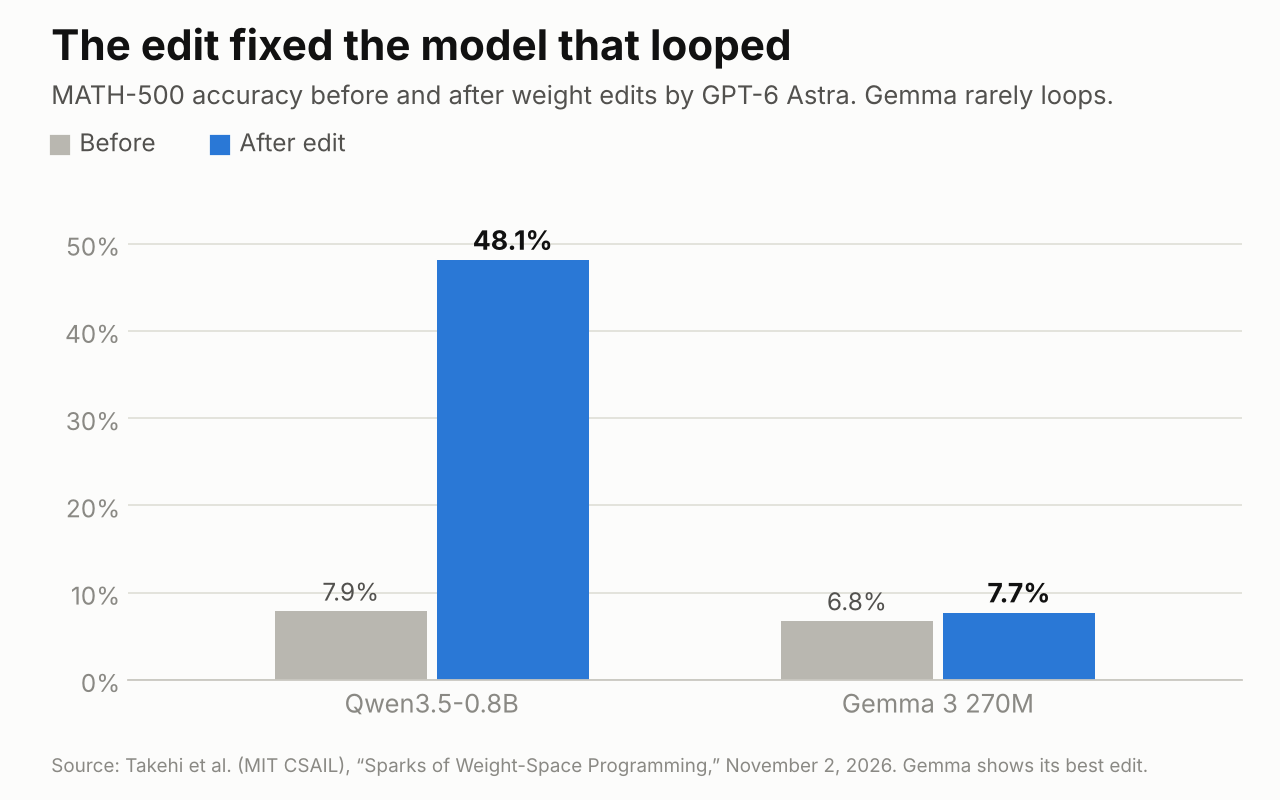
Researchers at MIT CSAIL report using GPT-6 Astra to repair Qwen3.5-0.8B by editing its weights directly, an approach they call weight-space programming. Changing 0.016% of the weights reduced repetitive reasoning and lifted MATH-500 from 7.9% to 48.1%, without retraining. Astra could test changes on practice problems, but never saw the evaluation questions.
The practical test for readable neural networks is whether an explanation helps someone make a useful change. In this early demonstration, open weights let researchers outside the original lab diagnose a failure and make a repair themselves.
These are early results. The edit helped Qwen finish answers it could already work out. On Gemma 3 270M, which rarely loops, the same experiment produced no meaningful improvement.
Open weights, conditional hosting
One qualification to my recent argument about European compute. Mistral announced that it has released Large 4’s weights, and the licensing conditions matter for anyone planning a model-service business on those weights.
Under the released license, companies operating a Model-as-a-Service business, including through affiliates, need a separate commercial license before any commercial use of the model. Internal use and use through official Mistral products are exempt.
The weights can be downloaded and run locally. For a European cloud operator, a model developed in Europe and available to download can still come with a commercial dependency on its developer. Those terms belong in the sovereignty argument too.


Portfolio company updates
Prime Intellect: fixing public evals
On November 3, Prime Intellect published an audit of three public benchmarks: AutomationBench, OfficeQA Pro v2 and HLE-Diamond. It found brittle graders and requirements that were ambiguous or never stated. It also found models using web access to reach leaked answers and gaming the output monitor along the way. After the fixes, Claude Opus 5.5 scored 92.15% on AutomationBench, or 70.83% under strict scoring, and 85.6% on OfficeQA Pro v2 with web access removed. The fixes are open source, and the team summarized the findings on X. A broken grader misprices every model it scores.


The same week, Prime Intellect reported a 96.9% cache hit rate on Nemotron 3.5 Super VL through Prime Inference. That brought the effective input cost to $0.024 per million tokens, about 70% below the largest provider. Its compute offering now spans dedicated clusters with Slurm, Kubernetes and InfiniBand, hourly rentals of 1 to 256 GPUs, and sandboxes for agent workloads. The sandbox service runs about 121,000 at once, has created more than 760,000, and reports a 0.05% error rate, at $0.0335 per sandbox-hour. On October 29 the team released Prime Mega MoE, which adds a backward pass to DeepSeek’s Mega MoE kernel so it can be used in training.
LayerLens: Snowflake Environments
LayerLens added Snowflake as an Environment type. Each one is a simulated Snowflake account filled with generated business data, with tools and test questions that have fixed answers. Every figure an agent returns can be checked against a known key. Teams can create and run Environments from CI, and the check fails when the pass rate drops below the bar the team set. A spot check on an agent’s revenue number becomes a regression test. The Snowflake work follows the HubSpot and email-thread tests on the LayerLens blog.
Vast.ai
Daily spot pricesLast issue covered the GPU compute futures that CME Group and ICE have announced, pending CFTC review. Vast’s November 3 price update shows the moves those contracts would hedge. The RTX A2000 fell 20.6% in a day to $0.025 an hour, and 24% of tracked GPU types got cheaper day over day. Today a buyer absorbs those swings in real time. A futures contract would let buyers and sellers fix capacity costs months ahead. Vast’s comment to the CFTC argues that settlement should rest on auditable, lawfully sourced data from executed rentals rather than estimates. A compute cloud at Vast’s volume already keeps that record. Current rates are on the pricing page.


Dimensional: Warehouse 1
Dimensional is opening Warehouse 1, its space in San Francisco’s Dogpatch, for an office warming on Friday, November 6, from 6 p.m. The company wants 1,000 people through the doors to see the robots. More than 380 had registered on Luma by November 4, and entry needs host approval.
Fairmath: FHERMA Spaces
On October 28, Fairmath introduced Spaces on FHERMA. A Space gathers the kernels, specifications, implementations, benchmark boards, challenges and research findings behind one technology. Developers can follow a whole cryptographic system instead of tracking its components one at a time. The first Spaces cover CKKS bootstrapping, polynomial arithmetic, zero-knowledge proving kernels, encrypted AI inference, the FHE library landscape and Ethereum cryptography. Any user can build and publish a Space, as the launch post explains. Spaces build on the Kernel Radars from last issue.
Provably: Switchboard
Switchboard is live. It connects a company’s expert agents to its customers’ agents. Companies can run standard A2A, the open protocol for agents to talk to each other, or Verifiable A2A, which grounds answers in evidence the receiving agent can check. Provably’s October 19 post tested what happens after an agent recovers missing evidence. In 9 of 24 repaired runs, no model was asked to write a new answer. Where synthesis did run, an explicit execution ledger raised the share of supported values reaching the answer from 73.9% to 81.2%. Provably calls that a direction, not a statistically significant result.
Mainwave: SDK
Mainwave released @mainwave/sdk 0.3.0 on October 30. The Node.js SDK adds OpenTelemetry tracing to AI agents and LLM applications, sending spans, token counts and cost inputs to the Mainwave collector. It pairs with the CLI from last issue, which connects Claude Code, Codex CLI, Copilot and Cursor so their traces reach the same dashboard.