


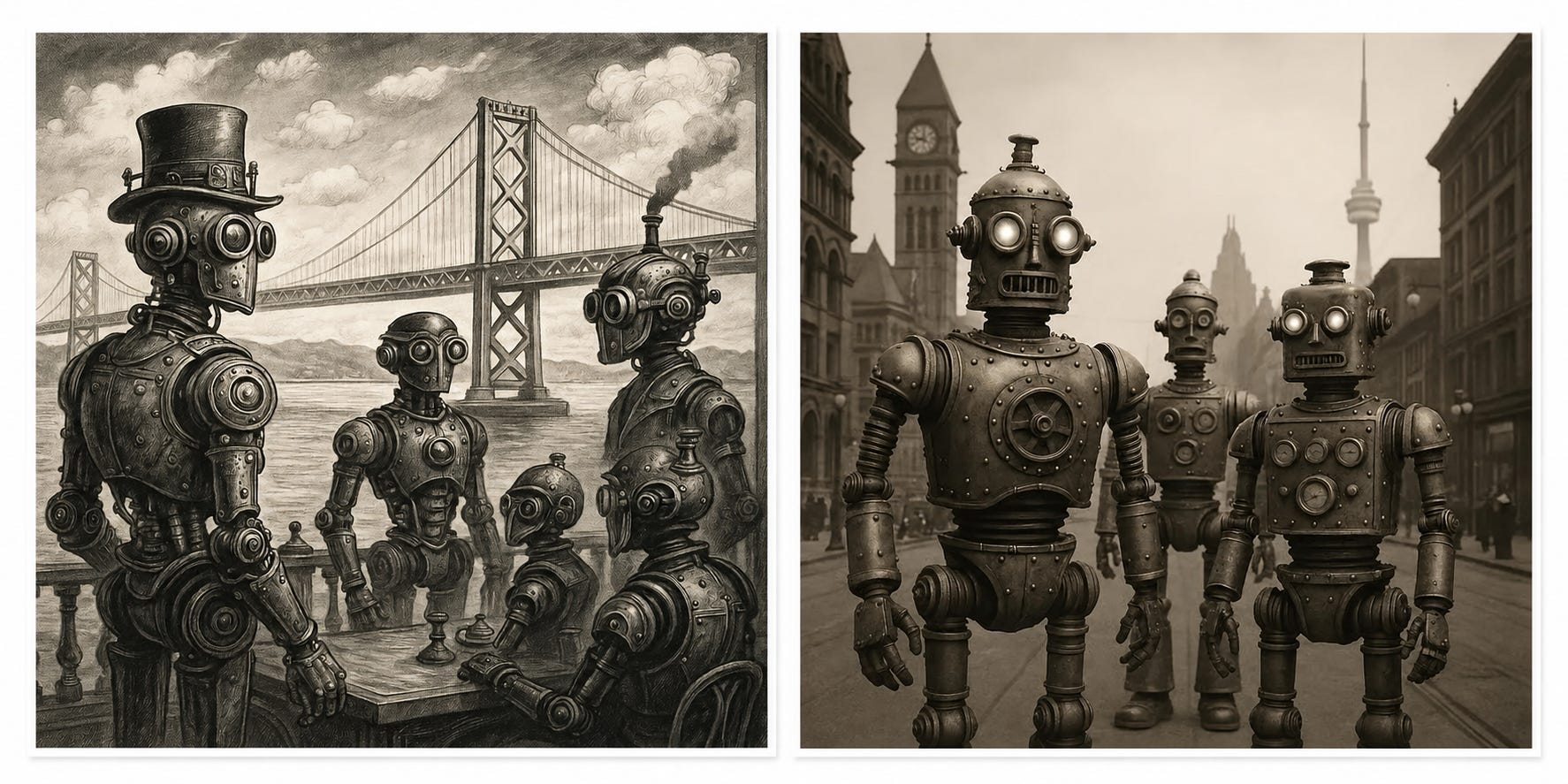
I have been decorating Robot Wave with steampunk imagery since the first issue, and I have never really explained why.
Steampunk represents a specific kind of futurism: the future imagined through the machinery of the present. I often think AI discourse is unwittingly channeling H.G. Wells, imagining the next century with today’s machines before the science of intelligence is fully understood.
You know the syllogism, because it’s currently organizing a few trillion dollars of capital: scaling leads to AGI, AGI leads to recursive technological acceleration, and the resulting superintelligence gets to work on the Dyson sphere, the star-scale energy harvester that has become the timeline’s favorite retirement plan for humanity. Indeed as AI 2027 predicts in the hopeful version of its 2 endings:
“The rockets start launching. People terraform and settle the solar system, and prepare to go beyond. AIs running at thousands of times subjective human speed reflect on the meaning of existence, exchanging findings with each other, and shaping the values it will bring to the stars. A new age dawns, one that is unimaginably amazing in almost every way but more familiar in some.”
and in the not so hopeful version where the robots wipe us out:
“The new decade dawns with Consensus-1’s robot servitors spreading throughout the solar system. By 2035, trillions of tons of planetary material have been launched into space and turned into rings of satellites orbiting the sun.”
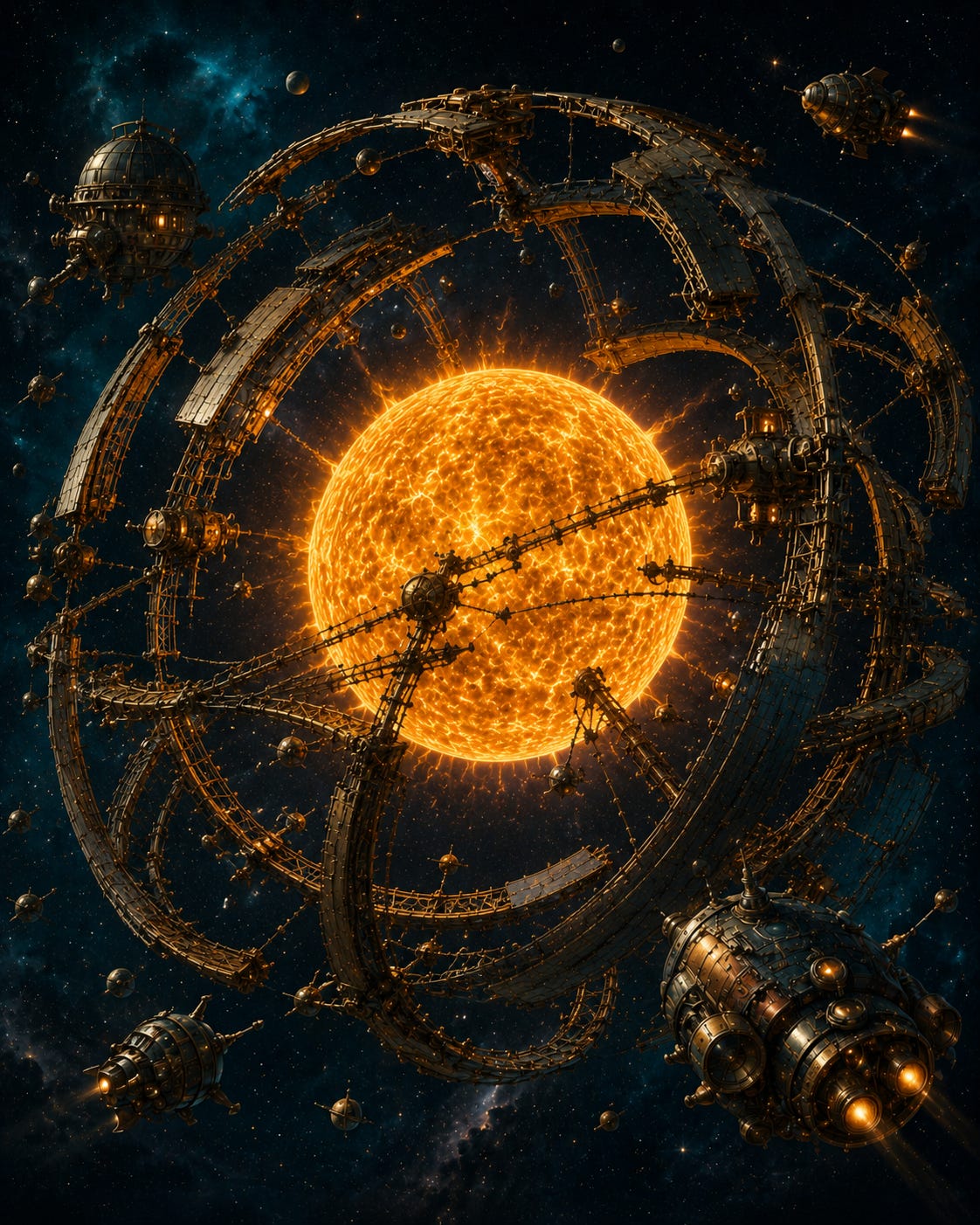
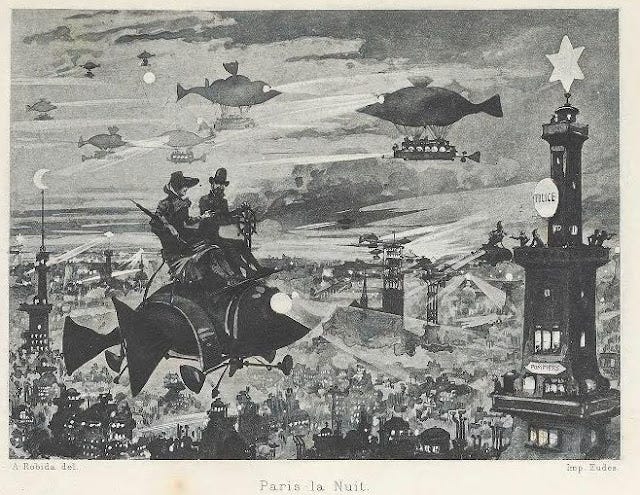
The logic of scaling and its extrapolation might be sound, and perhaps this is the way. Either way, whenever we do achieve AGI/ASI and manage to apply it successfully, most predictions fall apart, as I said when I wrote about moats. But the last object in the chain deserves a closer look, because we have seen it before. It was a hansom cab, and it flew over Paris.
The Flying Cab
In 1883, Albert Robida imagined Paris in the 1950s with the aérocab: the horse cab of his own streets, lifted into the air. Le Vingtième Siècle also gave the home a téléphonoscope, a wall-mounted screen for news, theater, lessons, conversation, and family dinners at a distance. Sixteen years later, Jean-Marc Côté and a team of illustrators produced the En L’An 2000 cards for the 1900 Paris Exposition. They returned to the same assumptions: air cabs, winged firemen, automated domestic work, mechanized leisure, undersea transport. The cards were printed in batches from 1899 to 1910, never distributed, and forgotten until Isaac Asimov published a recovered set as Futuredays in 1986.
The cards clearly envision the year 2000 as an extrapolation of 1900. That instinct has a long pedigree in philosophy and cognitive science: imagination does not create ex nihilo, but recombines, transforms, and abstracts from prior experience.
Every era draws its future in the vocabulary of its present, and novelty usually comes from new arrangements of stored material: memories, learned concepts, metaphors, images, and technical forms already available to the mind. Robida almost perfectly predicted television, screens, and video, for example, but he built it out of brass and gaslight.
His téléphonoscope anticipates the future, but its imagined form still belongs to the materials and assumptions of his own century.
The Sixth Decimal Place
Why did the sharpest futurists of the belle époque imagine a future so mechanically inventive, yet so conceptually narrow? Because they lived inside a scientific culture that increasingly treated the foundations as settled.
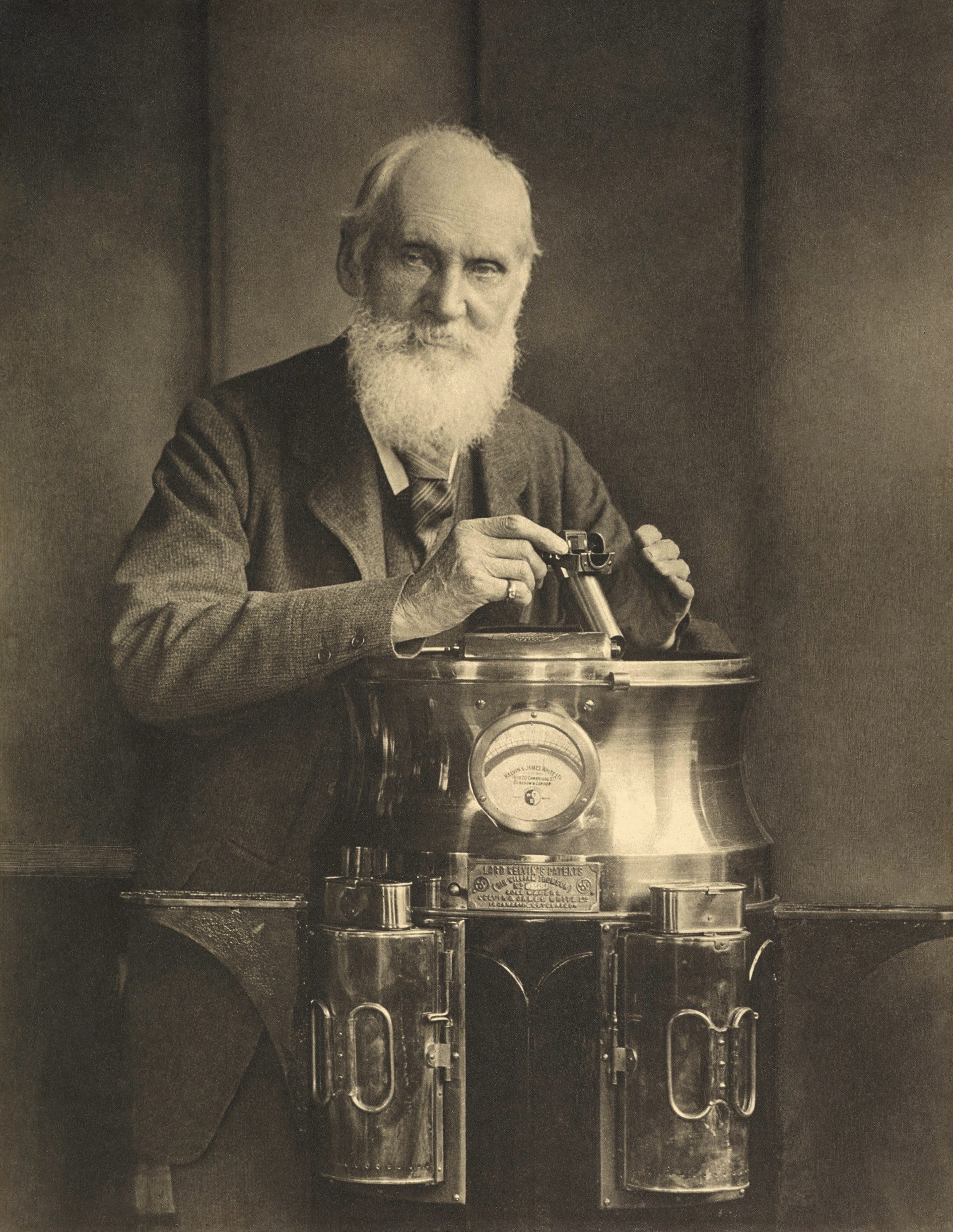
In 1894, at the dedication of the Ryerson Physical Laboratory in Chicago, Albert Michelson told his audience that most of the grand underlying principles of physical science had been firmly established. He then quoted an unnamed eminent physicist: “The future truths of physical science are to be looked for in the sixth place of decimals.” The line is often attributed to Lord Kelvin, but Kelvin never said it. It kept circulating because it captured what many physicists already believed.
Incredibly, the same confidence shaped how senior physicists guided their students. In the 1870s, Philipp von Jolly advised the young Max Planck against a career in physics, describing it as a “nearly matured” science with only minor problems left to examine. In April 1900, Kelvin gave his Royal Institution lecture on the two remaining “clouds” over physics: the ether problem and the equipartition of energy. To many physicists, the basic structure of the field was already in place, leaving only marginal improvements for future scientists: refining existing theories, applying their principles, and engineering new uses.
That the belle époque could imagine such extraordinary inventions without considering new substrates speaks to how treating fundamentals as settled limits creativity and inhibits our ability to properly predict what’s to come.
The Break
The irony is that the foundations were actually evolving at the same time as the leading physicists were declaring them settled.
Between 1895 and 1905, the discovery of X-rays and radioactivity (both by accident), the electron, Planck’s quantum, and Einstein’s annus mirabilis papers had turned the two “minor” problems into the basis of a new physics. Kelvin counted his clouds in April 1900, but within five years, the ether problem had been dissolved and equipartition was on its way to being replaced.
This “new” physics, however, first arrived as a collection of awkward observations and unresolved technical problems. They weren’t treated as groundbreaking at all, because from within the old framework these discoveries were treated as “refinements” or marginal improvements, which were the only things left for science to explain.
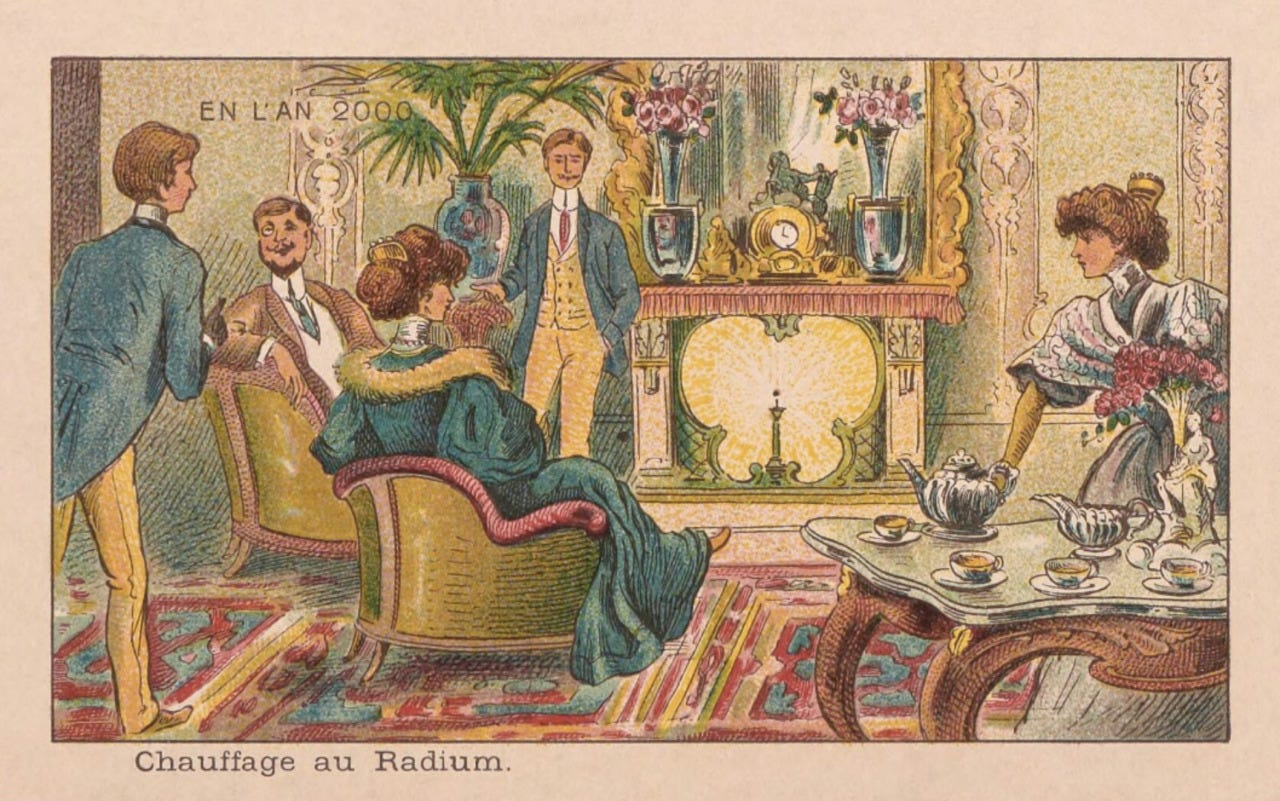
The Côté cards kept appearing through this transition, for example. My favorite card, the one Asimov singled out, heats a living room with a speck of radium glowing in the fireplace. Although the physics that would define the twentieth century had already appeared, the old imagination could still only understand it as an improved source of heat. Electronics, nuclear power, computation, and lasers came out of the same anomalies that 1900 had treated as refinements.
Engineering Intelligence
Which brings us back to the present and AI. Few serious people claim to possess a complete theory of intelligence, but much of the industry has become highly confident in a method for producing its final form.
Transformers, scaling laws, reinforcement learning, inference-time compute; whatever remains is engineering. Sam Altman opened 2025 writing: “We are now confident we know how to build AGI as we have traditionally understood it.“ Two paragraphs later: “With superintelligence, we can do anything else.” The first sentence treats AGI as self-evidently attainable, and little more than persistent engineering. The second turns superintelligence into the general instrument through which all other problems get solved downstream. Together they constitute incredible confidence that the “foundations are settled.”
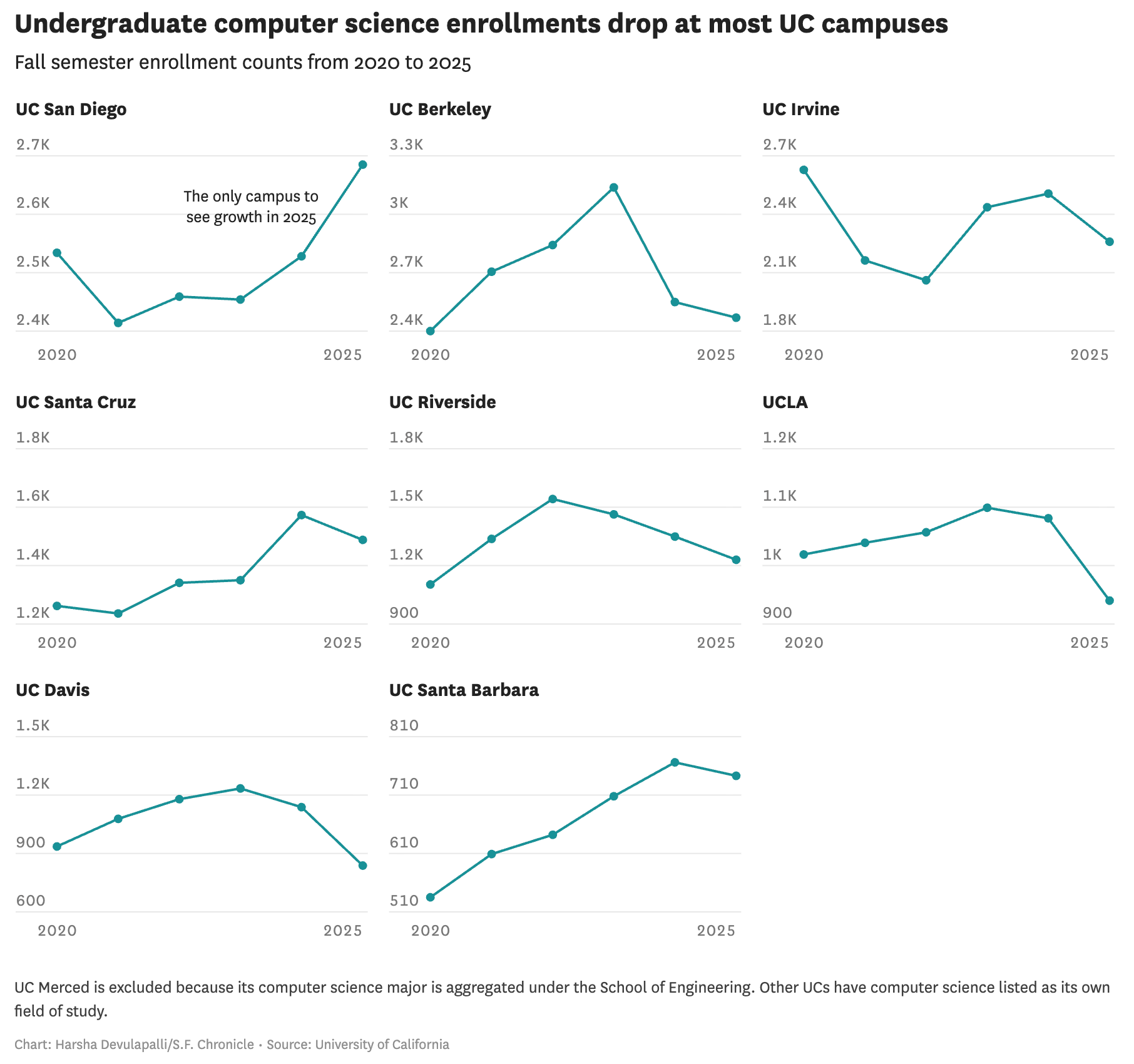
If he’s to be believed, Sutton’s Bitter Lesson has been promoted from essay to ideology, and AI researchers now get advised off working on fundamental architecture roughly the way von Jolly advised Planck off physics. We’re seeing early versions of this manifest in a declining number of students electing to pursue computer science degrees.
If you want to know whether the industry believes this, follow the money. The four largest hyperscalers have told investors to expect roughly $700 billion in capital expenditure for 2026, up from about $410 billion in 2025.
And to be fair, the confidence has earned its footing. A sixty-year-old in 1900 had watched railways, the telegraph, the telephone, and electric light arrive within a single lifetime, and extrapolated accordingly. A researcher today has watched eight years of scaling curves hold and every predicted wall get climbed. The labs have built something extraordinary and the exponentials are real (the valuations are a separate conversation). The risk is that a record of recent progress starts being treated as a law of the future, disqualifying any other pursuits and limiting our imagination.
The Anomaly Bin
Every confident era has a way of classifying the problems that do not yet fit. Ilya Sutskever presented on the main stage at NeurIPS in December 2024 and confidently claimed pre-training as we know it would unquestionably end: “While compute is growing,” he said, “the data is not growing, because we have but one internet.”
Although Ilya was being a bit hyperbolic, the unresolved problems are familiar. Current models do still struggle with the basic properties we associate with intelligence: continuous learning, sample efficiency, energy efficiency, and reliable long-horizon action.
Models freeze at deployment and cannot learn from experience. Sample efficiency runs orders of magnitude short of a child. Brains produce intelligence with tiny amounts of power compared with AI systems, yet the industry is currently solving the problem by building enormous energy infrastructure. Our below-the-model thesis, for example, starts with the fact that the current path to machine intelligence is becoming a physical infrastructure problem.
At the same conference, however, Noam Brown said he had never heard a serious AI researcher say the field is hitting a wall. Sutskever and Brown can both be right: AI can keep advancing while still accumulating unresolved anomalies. But the existence of those anomalies doesn’t disprove the current paradigm, and the success of the current paradigm doesn’t make them irrelevant. In 1900, the loose ends in physics still looked manageable from inside the old framework. The question for AI is whether today’s loose ends are manageable defects in the current approach, or early signs that the next foundation will look different.
The Dyson Sphere Is a Flying Cab
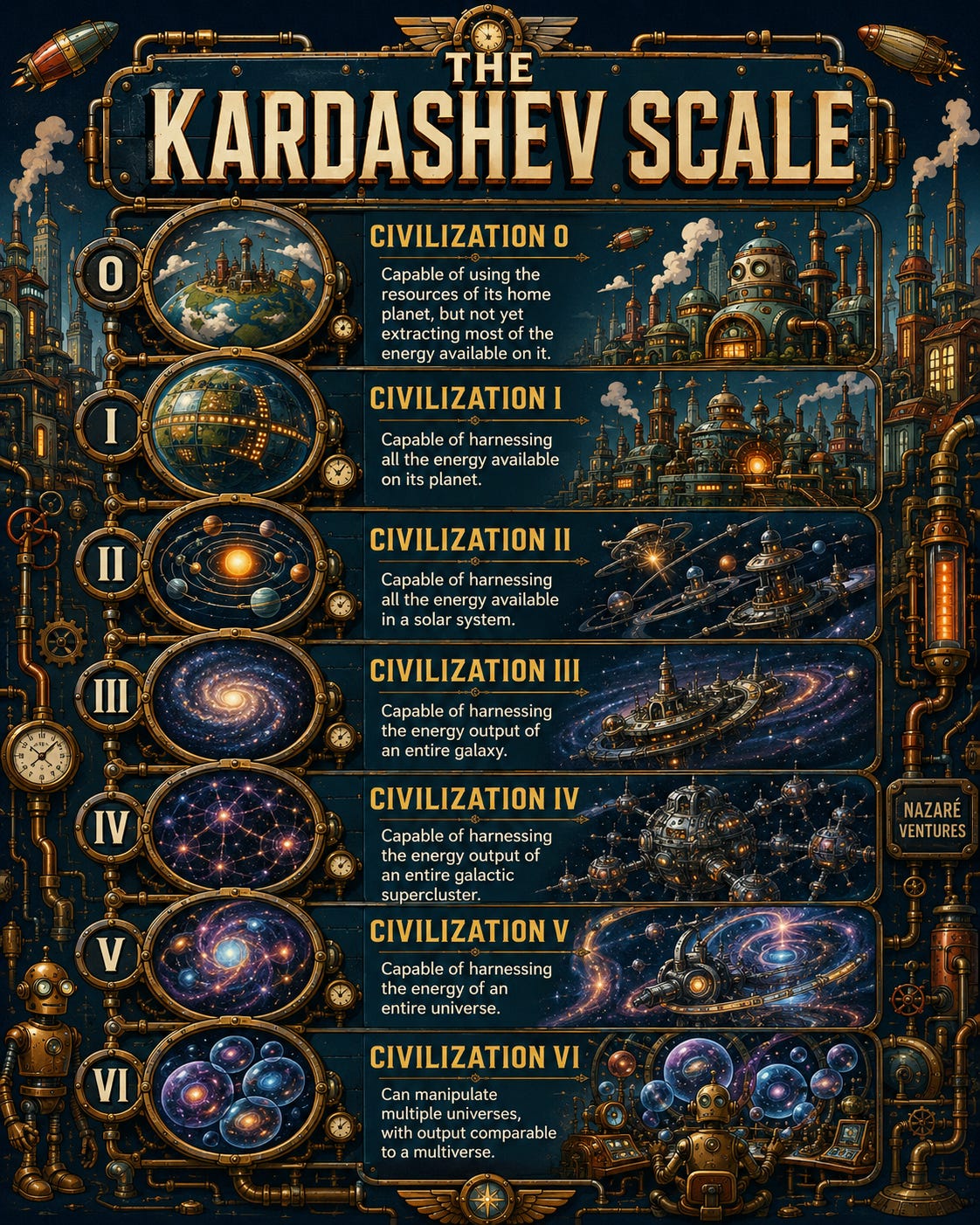
The Dyson sphere belongs to the same pattern. Freeman Dyson’s 1960 paper in Science framed it as a SETI thought experiment, borrowing the idea, by his own account, from Olaf Stapledon’s 1937 novel Star Maker. Nikolai Kardashev’s 1964 scale did something similar, ranking civilizations by the power they consume. Both ideas come from a high-industrial imagination in which progress still meant larger systems of energy capture, and the contemporary version carries that assumption into AI: if intelligence is produced by scaling computation, then the endpoint naturally becomes a civilization-scale energy project. The question is whether intelligence will remain bound to that path. If it becomes more efficient, more adaptive, or less dependent on today’s infrastructure, the Dyson sphere starts to look like this era’s téléphonoscope: right about the ambition, wrong about the substrate.
The analogy only works if it survives the obvious objection: Michelson’s generation was wrong almost immediately, while the scaling generation has been directionally right for years. Most anomalies resolve inside the framework that produced them; Kelvin’s clouds are famous because they became exceptions. Einstein himself dissolved the ether problem by showing that light didn’t need a medium, then spent decades resisting the quantum theory that followed from the same rupture in physics. He knew the theory worked and still couldn’t accept what it implied. Correctly seeing one break in the foundations didn’t make him a reliable guide to the next.
We won’t know until much later whether the current path was sufficient, but the industry is already allocating roughly $700 billion a year as if it were. Our fund is built around the practical consequence of that uncertainty: the layers above and below the model keep their value whether the current recipe holds or breaks. I made the longer version of that argument in Models Aren’t Moats.
Robida’s téléphonoscope anticipated a real future but built it out of the machinery of his own century. Steampunk shows a future that looks radical until you notice it’s built on the assumption of the present extrapolated forward. The future will inevitably be transformative, but it will probably arrive in forms we can’t anticipate.