


Over the course of my travels this year, I've witnessed a profound transformation in how we talk about AI. What began as conversations with academic researchers, investors, and founders about technology has rapidly shifted to geopolitics, economics, and strategic competition.
While demand for AI accelerates worldwide, geopolitical tensions and economic policies – tariffs, trade restrictions, and protectionism – are creating significant uncertainty. I articulated this observation in my 2-part series titled Make AI Cheap Again (2). (pt. 1 here)
AI has transcended its origins as a technology to become the centerpiece of national strategy and global power struggles. Countries, corporations, and even individuals are now maneuvering for leverage, influence, and control.
In these unfolding global tensions, there probably won’t be dystopian Terminator scenarios, but there (unfortunately) may well be drone warfare. At its core, this competition revolves around four critical resources: talent, capital, compute, and energy – each becoming increasingly strategic and contested. The global AI wars have begun.
Talent & Capital: The First Frontline
The talent race remains fierce, with Silicon Valley's magnetism drawing researchers globally and driving significant progress. China is close behind, rapidly expanding its AI workforce through state directives (even recruiting laid-off US scientists), while Europe's academic institutions maintain incredible intellectual firepower. Europe's challenge is translating intellect and academia into action. Europe risks losing ground because it’s incapable of moving from research to impact in a risk-averse regulatory environment that prioritizes caution over risk-taking and innovation.
Capital deployment demonstrates equally stark contrasts. The United States intends to build its AI future primarily through private capital (including the Trump-coordinated Stargate project), with venture funding racing to back founders and startups with minimal constraint and maximum speed.
Europe, signaled by President Macron's €109 billion public investment announcement at the Paris AI Action Summit, attempts to compete while maintaining regulatory control. Arthur Mensch continues to maintain that Mistral is not for sale and intends to go public.
China once again is channeling state resources into research, chip manufacturing, and energy infrastructure at scales few can match.
These aren’t simply investments – they’re geopolitical signaling. On this new, fiercely contested global stage, the battle lines are being drawn differently.
Compute Infrastructure Has Become a Sovereign-Grade Asset
Beyond talent and money, AI’s demand for computational resources has reshaped global supply chains and the organization of world trade.
Perhaps most transformative is how compute infrastructure has evolved into a sovereign-grade asset comparable to energy, defense, and finance. Governments, states, and large corporations are beginning to treat AI clusters as high-security fortresses that house critical data, proprietary models, and national intellectual capital. These clusters are tightly controlled and heavily resourced, forming the apex of a global compute hierarchy.
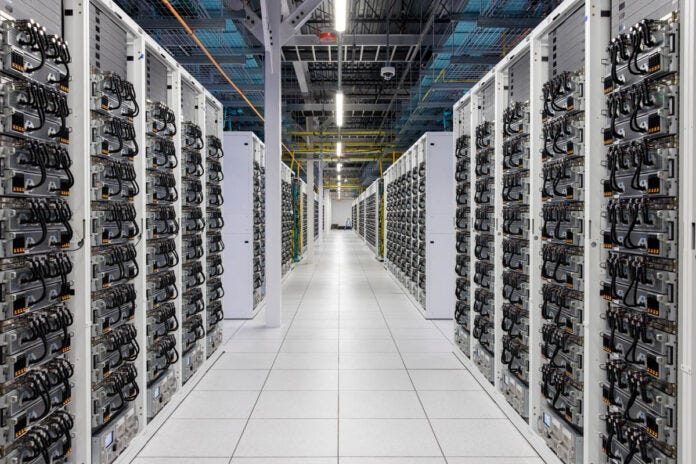
Additionally, the market dominance of NVIDIA, Google, OpenAI and a handful of others creates dependencies that nations desperately seek to mitigate. America and China's semiconductor battles – playing out through export controls, sanctions, and tariffs – are merely the visible front of this deeper strategic contest.
At the same time, the broader AI ecosystem depends on accessible and flexible compute options that support rapid experimentation and innovation.
This has created a bifurcated system: heavily secured, extremely expensive AI megaclusters housing critical data and proprietary models on the one hand, while a more accessible layer supports broader experimentation. The distinction reflects the growing alignment of infrastructure with national power.
These dynamics inform an important part of Nazaré’s central thesis: a massive opportunity exists to build architecture designed to handle the full continuum of compute. We call it the “internet-scale operating system for the future of AI.”
Megaclusters for research and pushing the boundaries (coveted & protected by governments & corporations alike)
Markets serving long-tail, idle, and consumer compute at lower costs
Distributed networks for cheaper, more efficient training and inference
Open source frameworks inviting innovation from anywhere in the world
Performant infrastructure and apps designed for edge devices (phones, drones, robots, etc)
Energy Constraints Will Determine the Pace of AI Expansion
Energy is becoming equally critical and may ultimately determine the winner(s) of these wars. AI workloads consume enormous amounts of electricity, and as a result energy availability will be a primary bottleneck in the global race to build and deploy advanced AI systems.
AI's overwhelming electricity demands are shifting priorities toward abundant, affordable power sources. Nuclear energy stands poised for a renaissance, with innovation focusing on smaller, safer reactors powering localized compute clusters. The decades of nuclear development stagnation have left a gap that must now be urgently filled, with countries like China already advancing meltdown-resistant designs. Nations capable of supplying cost-effective energy – from nuclear to renewables – gain inherent advantages in the AI race.
Regulation vs. Innovation: Europe's Dilemma
Europe's approach to this competition reveals a fundamental dilemma. While the US maintains an innovation-first approach (though not without attempts at regulatory capture), the EU has implemented frameworks that risk stifling startups.
Consider launching a dating or tutoring app in Europe today. Classified as "high-risk" by the European AI Act, such applications face prohibitively difficult compliance hurdles that protect bureaucratic structures more than they do citizens. This recalls Europe's COVID-era furlough policies: prioritizing social stability over economic agility may provide short-term protection, but it sacrifices long-term competitiveness.
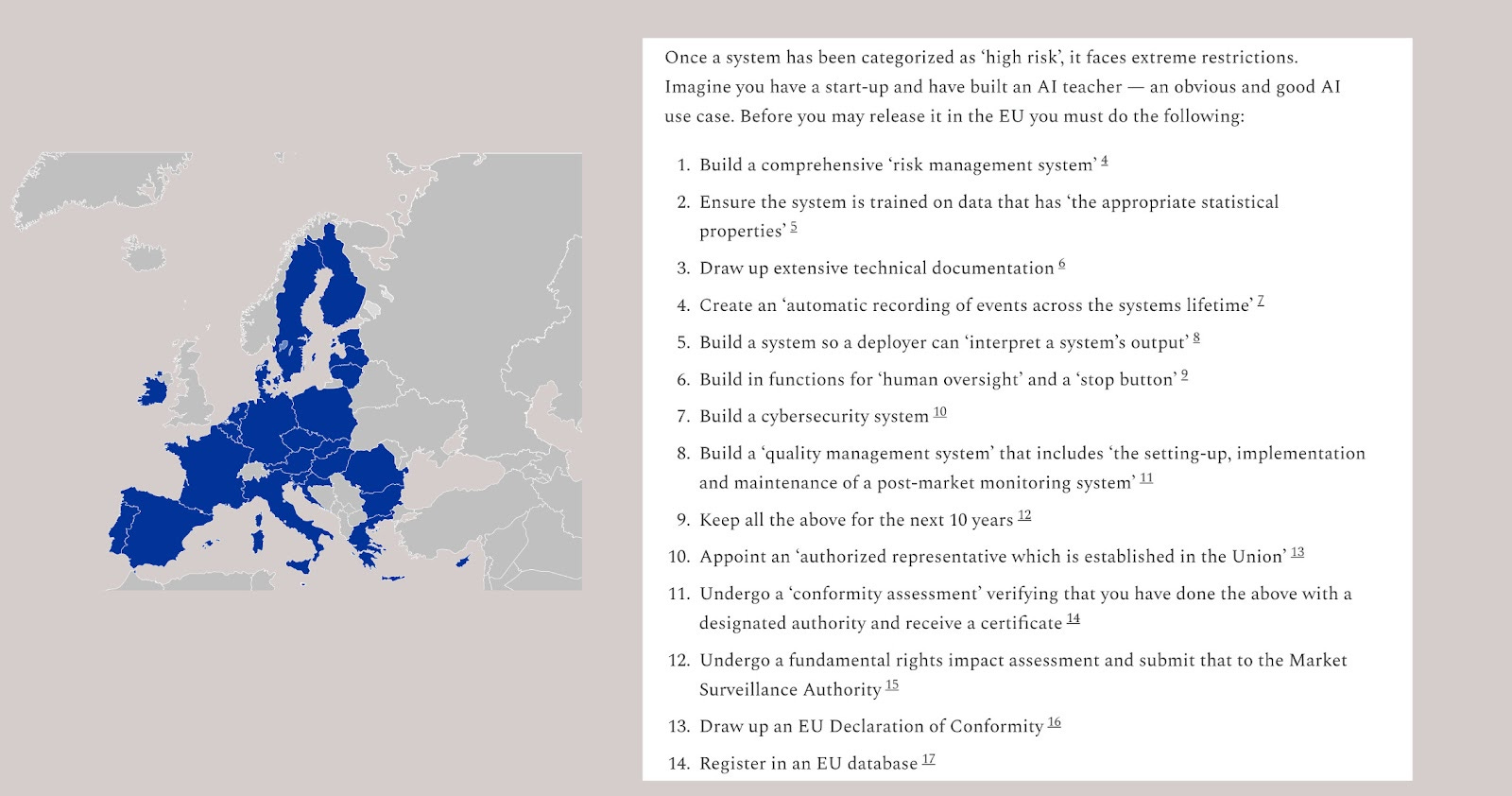
To be fair, the European AI Act is on the brink of repeal, and the controversial GDPR is under reassessment. This kind of re-evaluation signals the beginning of Europe’s realization that they are behind in this race, and remaining behind may further compromise their already-fragile position in the global hierarchy. What’s more, it is also home to emerging unicorns and AI darlings Lovable and Mistral, indicating it is far from out of this race entirely.
Ultimately, the challenge facing Europe is as follows: can it balance regulation and innovation, or will its cautious approach doom it to permanent second-tier status in AI and the rest of the world? Europe is not alone in attempting to regulate AI. The failed California AI act attempted to control AI development and increase the burden to developers for government reporting. Related bills are in preparation currently and we anticipate a second attempt at this oversight.
The End Game: Why Slowing Down Isn't an Option
The inherent acceleration in AI development means countries embracing it early will create, widen, and maintain advantages that may be impossible for others to catch up with. Nations hesitating now risk permanent relegation, politically, economically and culturally.
To slow adoption is potentially suicidal in the competitive global landscape, because this isn't a race for technological leadership – it's a contest for who controls the future.
As I connect with researchers, investors, and founders globally, I persistently question how we navigate this delicate balance: achieving rapid innovation without abandoning ethical, social, and regulatory responsibilities. The AI wars have begun, and their outcomes will shape our future in ways we're only beginning to comprehend.