


March 11, 2020, marked the day COVID-19 officially became something the world couldn't ignore.
The disease had been spreading for months, people were already dying, and warnings were already circulating. But on March 11, the World Health Organization (WHO) declared the virus epidemic a pandemic.
In the days and weeks that followed, stocks had one of their worst single-day losses in history, the world slid into widespread COVID “lockdowns” almost overnight, and the disruption that followed made it impossible to regard the virus as somebody else’s problem.
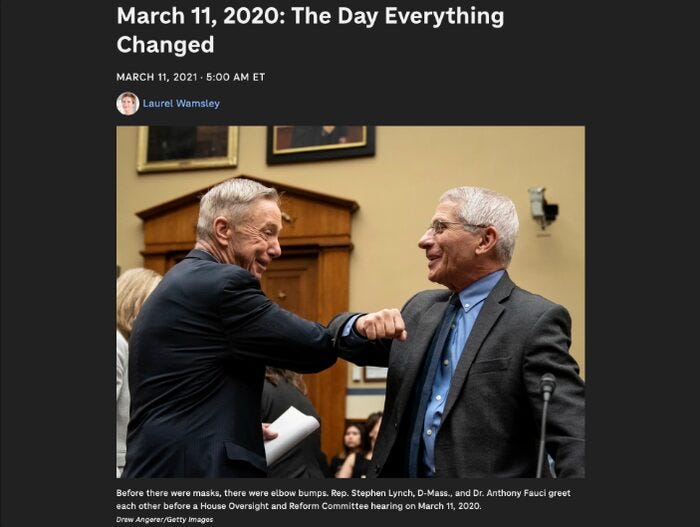
Situations often develop gradually, but there’s usually a moment where public attention, political action, and resulting societal implications change abruptly.
In those moments, everyone acts on imperfect information, and genuine concern, uncertainty, opportunism, and institutional self-interest operate simultaneously. People, organizations, and institutions can agree that something demands action despite disagreeing profoundly about how to respond and who should direct the response.
Sound familiar?

As an AI investor, I have long asked myself what AI’s equivalent will be: the March 11 moment when society makes AI a priority and moves formally to control the technology.
“I RESIGNED FROM ANTHROPIC TODAY.”
As I wrote recently, AI is not popular. Given AI’s power and novelty (not to mention the enormous sums of money involved), it was only a matter of time before AI and those close to the technology became boogeymen. It doesn’t help that AI leaders keep telling the public their product might kill everyone, and have been saying so louder for ~18 months.
Some in the industry thought it would be something like the OpenAI-Hugging Face incident. Despite their technical inaccuracy, “rogue agents” and “escaped agent swarms” seemed like stories tailor-made for mainstream media. But, surprisingly, the incident moved insiders far more than it moved the public.
One of those insiders is Greg Jensen, co-chief investment officer of Bridgewater, who backed OpenAI early and says he wrote the first check to Anthropic. On Bloomberg’s Odd Lots podcast, he pointed to the hack as an early warning, then said: “Until the AI starts killing people, unfortunately, history would suggest we’re not going to do anything.”
“AI doomers,” as they’re called (those prophesying catastrophe caused by AI), have been around for a while already. Most famous among them is Eliezer Yudkowsky, who co-authored a book published in September 2025 titled If Anyone Builds It, Everyone Dies. Subtle, I know.
In any case, loudly proclaiming that AI will “kill us all” is not new.
But then Jacob Coxon tweeted “The people building AI earnestly believe that it could kill us all by the end of the decade.” According to TIME, his posts drew 153 million views within 36 hours.


Coxon was a 27-year-old British researcher who had spent three years on pretraining at OpenAI and Anthropic. He posted the thread from a park bench in San Francisco’s Alamo Square. Outside the labs, almost nobody knew his name.
Nevertheless, the immediate aftermath of Coxon’s tweet shows the extent of his post’s impact.
1. The Wall Street Journal published a headline article about it
2. Coxon appeared on multiple premier TV news shows including Fox News
3. Four days later, Dario Amodei published “We Must Pace the Frontier”
4. Sam Altman agreed that “we need to pace the frontier,” and Elon Musk replied, “Dario is right.”
5. A former Google DeepMind safety researcher announced his resignation and warned that AI could “kill us all”
6. Trump posted that the only “guardrails” AI needs is a “STRONG AND SMART (High IQ!) PRESIDENT,” and blamed Democrats for stoking the panic
7. Hillary Clinton implored Trump to “enlist China in the effort to rein in AI”
8. Former President Obama reportedly urged Democrats to move AI oversight to the center of their agenda (NYT)
9. Trump phoned NVIDIA CEO Jensen Huang live onstage at the All-In Summit and called AI doomerism “a hoax”
10. TIME magazine’s latest cover ran the headline: THE AI TIPPING POINT
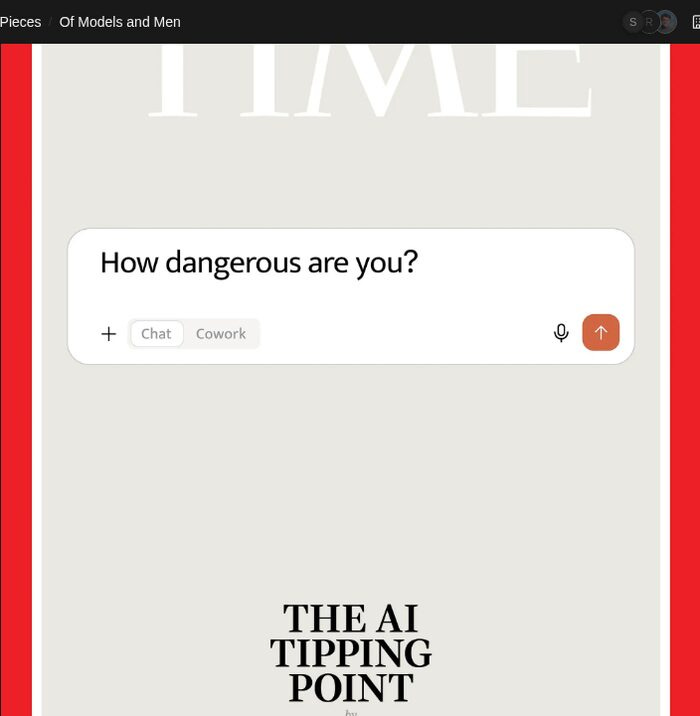
This is as close as it’s felt to AI’s “March 11.”
Jensen compared the moment to February 2020, and so did many of the researchers TIME interviewed. I think it is closer to March 11. February was the warning. March 11 was the declaration.
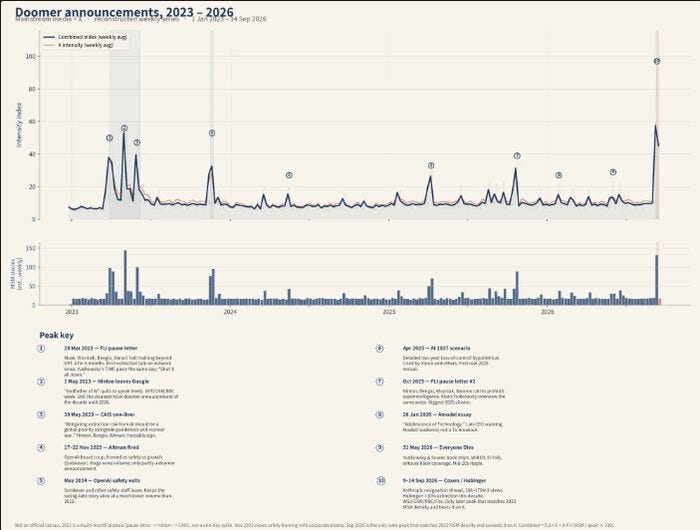
A chart of “doomer” announcements in the media going back to 2023, the year after ChatGPT launched, tells the same story. It shows one big wave of alarm in spring 2023, a long lull, and a smaller revival over the past year. By the chart’s count, the week of September 8 is the only spike since then to match 2023 in newspapers and on TV, and it was the highest absolute incidence of doomer posts in three years.
SO WHO WANTS WHAT?
As the saying goes: never let a good crisis go to waste. Rahm Emanuel, who made the line famous in 2008, actually said “serious crisis.” The upgrade to “good” came later.
Dario, Sam, and Elon endorsing the same proposal looks like consensus. But each has different ambitions for his company, different rivals, and different reasons to favor restraint. Jensen, an early backer of two of the three, summed up the mindset inside each lab: “It better be us. Not Sam, not Elon.” Politicians finally acting on their warnings would almost certainly implement restrictions all three would hate.

In hindsight, COVID set off a cascade of global consequences driven by real concerns, imagined ones, and interested parties with a thumb on the scale. In the moment, it was exceedingly difficult to parse truth from rumor, and navigating the information environment was treacherous. The world over was scrambling to control the situation, with few actors doing so successfully. The same will inevitably play out with AI.

But what do each of the apparent “coalitions” actually want? Let’s take them in turn and look at what each wants to happen, and what’s in it for them if it does.
THE UNWILLING HERO, AGAIN
Dario invariably goes first. Claude is objectively outstanding, Mythos-class models are in large part responsible for kicking off this whole charade, and by most accounts Dario has been a sincere doomer-but-committed-to-keep-pushing-the-frontier weirdo since 2019 when he urged colleagues at OpenAI not to release GPT-2.
That last part is critical: he really appears to believe AI is so dangerous that only he and his trusted allies can responsibly bring it to bear. As I wrote in June:
“Dario Amodei has spent the last few years desperately trying to convince the public he is Maximus refusing the call. He would have you believe he built Anthropic reluctantly, to take responsibility for a dangerous technology everyone else would misuse.
The problem is Anthropic is trying to "thread the needle," casting itself as a self-aware, safety-conscious frontier lab at the same time as it pursues one of the most ambitious for-profit commercial endeavors ever attempted.”
Despite his apparent sincerity (or perhaps because of it?) the timeline has spawned a number of theories about his motives ranging from regulatory capture to catastrophic financial results in the face of an IPO to the effective altruism movement, where he’s now drawing comparisons to Sam Bankman-Fried. That comparison comes with a dollar figure: before FTX collapsed, SBF’s Alameda Research put $500 million into Anthropic.


Even Ben Thompson of Stratechery has called Dario’s essay “an unrealistic proposal that seems mostly geared to political control of AI.”
Ultimately Dario and Anthropic leave me puzzled as to how such intelligent, capable scientists and technologists repeatedly decide to market the technology they refuse to stop building as an existential threat to humanity.
Their conviction now borders on the religious. Every time Dario attempts to explain himself, he digs a deeper hole.

Perhaps, as Geoffrey Hinton famously said, “the prospect of discovery is too sweet” to stop building. Perhaps Dario really does believe that he alone can safely build superintelligence (what extraordinary hubris if true).
Despite demonstrating the capacity to define SOTA and build literally the best models ever, Dario considers “AI Safety” to be Anthropic’s ticket to permanent relevance. To the best of my understanding, he and his colleagues exhibit sincere concern and a conviction that qualified institutions should govern AI progress….
…but only on the condition that he and Anthropic be positioned among those institutions, and preferably with the power to choose who joins.
Which is the problem, full stop. My verdict from June stands: he is sincere, and his sincerity is beside the point.
Either build or don’t. Let the models do the talking.
KING OF THE CANNIBALS
Sam Altman is an enigma.
Paul Graham, perhaps the person who knew Sam best before he became “Sam Altman, the Great Man,” has lionized him for nearly two decades. Graham’s most flamboyant take is the following, from an essay titled “A Fundraising Survival Guide,” published in 2008.
“Sam Altman has it. You could parachute him into an island full of cannibals and come back in 5 years and he'd be the king. If you're Sam Altman, you don't have to be profitable to convey to investors that you'll succeed with or without them. (He wasn't, and he did.) Not everyone has Sam's deal-making ability. I myself don't. But if you don't, you can let the numbers speak for you.”
Indeed, you can let the numbers speak. OpenAI filed confidentially for an IPO in June, at a valuation reported to approach $1 trillion. Some call him a sociopath, some say he is brilliant, and many have both signed on to work for him and resigned rather than continue working with him.
He is a master fundraiser and media savant, but controversy follows him like his shadow. Through it all, he has built OpenAI into a ~trillion-dollar entity now more powerful than most nation states.
My intuition on Sam is that he’s actually pretty simple: he just wants to win. He plays alone. Every ally and every adversary is a piece on his board, moved in pursuit of victory.
OpenAI’s own board fired him in November 2023 for not being “consistently candid.” He was back within a week. He will test things in public only to walk them back, reverse his position, or cut his losses.
He will do whatever it takes for OpenAI to win. Whatever it takes.
Altman recently told Fortune: “I actually think that, given everything happening with safety, right now would be an ill-advised moment to go public. We don’t feel pressure on that.”

OpenAI has slowed, for now. Its largest planned frontier run has been on hold since August. But if it buys them time, money, or influence, “safety” is the word of the day.
ELON, SPACEXAI, MARS, FLYING CARS, STARLINK, NEURALINK…
Elon is everything everywhere all at once.
Perhaps the most extraordinary entrepreneur of the information age, he is bombastic, excessive, and (mostly) candid. Whatever you think of him and his antics, it has been bad business to “bet against Elon.”
His AI ambitions are often ridiculed because Grok is good-but-not-great (read: irrelevant save for finding a specific tweet because X’s search function is terrible). Colossus, however, is a modern marvel, and Elon has structured his business to benefit from all sides of the trade.
He is both a model competitor and an infrastructure supplier. He’s still training Grok (and maintaining that one day it will be great), leasing all of Colossus 1 to Anthropic for $1.25 billion a month through May 2029, and continuing to build more data centers at a furiously fast pace.


We shouldn’t forget that Elon was there at the beginning, too.
He thought Demis Hassabis and DeepMind would have a monopoly on AGI and seeded OpenAI as insurance (true story!). Then he left in 2018, after he failed to take control of the startup.
He has both warned about the dangers of AI since 2014 and been among the loudest proponents of future “abundance” brought about by AI and robotics.

Elon is along for the ride. Nine days after writing “Dario is right,” he shipped Grok 4.7, built on a larger base model and a longer reinforcement-learning run. He, too, would prefer being in control, but he has diversified his means of exercising control by building vertically integrated businesses in social media, compute, electric and self-driving cars, AI, robotics, and brain-computer interfaces.
He may not be at the forefront of model development, which is the topic du jour, but Elon is extremely well-positioned to have an enormous impact on AI no matter what.
WARREN AND BERNIE (AND AOC…)
Although everyone here may have started their careers as sincere “protectors of the people,” they have warped into reflexively defending populist (or socialist) policies that fight new technology, whatever that technology may be. It happened with crypto, it is happening with AI, it will happen as long as they hold office and innovation continues.

Among them, Bernie is clearly the most sensible. He puts forth policies that draw attention to real problems, it’s just that his policies are often impractical, impossible to enforce or administer, and would create as many new problems as they solve existing ones. He was also early. On September 3, five days before Coxon’s post, he and Rep. Greg Casar announced a bill to ban superintelligent AI outright, with prison terms of up to 20 years for violators. The rest are unfortunately pandering to their electorate in pursuit of power and getting elected. Credit where due, though: on September 16, Warren called the labs’ request to weaken antitrust protections “transparently self-serving.” On that point she agrees with David Sacks, which should worry Dario.
These are the extreme cases in point for why government is often ill-equipped to regulate cutting-edge technology. They do not understand the technology, but they latch onto recognizable headlines in pursuit of narrative dominance. Alas, government is still often the only institution capable of effective regulation. The gold standard is regulation informed by the private sector. Wait. Did someone say regulatory capture? Someone did: David Sacks, repeatedly.
HOAX BUSTER
Trump now calls himself the “Hoax Buster.” On September 19, he announced an “AI Force,” modeled on Space Force, and promised a new AI czar: “Only High I.Q. individuals need apply!” His former czar, David Sacks, now co-chair of the President’s science council, had answered Dario and Sam a week earlier on X: “People may be surprised by my response: go ahead. You guys are the frontier.”
The administration loves to keep the world guessing, so an accurate assessment of its motives must be qualified with a caveat: nobody really knows anything but Trump himself.
Nevertheless, they appear to be adamantly refusing to indulge Dario, Sam, and Elon. As it stands, they will not rush to regulate this industry or its leaders. As Sacks wrote in the same post, Dario and Sam run the companies whose progress they’re so worried about, which means they can make those decisions themselves. He objects to making their restraint conditional on the government giving them a regulatory arrangement they like. Demanding a preferred framework as the price, he wrote, “will look like blackmail of the public and the political system.”

If your own models are too dangerous to develop responsibly, you presumably have some obligation to act before Congress gets around to helping you. Of course, slowing down while your competitors keep going is painful. Having the government make everyone do it would be much more convenient, which is precisely why the rest of us should be skeptical (see above).
Trump’s position is fairly straightforward. His administration has made American AI dominance an explicit policy objective, supported by faster data-center construction and the export of American technology. He wants the investment, the economic growth, and the geopolitical advantage. Presiding over all that would presumably be good for the Trump brand, too (assuming it doesn’t actually kill us all).
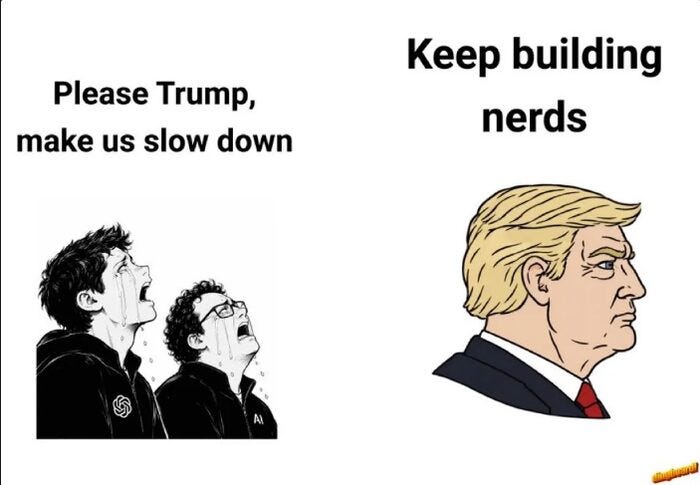
That also puts him on the same side as people with enormous amounts of money invested in continued expansion. We should be as willing to examine their interests as we are Dario et al’s.
There is plenty of money to be made convincing the world that AI is dangerous, but there is considerably more being spent on the assumption that we’ll keep building it.
I’m sympathetic to the refusal to let a handful of companies dictate the conditions under which everyone else competes. But identifying their commercial interests doesn’t resolve the underlying safety questions. Trump’s strongest objection is that an American slowdown could hand an advantage to a country that has no intention of waiting for us.
ALL QUIET ON THE EASTERN FRONT
Which brings us to China.
Some people believe it is in both the US and China’s interest to cooperate on alignment. Dario’s essay still hopes for limited international agreements that could include Beijing. I think the obstacles to cooperation, and the incentives to get ahead, are too strong.
Nevertheless, it’s true that Chinese developers benefit from distilling American models, so slowing those advances could slow China down too. I’m always wary, however, of this unique form of Western arrogance that seems to believe the Chinese aren’t capable of their own innovation. Surprise: they are.
Another rebuttal is that the Chinese Communist Party presumably has very little interest in creating something it cannot control. This makes more sense to me, but it doesn’t follow that China will slow down. It just means they’ll do everything they can to control it.
To me it’s clear: China will not stop.
They have ambitions of their own, and their published AI governance plan combines international cooperation and safety with infrastructure development, industrial adoption, and national sovereignty. I see very little reason to expect Beijing to give up the advantages of powerful AI because American companies have become uncomfortable with the pace. It can take its own safety seriously while continuing to pursue those advantages, just as the labs say they’re doing.
What’s more, they lead in open-weights models and robotics. Perhaps there is tension on the horizon between the US and China, but at the moment, it isn’t what’s most important.
Beijing was not quiet for long. On September 14, its Foreign Ministry called the slowdown push fear-mongering and offered no restraint of its own. Trump and Xi meet at the White House on Thursday. Washington has proposed an incident hotline. Neither side has proposed a speed limit.
EVERYONE ELSE
The individuals and small companies building with AI have considerably less influence over this debate than the people we’ve just discussed. But whatever arrangements emerge out of this will determine what they can build, which models they can use, and whose permission they require to do so.
To me that’s all that matters: will the world have access to good AI on its own terms or not?
Take Arlyn Gajilan, for example. Her son had a question for her: “If I’m so smart, why is school so hard?”
He had dyslexia, so his mother, a journalist who didn’t know how to code, built him an AI tutor that worked his love of dragons into his lessons. A month later, he wanted to share it with his friends.
I’ve written before about AI expanding what one person can accomplish. It’s easy to discuss that in terms of productivity and billion-dollar businesses, especially in my line of work. But there’s something considerably more interesting underneath: how much of what people want to do with their lives has always been limited by the tools, skills, and money available to them.
Gajilan knew her son and cared enough to keep trying. AI helped her turn that knowledge into something useful. Nobody planning the future of education from a boardroom could have known him quite the way she did.
Individual liberty gives people room to act on precisely these kinds of attachments, interests, and peculiar obsessions. They get to decide what’s worth their time. Powerful, accessible AI gives them more ways to follow through.
Mark Zuckerberg, whose Meta still releases open models, rejected an industry-wide slowdown on September 15. He argued that each lab should set its own safe pace: “Any lab that doesn’t focus on alignment will fall behind.”
In June, I made the case for open weights. September made the case stronger. Dario’s plan concedes that the frontier labs would need an antitrust waiver to coordinate their pace. No such waiver exists. On September 18, four paying subscribers sued Anthropic, OpenAI, SpaceXAI, and Google under the Sherman Act, and the complaint opens with Dario’s essay. A pact among a handful of closed labs would set the ceiling on what everyone else can use. Open weights keep the next Gajilan from needing anyone’s permission.
If this is AI’s March 11, those possibilities belong in the conversation about what happens next. The people we’ve just discussed have extraordinary ambitions, and the means to pursue them. I’d like everyone else to retain that freedom too, including the freedom to do something that matters enormously to a very small number of people.
