


Late last month, engineering students at ETH Zurich organised Europe’s first robot boxing match. They spent their weekend in a military hangar on the outskirts of the city, directing humanoid robots with video game controllers while a 24-year-old in sunglasses played MC. It was ridiculous. It was also, in the way that matters most to investors, a leading indicator.

In 2013, Chris Dixon observed that the best way to predict where technology is heading is to watch what the smartest people do with their free time. Linux was a Finnish student’s hobby project. Git was written in ten days out of necessity, after a licensing dispute stripped the Linux kernel team of their tools. Bitcoin was mined on a personal laptop by someone who never identified themselves. The pattern is consistent, and the economic logic is simple: when the marginal cost of experimentation falls toward zero, the rate of experimentation rises toward infinity. That mechanism — more consumption as unit costs fall, not less — is what economists call Jevons Paradox. The question worth asking is what happens when it plays out at the frontier of a general-purpose technology.
The answer, it turns out, is complicated.
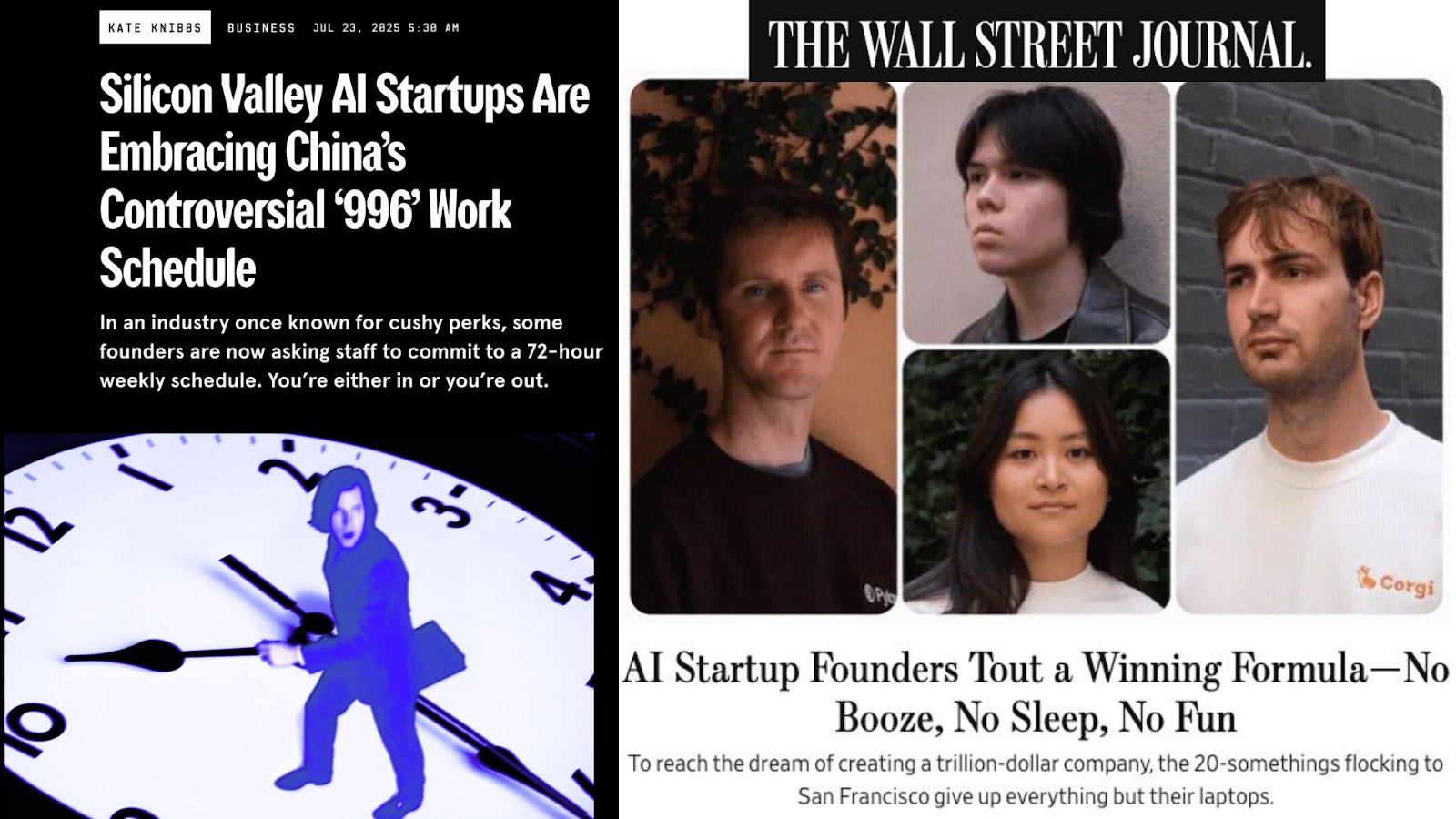
A short aside: I am not sure anyone working seriously in AI has weekends right now (Exhibit A & Exhibit B). When they do, they seem to spend them on AI anyway.
The Prediction Arrives Early — and Messily
In January 2024, Sam Altman told Alexis Ohanian that he and his tech-CEO friends maintained a betting pool for the first year someone builds a billion-dollar company alone — something that “would have been unimaginable without AI and now will happen.” This week, the New York Times reported that Matthew Gallagher, a 41-year-old from Los Angeles, appeared to have done exactly that: $401 million in self-reported revenue in the first full year, two employees, 16.2% net margins, built on a suite of AI tools from his home office. The story went immediately viral as vindication of Altman’s thesis.
Then came the rest of the story. The FDA had issued Medvi a warning letter six weeks before the Times published. Active class-action lawsuits allege spam affiliates using falsified headers and spoofed domains. A data breach at one of its key infrastructure partners exposed records from over a million patients. Critics, including Gary Marcus, are now characterising Medvi not as proof of AI’s potential but as a warning about how it can be abused — a fraud layer built efficiently on top of regulatory grey areas, with AI handling the wrapper.
This is, in fact, how these transitions always begin. The web’s first commercial wave produced spam operations and grey-market pharmacies alongside Amazon. Crypto’s first cycle produced scams faster than it produced infrastructure. When the cost of building something falls sharply, the first actors to exploit the new economics are not always the ones you would invite to a portfolio review. The structural point — that AI is compressing the cost of company formation by an order of magnitude — is not undermined by Medvi being a poor representative of it. If anything, the speed with which a regulatory arbitrage operation could scale to $400 million using off-the-shelf AI tools is its own kind of proof. Jevons Paradox does not distinguish between use cases.
The more durable examples of the thesis are less dramatic, and less tainted.
Architecture Beats Capital
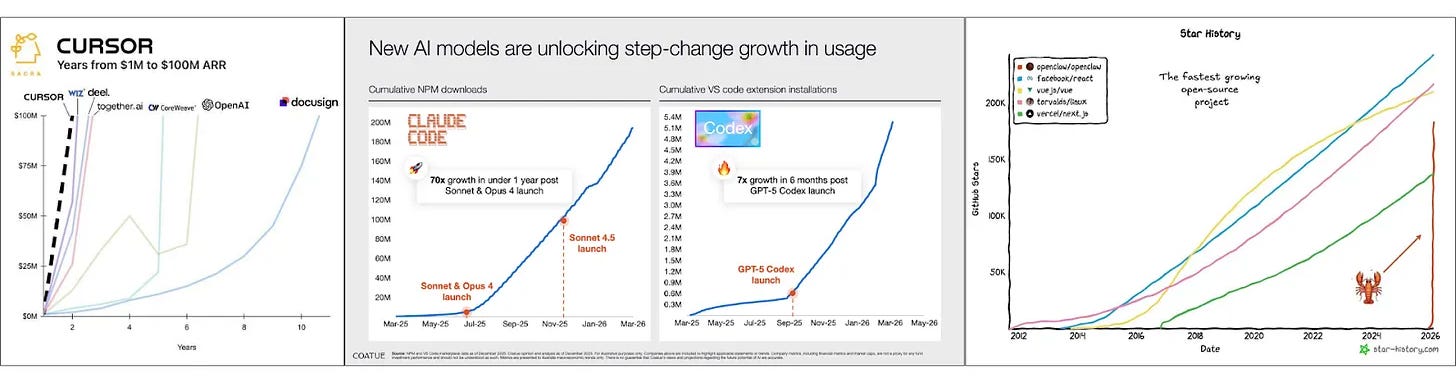
The cleaner proof is OpenClaw. Peter Steinberger — a veteran developer from Vienna who had already sold one company — started exploring AI agents as a side project in November 2025. He open-sourced the result. Within 60 days it had accumulated more GitHub stars than React managed in its first eight years. Sam Altman and Mark Zuckerberg both reached out personally. Steinberger chose OpenAI. The project moved to an independent foundation under MIT licence. OpenAI hired one person and acquired proof that a single developer with the right vision could build the most widely adopted open-source agent framework on the planet.
Steinberger’s contribution was architectural vision, not proprietary technology. Persistent identity, memory, configurable security, a messaging-first interface — all the pieces existed. The insight was that they were more valuable combined than separate. That is precisely the kind of leverage that compounds as models improve, and that no regulatory grey area is required to exploit.
The Toolkit Gets Cheaper Every Day
Since April 1 alone, three further developments have arrived that illustrate the pace.
Google released Gemma 4, a full distillation of Gemini 3’s capabilities into open models on Hugging Face, Kaggle, and Ollama under Apache 2.0 — the most permissive open licence available. Four sizes; the mid-range runs near-frontier intelligence on a single gaming GPU. Vision, speech, tool use, and extended reasoning built in. Free to use, modify, or commercialise. Xiaomi’s MiMo-V2-Pro spent the preceding week anonymously topping OpenRouter usage charts as “Hunter Alpha” — processing over one trillion tokens before anyone knew it was a smartphone company — then officially launched on March 18. And Google published TurboQuant on March 24, a compression algorithm that shrinks LLM inference memory by 6x with no accuracy loss, contributing to roughly $100 billion in losses across the memory chip sector in two days. Cloudflare’s CEO called it Google’s DeepSeek moment.
OpenAI, meanwhile, acquired TBPN for what the Financial Times pegged in the low hundreds of millions. Vanity Fair’s January profile explains why it mattered: a small but genuinely influential audience of technology decision-makers, built without the friction of traditional media. A16z reached the same distribution conclusion through their New Media initiative. The bet across the industry is that winning the AI race is as much about controlling the conversation around AI as it is about having the best model.
The Nervous System Problem
The same dynamics are arriving in physical systems. Open robotics platforms are combining symbolic AI with language models, and research-grade hardware has fallen below $5,000. The open-source forces that transformed software over the past three years are beginning to work on atoms.
The unsolved problem is the handoff. AI reasons in concepts; robots operate in milliseconds. Translating intent into physical action, feeding sensory data back in real time, adapting to an uncontrolled environment — this is where most current systems fail. One of Nazare’s portfolio companies, Dimensional, is building exactly this layer. Their product, dimOS, is an open, hardware-agnostic operating system that sits between the AI brain and the robot body, exposing a standardised interface across humanoids, quadrupeds, and drones. Developers direct hardware in natural language; the OS handles perception, planning, and motor control underneath. Humanoid robots navigating around people and obstacles autonomously, drones training themselves to fly through reinforcement learning in fifteen minutes without hand-tuning — these are working deployments, not demos. They have just launched a builder residency in Shenzhen: free robots, compute credits, housing, and customer introductions. Build the nervous system, make it open, and the builders will come.

If You Build It
The models are improving rapidly, and many of the best ones are now free to run. Tools like Claude Code and Cowork have reduced the technical barrier to writing software to something close to zero. The number of people who have yet to discover that they can automate a repetitive task, ship something useful, or change their circumstances before Monday morning is very large. That population is shrinking fast. The first wave will include bad actors. It always does. The second wave is what changes the world.
As Packy McCormick noted last week, what a week for the optimists. We are nowhere near the top of this curve.