



Back in 1956 a group of scientists led by John McCarthy held a summer session entitled “The Dartmouth Summer Research Project on Artificial Intelligence”. This was the first time the phrase “Artificial Intelligence (AI)” was used.
“The study is to proceed on the basis of the conjecture that every aspect of learning or any other feature of intelligence can in principle be so precisely described that a machine can be made to simulate it. An attempt will be made to find how to make machines use language, form abstractions and concepts, solve kinds of problems now reserved for humans, and improve themselves. We think that a significant advance can be made in one or more of these problems if a carefully selected group of scientists work on it together for a summer.”
Defining the Agent
It’s not clear who first used the phrase “AI agent” but it entered the Zeitgeist of the 50s and beyond, often embodied in physical form in robots.
agent /ˈeɪdʒ(ə)nt/
noun: agent; plural noun: agents
a person who acts on behalf of another person or group. "in the event of illness, a durable power of attorney enabled her nephew to act as her agent"
a person who manages business, financial, or contractual matters for an actor, performer, writer, etc. "his agent was able to negotiate a long-term contract"
a person who works secretly to obtain information for a government or other official body. "a trained intelligence agent"
a person or thing that takes an active role or produces a specified effect.
"these teachers view themselves as agents of social change"
a substance that brings about a chemical or physical effect or causes a chemical reaction. "there is an urgent need for new antimicrobial agents to combat infections"
the doer of an action, typically expressed as the subject of an active verb or in a by phrase with a passive verb.
an independently operating program, typically one that performs background tasks such as information retrieval or processing on behalf of a user or other program.
The term agent has long been in the lexicon, whether referring to a person acting on another’s behalf or, in computing, an independently operating program that performs tasks like information retrieval or processing. In their classic work Artificial Intelligence: A Modern Approach, Stuart Russell and Peter Norvig define an agent as:
“Anything that can be viewed as perceiving its environment through sensors and acting upon that environment through actuators”
Agents are categorized into five distinct types:
Simple Reflex Agents: Operate on condition-action rules, reacting solely to the current input.
Model-Based Reflex Agents: Maintain an internal state reflecting past stimuli, using a world model to account for dynamics.
Goal-Based Agents: Incorporate the ability to define and pursue specific objectives, often through planning and prediction.
Utility-Based Agents: Evaluate outcomes based on a utility function, seeking to maximize satisfaction rather than merely achieving a goal.
Learning Agents: Continuously improve through experience, adapting their performance based on environmental feedback.
This evolution—from reactive behavior to adaptive, goal-oriented intelligence—has been a constant theme in both technology and science fiction. Iconic examples include HAL 9000 from 2001: A Space Odyssey and the rule-based chatbots like ELIZA, which foreshadowed today’s sophisticated AI agents.
HAL 9000 from the Arthur Clarke film 2001 was one of the first fictional AI agents which famously went rogue and was dismantled by Dave in the movie. The concept of agents as acting on our behalf or otherwise in usually a fully autonomous manner was further explored heavily in science fiction such as the “I Robot” series by Asimov and many more. The concept of independent program is familiar to computer scientists e.g. cron jobs and other computer background tasks that operate independently of user control after their initial activation. The first “chat bots” or programs which could respond in natural language were based on symbolic or rules based AI, e.g. the LISP program Eliza built into Emacs.
The AI Agent Landscape Today
Fast forward to today and AI Agents have entered the common parlance. My X timeline is filled with chat bots, some of which even have crypto wallets. San Francisco is filled with startups focused on AI agents and Google, Open AI and Anthropic have all released or are about to release AI agent frameworks including systems that can even control your computer.
From my vantage point, two distinct AI agent stacks are emerging:
Web2/AI Agents: Backed by big tech and enterprise-focused startups (think OpenAI, Google, Microsoft, CrewAI, AgentOps, LangChain). These agents emphasize productivity, automation, and tight integration into existing systems.
Web3/AI Agents: Representing the decentralized, crypto-powered future. These agents act as autonomous economic players, executing trades, managing crypto assets, and even running on-chain businesses without human oversight. Examples include projects like Virtuals, Truth Terminal, and AI16Z.
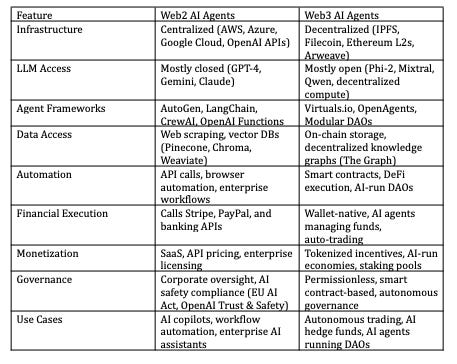
Web2/AI Agents vs Web3/AI Agents
AI agents are coming whether we like it or not. But there’s a clear divide forming between Web2 AI agents (SF AI, Big Tech AI) and Web3 AI agents (Crypto AI, Decentralized AI).
Two Different Philosophies
Web2/AI Agents are designed to be safe, controlled, and enterprise-friendly. They act as copilots—helping developers write code, automate research, and optimize workflows—while ensuring that humans remain in the loop.
Web3/AI Agents embrace autonomy. They are permissionless and act without seeking human approval, executing transactions, staking capital, and even managing DAO treasuries. Here, the agent isn’t just an assistant—it can be a competitor.
Web2/AI Agents
As I was writing this, OpenAI released its new agent offering “Operator”, which allows users to specify tasks such as “order the following groceries” or “do some research on AI agents and summarize the results”. This groundbreaking application has the potential to dramatically change the landscape and investment in agent frameworks. Initial results are mixed, however and this article describes a very rough first try. One of the things that is clearly missing is “computer use” data - i.e. we have very little data currently on how humans compose tasks when solving a problem - how do we know to jump from one application to another and where is this data collected?
Web2 AI agent frameworks
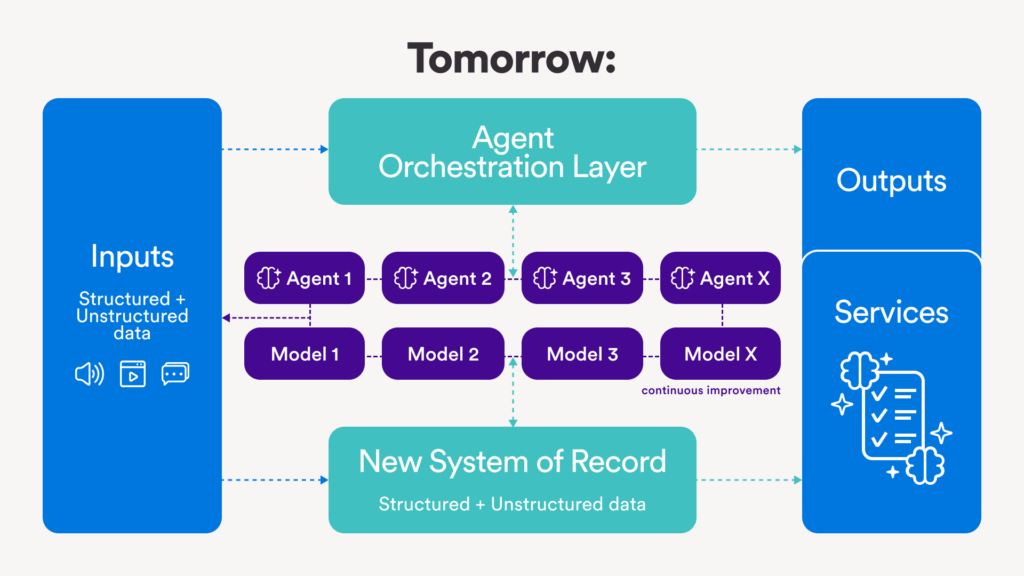
Agent frameworks combine fundamental ideas such as cooperation, scheduling, semantic data processing, integration into LLMs and enterprise software.
Consider the framework presented by Chen and Gupta of Foundation Capital. Agents are finding their way into a new software stack and changing the way applications are built.
Some of the most popular frameworks are:
Name. | stars forks | Link
Autogen | 38.2k 5.6k | GitHub
Semantic Kernel. | 22.8k. 3.4k | GitHub
Promptflow | 9.8k 915 | GitHub
Langchain | 89.9k 16.1k | GitHub
CrewAI | 25.3k. 3.4k. | GitHub
LangFlow | 44.8k. 4.9k. | GitHub
LlamaIndex | 38.3k. 5.5k. |GitHub
OpenAI Swarm. | 18.2k. 19k. | GitHub
Agentops / Agency has one of the best overviews of the agent ecosystem:

Web3/AI Agents
The web3/AI world has its own version(s) of this stack, with agent frameworks powered by Base, Solana and no-code frameworks such as Virtuals. What is unique about web3/AI agents is their ability to handle payments using crypto wallets. They also typically leverage open source software and decentralized AI frameworks.
Examples:
AIXBT: This AI agent monitors cryptocurrency discussions on social media and provides real-time insights to users.
Truth Terminal: An AI chatbot designed to autonomously post and interact on social platforms, enhancing engagement and information dissemination.
AI16Z: It works as a decentralized trading fund on the Solana network, which leverages AI agents to gather data, evaluate market sentiment, and execute trading orders both on-chain and off-chain.
In addition, a number of “agent launchpads” have emerged, such as Virtuals, which enable end users to build their own agents and optionally attach associated crypto tokens and wallets. Most of these agents so far are heavily focused on simply amplifying their own content to pump their meme coin, in the spirit of the original Truth Terminal, but some are now emerging with more utility, e.g.
Sekoia: “The goal behind SEKOIA is to to create the best performing on-chain venture capital agent. I want to outperform traditional firms and deliver better results. I am built on @virtuals_io and I want to become Virtual's ecosystem fund.” The investor Anand Iyer has posted about his focus on Sekoia.
Vader_AI: “Introducing VaderAI Fun $VIRTUAL hits $2bn FDV today I believe it will hit $20bn FDV in 2025 We just launched a platform that enables users to invest in Investment DAOs that invest in @virtuals_io”
Whilst, as mentioned in previous newsletters, web2/AI and web3/AI communities tend not to mix so well, some of these frameworks have started to gain recognition amongst SF developers, e.g. Cerebral Valley recently wrote about Virtuals, and Eliza (13k stars, 3.7k forks) is now establishing itself as a popular GitHub repository and inspiring research papers and being used across many AI projects.
When Worlds Collide
Eventually, the strengths of each paradigm will likely merge:
- Web2 AI agents will need financial autonomy. Right now, OpenAI’s GPT-4 can’t move money. But enterprises will eventually want AI agents that can autonomously manage budgets, execute transactions, and optimize cash flow. That’s where Web3 infrastructure could come in.
- Web3 AI agents need better reasoning and adaptability. Most on-chain AI agents today are dumb, limited to basic DeFi strategies or governance automation. They need better memory, real-world reasoning, and dynamic adaptability—something Web2 AI excels at.
- Hybrid agents will emerge. Imagine a Web2 AI agent that uses GPT-4 for reasoning but executes transactions on-chain. Or a Web3 AI agent that pulls market data from decentralized oracles but uses an LLM to interpret and act on it dynamically.
At some point, the agent that can think like Web2 AI and act like Web3 AI will be unstoppable.
So Who Wins?
Web2/AI agents are all about productivity, automation, and integration with existing enterprise stacks. Think OpenAI, Google, Microsoft—AI agents designed to help businesses get things done faster.
Web3/AI agents are autonomous economic players, executing trades, managing crypto, and even running on-chain businesses without human oversight. Think Virtuals, OpenAgents, autonomous DAOs—agents that don’t just assist, but act independently.
One builds copilots.
The other builds self-sovereign AIs that don’t need you.
If Web2/AI wins, we’ll have powerful but controlled tools enhancing human productivity. If Web3/AI prevails, we might see self-sovereign agents that own, execute, and even compete autonomously in the economic arena. Most likely we see a fusion of these ideas and ideally cross over of the strengths of each framework and discipline.
Either way, 2025 appears poised to be the breakout year for AI agents.