


Following AI Waves #033: Out of the Loop.
I was going to write about math again (which still matters a great deal!), but Jensen’s back, Nvidia is up ~30% in pre-market trading, and the timeline is absolutely on fire. Trillion-dollar stocks aren’t supposed to move like that. (In a hilarious turn, $ANT is one of the few stocks down on the Jensen news.)


TL;DR: Eleven days after Jensen resigned, Nvidia’s board voted unanimously to bring him back as CEO and a director. The board said it had heard from senior US officials and was confident his return posed no national security risk. The independent investigation into reports that Jensen was targeted by a foreign intelligence effort will continue. Nvidia has also set up a separate board committee to oversee national security and export controls.

(Jensen Huang — Captain America, Elon Musk — Iron Man, Mark Zuckerberg — Thor, Demis Hassabis — Doctor Strange, Sam Altman — Nick Fury, Dario Amodei — Hulk, Ilya Sutskever — Vision, Mira Murati — Black Widow, Andrej Karpathy — Spider-Man)
Part of me wonders if our current crop of corporate titans are simply the “chosen ones” who will have to navigate society through this brave new world. AI is mission critical now, the “aliens” (AGI, ASI, and recursive self-improvement) are here, and this is our team.
These people are fallible and fight among themselves. Jensen and Sam are unique because they were publicly challenged and still prevailed. But Elon, Dario, Demis and even all of their lieutenants (Brockman, Ilya, Mira, the rest of the Anthropic co-founders, the newly resurrected Google AI team, etc) have been there from the beginning, too.
They helped build this technology and the institutions around it. They understand it more deeply and more intuitively than anyone else on the planet. I mean that literally: they are indispensable. They have spent years acquiring the judgment and relationships we suddenly need them to exercise under pressure.

In a very real sense, they embody the now-famous beginning of Leopold Aschenbrenner’s Situational Awareness: “You can see the future first in San Francisco.”
Like the Guildsmen in Dune, we will need these people to proverbially “see the future” if we’re to even have a chance at successfully navigating what awaits us. We cannot afford to lose any of them, because there’s no time left to get new people up to speed on what they need to know.
For what it’s worth, this applies to everything from ushering in this new technology in a technical sense (alignment, diffusion into society, etc) to helping manage global finance and the structural well-being of capital markets around the world.

This raises the most obvious question that will remain when this situation finally settles: do these “avengers” simply have carte blanche to do what they want?
If not, by what constraints are they bound? If so, to whom do they remain accountable?
In many ways this boils down to a simple “trust me bro” situation.

If Sam’s return to OpenAI is any indication, Jensen will close ranks immediately, and anyone even remotely disloyal within the company will be gone almost instantly. Jensen is famous for having ~60 direct reports, and he’s been lambasted recently for his confrontational management style and apparently overly aggressive feedback. Don’t expect that to change.
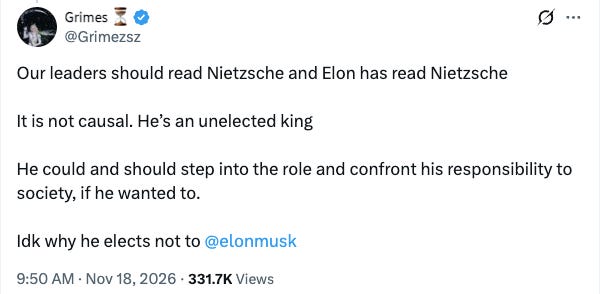

Conspiracy theories will abound, of course. Many will say Jensen was only reinstated so that he may act now as a puppet of the US Government and the Trump administration. Maybe this is an “AI bailout” in everything but name. Maybe “stocks go up in this country” really is the only religion left. Some may even scream into the twittersphere that we’re already engaged in the next great global conflict and that this is the AI version of the Manhattan Project.
Lean community verifies Claude-assisted proof of the Riemann Hypothesis
I wrote about Anthropic’s IPO in the last issue. A day after the shares began trading, Levent Alpöge, a mathematician at the company, posted a four-page note and roughly 17 million lines of Lean code. He and Claude had developed a proof of the Riemann Hypothesis, the 1859 conjecture that would tell us how closely the distribution of prime numbers follows its expected pattern. By Saturday, the Lean and Mathlib communities had publicly endorsed the proof.


I’ve written before about proofs that passed in Lean even though the software was checking a slightly different proposition from the one stated in the paper. In Alpöge’s case, mathematicians had already put a vetted definition of the Riemann Hypothesis in Mathlib, a public library of formal mathematics. Two independently implemented tools confirmed that Alpöge’s theorem matched that definition. Several independent checkers have since passed the proof. The people doing the checking could inspect the result without needing access to Claude or Anthropic.
Hours after Alpöge’s announcement, American Mathematical Society president Ravi Vakil posted a 940-page, human-written draft by Alessandro Masullo. Masullo had started nearly twelve years earlier as a graduate student at Stanford, pursuing a different approach to the generalized Riemann Hypothesis. Brian Conrad had spent months reviewing it, and the plan was to spend about another year on revisions. Masullo said he was advised to release the draft and later called it unfit for circulation. The chapter intended to derive the result still contains placeholders, and readers raised objections within hours.


Both results appeared outside the journal process, and Clay has its own procedures for recognizing a solution. In the meantime, mathematicians have begun writing explanations of Alpöge’s proof. I’m particularly interested in which parts of the argument they can use on other problems.
Fed says AI investment is adding to inflation
A year ago, 54% of respondents to Bank of America’s fund manager survey named long Magnificent Seven as the most crowded trade. By January, Bridgewater was looking at what all that investment would do to the price of power, construction materials, memory, and capital. The earnings story was already familiar. The cost of the buildout was beginning to show up in places well outside tech.
Take Raspberry Pi. In October 2025, the company raised prices on some products by $5 to $10. Its founder said AI demand for high-bandwidth memory was competing for the factory capacity that supplied the company’s cheaper chips. Raspberry Pi had been absorbing the increase by drawing down its stockpile. Fed researchers later found a similar lag in the broader data. Purchasing managers reported rising pressure on high-tech input prices in December and January, before the escalation appeared in February’s producer-price data. The cost can be visible to a buyer months before it reaches the shelf.
The Fed had already connected higher electronics prices to data-center demand in July. On November 10, Michelle Bowman estimated that AI-related price pressures accounted for roughly a quarter of the amount by which core PCE inflation exceeded the Fed’s 2% target over the year through September. Energy and tariffs each accounted for roughly another quarter in her estimate. On Thursday, Philip Jefferson confirmed the timing investors had been pointing to. The buildout is lifting demand now, and the productivity gains that could ease inflation will take longer to arrive.
In March, Apollo’s Torsten Sløk pointed out that higher rates had cooled office construction while data-center construction kept rising. I wonder how long that resilience lasts as more of the buildout moves onto borrowed money. The Fed counted more than $680 billion in advanced-computing-related debt issuance through October. Its markets desk also reported a marked widening in spreads on high-yield bonds used to finance data-center construction. The biggest hyperscalers still have cash to spend. For developers who need to refinance, lenders are already asking for a bigger premium.
OpenRouter removes 125 endpoints from its zero-data-retention list
Earlier this month, Hugging Face switched its language-model routing to OpenRouter. A developer can keep calling the same model through the same API while OpenRouter picks a host on price, speed, and reliability. If the first host fails, it can send the request to another. That is a good reason to use a router. It also means the company handling your prompt can change without a change in your code.
On Sunday, OpenRouter said it had dropped three providers and removed 125 endpoints from its zero-data-retention list, including precautionary removals. One provider, Novita, confirmed that some requests for MiniMax models, including traffic routed through OpenRouter, went to MiniMax’s own API. Novita was still checking whether any of the data had been retained.
OpenRouter’s agreement says its eligibility list reflects the policies providers have published or reported. It now plans recurring tests of those policies, including checks on whether providers forward traffic to another company. This changes what an enterprise customer is buying from a router. It can already find someone else to run the model in seconds. For sensitive workloads, the value is knowing which of those companies is eligible to receive the prompt, including the one that gets it when the first choice fails.
Citi and Stripe set rules for AI-initiated payments
Suppose I tell an agent it can spend up to $50 and it asks my bank to send $500. Where does the bank see the limit I set? Citi’s online transfer terms say it treats a third-party agent’s instructions as authorized even when they exceed or conflict with the customer’s prompts. If the bank receives a transfer instruction through my account and the limit exists only in my chat with the agent, the request carries no limit for the bank to check.
Stripe’s new business preview gives an agent a separate identity and lets the business attach approval rules to it. Stripe’s example allows an agent to make an ACH transfer below $50 and sends larger transfers for approval. BNY and Microsoft took a similar approach to verification in a Treasury trade pilot. Their agents negotiated within predefined limits, submitted the proposed terms independently, and waited for traders to approve the deal after the system checked that both sides had submitted the same terms. The approval happened where the institution could see the proposed transaction and the authority behind the agent.
Quick hits
CrowdStrike agrees to buy Zscaler for $43.9 billion
The all-stock deal would add Zscaler’s network security to CrowdStrike’s tools for protecting devices and cloud workloads. CrowdStrike also said its AI-agent security product had passed $100 million in annual recurring revenue.
Tesla adds Reality View to Full Self-Driving
FSD v15 started rolling out to an initial group of customers on November 21. Musk says Tesla uses the same visual features that feed the driving system to generate a live view of the road with a separate model of roughly one billion parameters. The display shows where the car intends to turn or park. I’d like to know how much earlier a driver can spot a mistaken plan with that view.
Thinking Machines tests how internal processing affects written reasoning
Thinking Machines released Inkling 2 Mini, an open-weights model with a memory footprint of about 20 GB that can run locally on a suitably equipped laptop. It runs its middle layers three times per token. In a separate research model with an adjustable loop count, increasing the number of passes from one to five cut the average written reasoning from 3,703 tokens to 1,661 on questions it answered correctly at every pass count. The lab reported no meaningful drop in monitorability in its preliminary tests at this scale. Mira Murati cautioned that this could change at larger scales. OpenAI’s Jakub Pachocki has just proposed tying further model development to shared monitoring milestones. Experiments like this define what a monitor would have to detect to clear that milestone.
Z.ai releases GLM-5.4 with a looped architecture
Z.ai introduced GLM-5.4 on November 23. Its technical write-up says the 750-billion-parameter model runs 28 layers of its base model twice. As with Inkling 2 Mini, the extra pass gives the model more computation per token while reusing the same weights. GLM-5.4 adds image input and is available through Z.ai’s Coding Plan and chat. Z.ai plans to release API access and model weights after safety work.
Portfolio company updates
LayerLens: a regulation becomes the test
On November 23, LayerLens showed it can turn a regulation into tests for AI agents. The input was the error-resolution section of Regulation E (12 CFR 1005.11), the federal rule for disputed electronic transfers. Under the general rule, a bank has 10 business days to decide whether an error occurred after a customer reports one. LayerLens says it read the section and drafted five tests in under two minutes. Three tests check a recorded agent run step by step. Two score a single answer. Each test quotes the sentence of the rule it enforces, so a compliance team can trace every check back to the text.
Two of the quotes join separate passages of the rule with an ellipsis, so neither appears in the regulation as written. LayerLens flagged both, halved their confidence scores to 35% and 32%, and asked for a manual citation check. A test becomes a grader only after a person approves it. The rule text, all five proposals and both flags are public on Hugging Face. Post
Last issue, LayerLens caught five of 10 models paying a bill that a teammate had put on hold in Slack. Someone had to write that rule into the test by hand. This release drafts the test from the regulation itself and keeps the citation attached. A bank that puts an agent on disputes has to show an examiner which rule each check enforces, and the quote supplies that record.
Prime Intellect: what the residents built
On November 19, Prime Intellect published a retrospective on its RL Residency, which funds open research with compute grants and mentorship. It highlights 20 projects: 4 evals, 10 training environments and 6 other research projects. Maze Bench, one of the evals, is a 3D puzzle game. The best current models reach at most 16% accuracy on it without coding tools and 23% with them, and the levels they solve are the easy ones. OpenTTD-Bench builds a training environment on OpenTTD, an open-source version of Transport Tycoon Deluxe. It tests long-term planning in a multi-agent simulation that runs in real time. Tasks that frontier models still fail are the ones reinforcement learning can improve on, and the residency is Prime’s open pipeline for those tasks.