


Three documents have compelled me to reflect on the current state of AI (again!).
The White House’s America’s AI Action Plan frames AI as a sovereign priority, calling for the construction of data centers, chip foundries, and energy infrastructure on a scale not seen since the Cold War.
Ed Zitron’s “AI Is a Money Trap” lays bare the fragility of the current AI economy, arguing that current valuations are untenable and that we are indeed in an “AI bubble.”
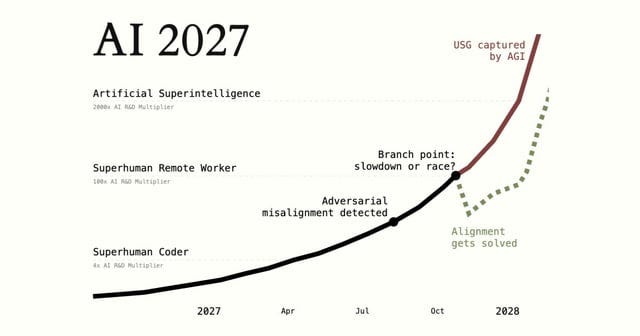
And the researchers behind AI 2027 imagine a near-term trajectory where the arms race to more powerful AI systems leads to misaligned models that pose grave dangers to society and humanity at large.
Each perspective highlights an important dimension of reality, but to me they remain incomplete.
In what follows I intend to draw on each of the three documents as inspiration for a broader reflection on the situation at large that seeks to understand what kinds of foundational ideas are common to them all.
To begin, the breathless enthusiasm that characterized the initial ChatGPT moment has given way to harder questions about sustainability, real-world utility, and the path forward. In short, it seems we’re finally entering the “Trough of Disillusionment” in this first wave of the AI transformation. I believe this pullback will initiate the transition to what I call “MACHA,” AI that’s more cost-effective and efficient.
More importantly, alignment is easily the single most relevant part of this technology’s evolution. Nevertheless, its being systematically ignored amid the economic and geopolitical races now defining the field.
The Global AI Wars
I wrote back in May that the “Global AI Wars had begun,” noting that talent, capital, compute, and energy would become the critical resources of AI competition. The Trump Administration’s AI Action Plan makes clear that compute infrastructure is being treated as a sovereign-grade asset comparable to energy, defense, or money.
The Action Plan reflects a familiar logic of industrial competition rooted in the assumption that technological leadership flows from superior infrastructure. The United States, it argues, must out-build rivals in compute, energy, and data infrastructure, ensuring that American systems set global standards.
But there’s fragility in the ambition. The breakdown of globalization and the reconfiguration of supply chains in the tariff era paired with politicized access to infrastructure have created an environment where compute is scarce, expensive, and contested. The illusion of infinite compute is gone.
In this world, we can’t afford mega-cluster maximalism, and by focusing almost exclusively on deregulation and capital expenditure, the Action Plan risks mistaking construction for progress.
The Plan paints an increasingly contentious and antagonistic race to dominate AI. In that scenario, costs will inevitably continue to rise and supply chains will be more and more vulnerable. Durable advantage will come from efficiency, resilience, and composability.
As we’ll see in a moment, current business models are likely insufficient for producing durable economic value. To the White House’s credit, it cites open-source development as a critical vector for innovation. I would add that distributed compute networks and local, on-device edge intelligence will also become realities because they are cheaper, more flexible, and more resilient under constraint.
Onshoring industry and encouraging national independence in critical AI inputs is a great start, but we still need to figure out what to do with intelligence once it’s been developed. Nations may race to build sovereign fortresses of compute, but the most valuable innovations will come from architectures that can thrive in an environment of scarcity and volatility.
Investment, Valuation, and the Price of Infinity
These dynamics are particularly relevant when we examine the current economics of AI development. With valuations that defy logic and business models that don’t seem capable of one day justifying the costs of doing business, Zitron is right to describe AI today as a “bubble.”
To understand why rational actors continue pouring unprecedented resources into what appears to be an unsustainable endeavor, however, we must recognize that these investments operate according to a different logic entirely.
As I wrote in AI and the price of infinity, these “investments” aren’t chasing returns in the traditional sense: they’re pursuing something greater, more like religion. The entire enterprise resembles a modern Tower of Babel: a race to the heavens to meet God. As such, there are only two questions worth asking:
Is AGI or Superintelligence (read: God) possible?
If so, then what’s the value of God?
The only sensible answer is, paradoxically, infinity. If one believes that AGI is possible and its value approaches infinity, one can justify almost any investment at all. We cannot price something that may fundamentally reorganize all economic activity, and some investors are evidently willing to bet extraordinary sums that this possibility is worth more than anything that has come before.
But even infinite ambitions must eventually confront finite constraints, and in the absence of successfully creating a form of God-like machine intelligence, AI needs to secure its unit economics, justify ROI, and turn the tide towards profitability.
In “Make AI Cheap Again” (Part 1 and Part 2) I demonstrated that economic pressure will force that shift. Companies, governments, and investors cannot sustain infinite burn, and they’ll begin to demand efficiency measured in cost per token, energy per inference, and return on investment.
Look no further than the disappointing release of GPT 5: tangible evidence that marginal improvements from scale are diminishing. What’s more, agents are largely still underwhelming, costs continue to rise, and we're immune now to the shock value of fundraising headlines.
Scale and general-purpose compute will continue to play an important role in pushing the frontier, but over-indexing on throughput, volume, and lock-in is what I call “fighting the last war.” These were the right heuristics for the first wave. They are insufficient for what comes next.
The future will be shaped less by the largest cluster and more by delivering cost-efficient “good enough” intelligence for specific use cases. Local, private models for healthcare, finance, or legal services, for example. General intelligence is sexy, but beyond pushing the frontier of what’s possible, it’s too expensive to apply to any individual use case. Developing compact models and niche use-cases efficient enough to be economically viable is the critical next step.
As such, we at Nazaré have long believed that algorithmic innovation is the real frontier. As I’ve argued before, smarter architectures, better coordination across models, and improved memory systems will matter more than raw FLOPs. DeepSeek and other breakthroughs have already shown that efficiency gains can rival or surpass brute force. The correction now underway will accelerate that trend.
The Alignment Challenge
These technical and economic pressures are converging with a growing recognition that the alignment challenge extends far beyond the narrow technical problems that have dominated academic discussion. If the economic and geopolitical analyses explain why today’s trajectory is unsustainable, AI 2027 explains what happens if it continues.
The scenarios are speculative (and the timeframes are arguable), but the underlying point is not: accelerating innovation and development will expose the alignment problem faster than our institutions are prepared to handle.
While ensuring that models do not hallucinate, deceive, or pursue unintended goals remains crucial, alignment must be understood more broadly as the fundamental challenge of building AI systems that serve human flourishing across multiple dimensions simultaneously.
Technical: ensuring truth, controllability, and safety.
Economic: ensuring AI can be delivered profitably, without perpetual subsidy or capex bubbles.
Political: ensuring AI strategies do not concentrate power in fragile ways or destabilize global systems.
Social: ensuring AI respects privacy, agency, and trust – AI is relational technology, and we need these systems that remember us to also respect our right to be forgotten.
Alignment, in other words, is the organizing challenge of the AI era. At its core, alignment should be understood not merely as a technical problem but as the organizing principle that must guide how we build, deploy, and govern these systems going forward.
The conclusion that emerges from this analysis is both straightforward and demanding. Washington is correct to treat AI as strategic infrastructure requiring sustained public investment and policy attention; current business models are, indeed, unsustainable and require more rigorous economic discipline; and we need efficiency, algorithmic innovation, and AI systems that can operate effectively across different computational environments.
Taken together, we’re left with an AI ecosystem that is economically inflated, geopolitically fragile, and socially precarious. Real resilience and sustainable progress will come only when the benefits of AI are distributed broadly across the economy and when the development of these systems is guided by alignment principles that serve humanity at large.
The decentralized AI community, which has long argued that distributed systems offer more efficient, economical, and resilient solutions than centralized alternatives, now has an opportunity to demonstrate these principles at scale. The risks of centralization are now more evident than ever, and the moment demands collective action to address them that prove decentralized AI can contribute meaningfully to alignment.